
US Blockade of Iran Ports After Failed Islamabad Talks (April 13, 2026): Oil Above $102, Strait of Hormuz Crisis, Global Markets Shock & War Fears Rise
US imposes a full naval blockade on Iran’s ports after failed Islamabad negotiations, pushing oil above $102 per barrel, triggering global market volatility, shipping disruption, inflation fears, and rising Strait of Hormuz conflict risk on April 13, 2026.
Raja Awais Ali
4/13/20266 min read
US Blockade of Iran’s Ports After Failed Islamabad Talks: Oil Above $102, Strait of Hormuz Crisis, and Global Economic Shock
On April 13, 2026, global geopolitics entered an extremely sensitive and dangerous phase when the United States announced a full maritime blockade of Iran’s ports and coastal areas following the collapse of high-level negotiations held in Islamabad. These talks were the first direct US–Iran engagement in over a decade and were considered the most significant diplomatic attempt since the 1979 Iranian Revolution, aimed at ending a rapidly escalating regional conflict. The discussions took place in the backdrop of a fragile two-week ceasefire that had followed six weeks of intense fighting, with the core objective of converting temporary de-escalation into a permanent peace framework. However, the negotiations ultimately failed due to deep disagreements over nuclear restrictions, regional influence, sanctions relief, and maritime control in the Strait of Hormuz, leading to a sharp escalation in both geopolitical and economic tensions across the Gulf region.
The Islamabad negotiations continued over the weekend between senior delegations from Washington and Tehran and focused on critical issues including Iran’s nuclear program, uranium enrichment limits, regional proxy networks, and maritime security arrangements in the Strait of Hormuz. The United States demanded a complete halt to Iran’s uranium enrichment activities, dismantling of key nuclear infrastructure, transfer of enriched uranium stocks outside the country, immediate cessation of financial and logistical support to groups such as Hamas, Hezbollah, and the Houthis, and full maritime openness in the Strait of Hormuz under international supervision. Iran rejected these demands, describing them as “maximum pressure diplomacy” and structurally unbalanced conditions designed to weaken its strategic position. Iranian Foreign Minister Abbas Araghchi stated that both sides had reportedly come close to an “Islamabad framework agreement,” but last-minute changes in US conditions resulted in a complete breakdown of trust, ultimately collapsing the negotiations.
Following the failure of talks, the US Central Command (CENTCOM) announced that from 10:00 AM US time on April 13, all maritime traffic entering or exiting Iranian ports would be halted under a coordinated naval blockade operation. The statement clarified that the blockade applies to vessels of all nationalities and is being enforced under a “neutral enforcement” framework. However, vessels transiting through the Strait of Hormuz toward non-Iranian destinations would still be allowed under strict monitoring and surveillance, meaning the Strait itself has not been fully closed but Iranian port access has been directly targeted. This creates a significant legal and strategic distinction that has major implications for international maritime law and global trade security.
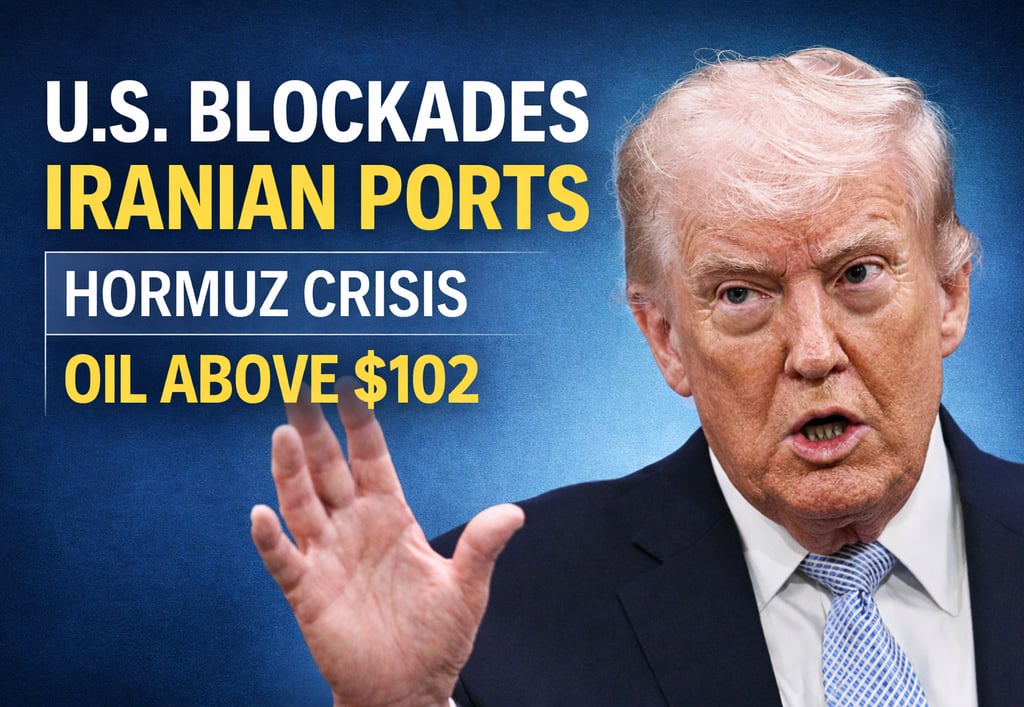
US President Donald Trump adopted an even more aggressive stance following the announcement, warning that any vessel paying tolls to Iran would be denied safe passage in international waters. He further stated that the US Navy would take action to destroy naval mines reportedly placed in the Strait of Hormuz, while accusing Iran of violating international law through toll collection practices. At the same time, Trump issued contradictory messaging by suggesting Iran might still return to negotiations, while also stating he did not care if Tehran refused to engage diplomatically, further increasing global uncertainty and volatility in financial markets.
International energy markets reacted immediately and sharply to the escalation. Brent crude oil prices surged by approximately 7% to 8%, pushing the benchmark above $102 per barrel, with sustained trading above the $100 psychological threshold. This sudden increase reflected growing fears of supply disruption from one of the world’s most critical energy transit corridors and triggered heightened volatility across global commodity markets.
The Strait of Hormuz remains the central focal point of this crisis, as nearly 20% of global oil and gas supplies pass through this strategic maritime route connecting the Persian Gulf to global markets. Following the blockade announcement, approximately 187 oil tankers were reported active in the Gulf region, while more than 180 million barrels of crude oil were estimated to be delayed or trapped within disrupted shipping routes. Several supertankers altered their courses, some vessels temporarily paused operations, and others reportedly reversed direction entirely due to rising security risks. Shipping companies also increased insurance premiums significantly, raising global transportation costs and adding further pressure to already fragile supply chains.
Iran strongly condemned the US action, calling it an act of aggression and a violation of international maritime law. The Islamic Revolutionary Guard Corps (IRGC) warned that any US or allied naval presence near Iranian waters would be treated as a breach of the ceasefire agreement and would face immediate and decisive retaliation. Iranian leadership accused Washington of abandoning diplomacy in favor of coercion and military pressure. Iranian President Masoud Pezeshkian, during discussions with Russian President Vladimir Putin, reiterated that Iran seeks a balanced and fair agreement but emphasized that international law must be respected by all parties involved.
Global financial markets experienced widespread disruption following the announcement. The US dollar strengthened significantly as investors shifted toward safe-haven assets, while US stock futures including Dow Jones, S&P 500, and Nasdaq declined under pressure. European and Asian markets followed a similar downward trend, reflecting a global risk-off sentiment driven by escalating geopolitical uncertainty.
Emerging economies were also severely affected. The Indian rupee weakened, equity markets came under pressure, and foreign investors began withdrawing capital from riskier assets. Reports indicated that nearly $19 billion in foreign portfolio outflows occurred from India alone, highlighting the global financial contagion effect of the crisis beyond the Middle East.
The crisis is also expected to intensify global inflationary pressures. Economists note that rising energy prices directly impact transportation costs, food supply chains, and industrial production. This situation builds on already elevated inflation levels observed in March 2026, and further escalation could significantly worsen global economic conditions, especially in energy-importing regions such as Europe and South Asia.
The Strait of Hormuz remains the most strategically important energy corridor in the world, responsible for nearly 20% of global oil and gas flows. Even partial disruption of this route can lead to severe consequences including supply shortages, shipping delays, and extreme price volatility across global markets.
Energy analysts warn that if tensions persist, oil prices could rise beyond $110 per barrel, potentially triggering a broader global economic slowdown. Key sectors such as aviation, logistics, transportation, and manufacturing are expected to be among the most heavily impacted if supply disruptions continue.
US President Donald Trump has also acknowledged domestic economic risks, stating that gasoline and fuel prices in the United States may remain elevated through the November 2026 midterm elections, adding internal political pressure to an already unstable international situation.
Defense analysts caution that large-scale naval blockade operations are highly controversial under international law and may be interpreted as acts of war under certain legal frameworks. If Iran responds by restricting or closing the Strait of Hormuz, the situation could rapidly escalate into a full-scale military confrontation involving multiple regional and global powers. The increasing military presence of US and allied forces in the Gulf further raises the risk of miscalculation or accidental escalation.
Although a ceasefire technically remains in place, it is now considered extremely fragile and under severe strain. Initially expected to last until April 22, 2026, the agreement is now at significant risk due to escalating military activity, economic shocks, and increasingly hostile political rhetoric from both sides.
Despite rising tensions, some diplomatic observers still believe that backchannel communications could eventually resume, as prolonged conflict would carry severe economic and strategic costs for both Washington and Tehran. However, current geopolitical momentum strongly favors escalation rather than compromise, making the coming days crucial in determining whether this crisis remains contained or expands into a broader regional or global conflict.
At present, global attention remains firmly focused on the Strait of Hormuz, where every development has the potential to reshape global energy security, financial stability, and the broader international geopolitical order.
China is advancing a long-term global trade strategy in 2026 aimed at strengthening its economic dominance despite ongoing trade pressure from the United States under President Donald Trump. According to economic reports dated 19 February 2026, China’s exports reached around $3.6 trillion in 2025, with a trade surplus exceeding $820 billion, showing its growing influence in global markets. Even with tariffs and restrictions, Beijing has successfully diversified its trade network across Asia, Europe, the Middle East, and Africa.
A major pillar of this strategy is expanding Free Trade Agreements and strengthening ties with the European Union, where trade has reached nearly $900 billion. China is also seeking entry into the CPTPP to gain wider access to Asia-Pacific markets and shape global trade rules. Alongside this, its dominance in key supply chains—such as solar panels, batteries, electric vehicles, and rare earth materials—gives it strong leverage in the global energy transition.
China is also pushing digital trade, fintech expansion, and wider use of the yuan in international settlements, while supporting its Belt and Road Initiative across more than 150 countries. Despite domestic challenges like slower GDP growth (around 4.8%), real estate stress, and demographic issues, China is shifting toward AI, semiconductors, and advanced manufacturing. Overall, its strategy focuses on trade expansion, supply chain control, and financial influence to maintain long-term global economic power.
👉 Read full details here: https://blinknews.blog/china-global-trade-strategy-2026-trump
Stay informed with the latest national and international news.
© 2026. All rights reserved.