
Trump Extends Iran Ceasefire Indefinitely as Peace Talks Remain Uncertain April 22, 2026 Latest Update
On April 22, 2026, President Donald Trump announced an indefinite extension of the Iran ceasefire amid ongoing war tensions, Pakistan-mediated peace talks in Islamabad, and rising global economic risks. However, uncertainty remains as Iran and Israel have not confirmed the agreement, while military and economic pressure continues across the region.
Raja Awais Ali
4/22/20264 min read
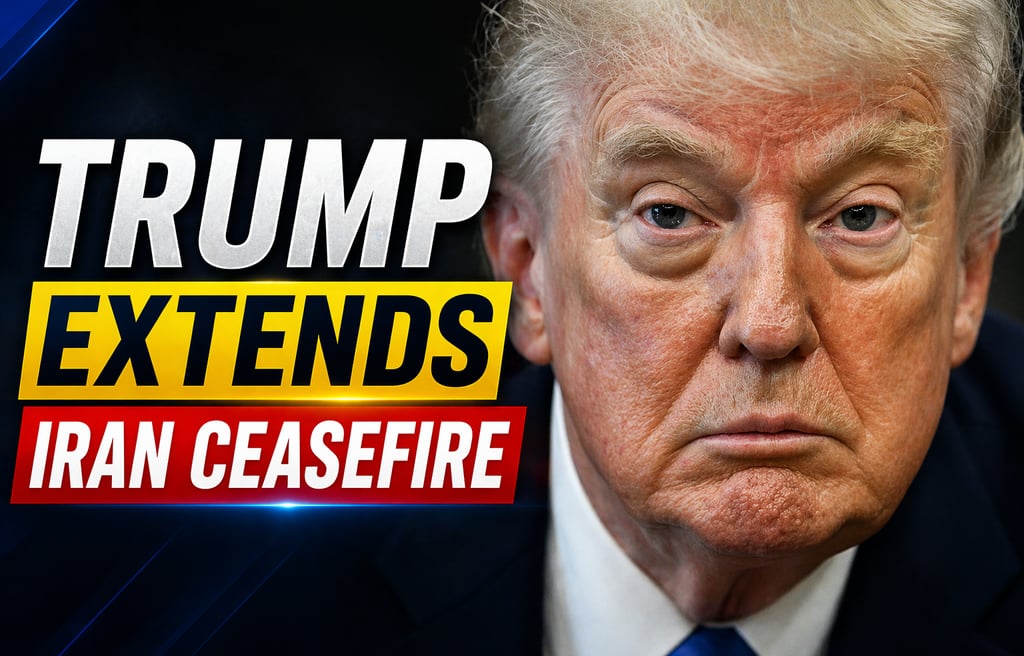
Trump Declares Indefinite Iran Ceasefire Extension as Peace Talks Face Uncertainty
On April 22, 2026, global politics entered a highly sensitive and decisive phase after US President Donald Trump announced an indefinite extension of the ceasefire with Iran. However, the situation remains unclear as neither Iran nor Israel has officially confirmed the decision, raising concerns that the move may be unilateral and could collapse at any moment, potentially reigniting full-scale military escalation.
According to the latest developments, the decision was made following a request from Pakistan to allow more time for ongoing peace negotiations in Islamabad, where Pakistan is playing a key mediating role between the United States, Iran, and other involved parties. These talks aim to reduce escalating tensions and prevent further regional destabilization.
President Trump stated that the United States would pause military strikes against Iran until its leadership presents a unified and clear proposal for negotiations. However, he simultaneously confirmed that the US Navy would continue its maritime blockade against Iran. This dual approach has created a strong contradiction in US policy, as diplomatic engagement continues alongside economic and military pressure.
Iran has strongly rejected the blockade, calling it equivalent to an act of war and warning of possible forceful responses. The Tasnim News Agency reported that Iran did not request any extension of the ceasefire and has treated the US announcement with skepticism. Additionally, an advisor to Iranian Parliament Speaker Mohammad Baqer Qalibaf described the move as a potential political strategy, further highlighting the deep mistrust between both sides.
The war, which began on February 28, 2026, after US and Israeli airstrikes on Iran, has rapidly expanded across the region. Gulf countries hosting US military bases have been affected, while Lebanon has become increasingly involved due to the participation of Iran-backed Hezbollah, turning the conflict into a multi-front war scenario.
So far, more than 5,000 civilians have been killed and hundreds of thousands displaced, with Iran and Lebanon reporting the highest number of casualties. Recent reports also confirm an Israeli drone strike in Lebanon’s Bekaa Valley that killed one person and injured two others, showing that ground-level clashes are still ongoing despite the ceasefire announcement.
One of the most critical global impacts of the conflict is the Strait of Hormuz, a vital energy route responsible for global oil transportation. The situation has reached what analysts describe as a “virtual disruption,” as Iran has restricted maritime movement in response to ongoing pressure. This has pushed global oil prices close to $100 per barrel, increasing fears of a global economic slowdown or recession.
Following Trump’s ceasefire extension announcement, financial markets showed temporary stability. US stock futures rose, the dollar fluctuated, and oil prices slightly eased. However, the overall market outlook remains unstable, with investors still concerned about potential escalation.
Tensions further increased after reports that US forces intercepted and seized two Iranian commercial vessels at sea. Iran condemned the action as “maritime piracy” and “state terrorism,” while the United States and its allies accused Iran of disrupting freedom of navigation in international waters.
Hours after announcing the ceasefire extension, Trump issued another strong statement warning that lifting the blockade would destroy any chance of a peace agreement. He further suggested that the United States could take even more severe action if necessary, including extreme military responses, highlighting the hardline stance alongside diplomatic efforts.
International reaction has also intensified. UN Secretary-General António Guterres expressed serious concern over the situation, warning that targeting civilian infrastructure such as power plants and bridges would violate international humanitarian law and could worsen the humanitarian crisis in the region.
Meanwhile, peace talks in Islamabad remain uncertain as US Vice President JD Vance has not yet departed Washington, despite Iran considering his participation important. Ongoing policy discussions within the White House have raised doubts about whether the negotiations will continue or collapse.
Earlier rounds of talks, held about 11 days ago, ended without any agreement. The main point of disagreement remains Iran’s nuclear program. The United States insists that Iran must reduce or remove its highly enriched uranium stockpile to prevent the possibility of nuclear weapon development. In contrast, Iran maintains that its nuclear program is entirely peaceful and protected under its rights as a signatory of the Nuclear Non-Proliferation Treaty.
At this stage, the central question remains whether Iran and Israel will formally accept the ceasefire extension. If they do not, the risk of renewed conflict remains extremely high. Analysts warn that failure of negotiations could push the region into a more dangerous phase with long-term consequences for global stability, energy markets, and international security.
Overall, the situation on April 22, 2026 reflects a fragile balance between diplomacy and military pressure. While temporary de-escalation has been achieved, lasting peace remains uncertain, and the coming days are expected to be critical in determining the future of the conflict.
US Election Trust Crisis 2026: Trump Fraud Claims & Midterm Risks
An April 23, 2026 public opinion study reveals a growing trust crisis in the U.S. electoral system ahead of the 2026 midterm elections. The survey of 4,557 Americans shows deep political polarization over election integrity.
Around 46% of Americans believe non-citizens vote illegally, including 82% Republicans vs 18% Democrats. Concerns about mail-in voting also remain high at 53% overall, with a major partisan divide.
The study finds 63% of Republicans still believe the 2020 election was stolen, despite no evidence. However, most Americans still trust their own vote will be counted correctly, showing a system vs personal trust gap.
Support for voter ID laws is strong (77% overall), while stricter policies like proof of citizenship remain controversial. Opinions on security at polling stations are also sharply divided.
Overall, the findings highlight rising polarization and weakening trust that could impact the 2026 midterm elections and democratic stability.
👉 Full analysis: https://blinknews.blog/us-election-trust-crisis-2026-trump-fraud-claims-poll-analysis
Stay informed with the latest national and international news.
© 2026. All rights reserved.