
US Election Trust Crisis 2026: Trump Fraud Claims, Poll Data & Midterm Risks Explained
Detailed April 23, 2026 analysis of US election trust crisis, Trump fraud claims, voter concerns, polling data and 2026 midterm risks.
Raja Awais Ali
4/23/20263 min read
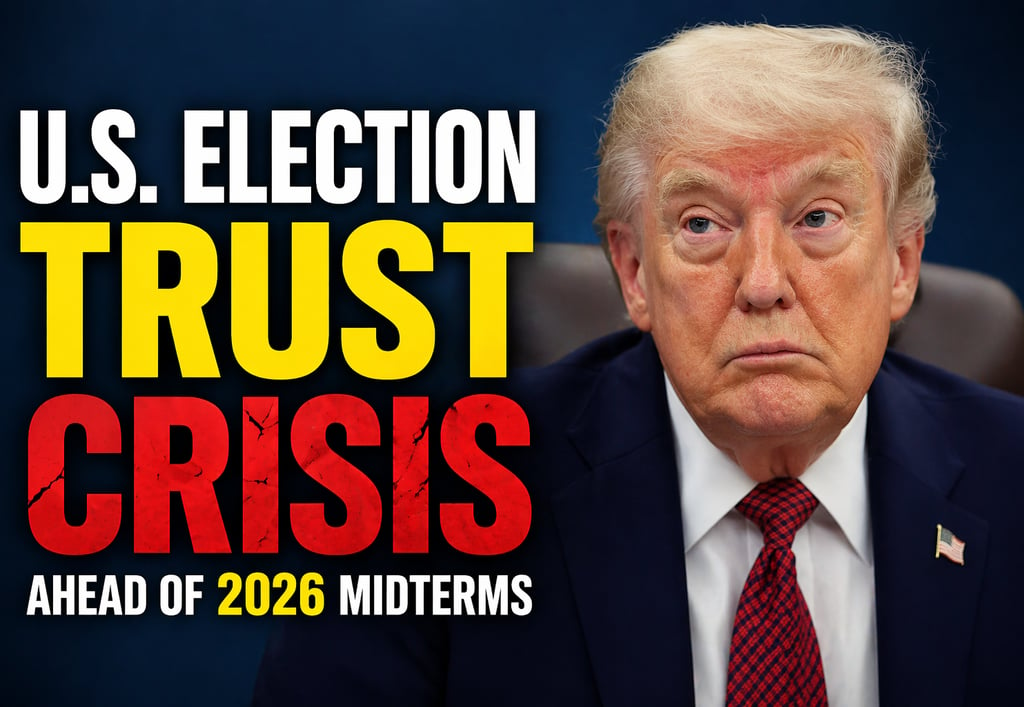
U.S. Election Trust Crisis: Donald Trump’s Fraud Claims, Deepening Public Divide, and Rising Political Tensions Ahead of the 2026 Midterms — Full Analysis
A major public opinion study released on April 23, 2026, has highlighted a critical and sensitive issue in American politics: the growing decline in trust in the electoral system. According to the findings, years of election fraud claims made by U.S. President Donald Trump have not only influenced public perception but have also significantly deepened political divisions across the country—especially as the United States approaches the November 2026 midterm elections.
The study was conducted over six days and included a total of 4,557 American adults, with a margin of error of approximately 2%. The results clearly reveal a sharp divide among Americans regarding the integrity of elections. Around 46% of respondents agreed with the statement that large numbers of fraudulent ballots are cast by non-citizens, despite the lack of strong evidence supporting this claim.
When broken down by political affiliation, the divide becomes even more pronounced. Approximately 82% of Republican voters believe that non-citizens vote in significant numbers, compared to just 18% of Democrats and 38% of independent voters. These figures demonstrate how narratives and information influence different political groups in very different ways.
Concerns about mail-in and absentee voting also remain high. About 53% of respondents expressed worry over potential fraud in mail-in ballots, while 43% said they were not concerned. Once again, a clear partisan gap is visible: 83% of Republicans expressed concern about mail-in voting, compared to only 33% of Democrats.
Taken together, these findings suggest that repeated claims and messaging questioning election integrity over the past several years have had a lasting impact on a significant portion of the population. In particular, statements made by Donald Trump and his allies have reinforced the belief among many Republican voters that the system lacks transparency.
Another key finding from the study is that approximately 63% of Republican voters still believe that the 2020 presidential election was “stolen.” This percentage has remained largely unchanged in recent years, despite multiple investigations, audits, and court rulings that found no evidence supporting widespread fraud. In contrast, only 9% of Democrats and 21% of independent voters share this belief.
Interestingly, despite widespread distrust at the system level, a large majority of Americans still believe that their own vote will be counted accurately. About 79% of Democrats and 71% of Republicans expressed confidence that their personal ballot would be counted correctly. This represents a notable paradox—while trust in the system overall is weakened, individual confidence remains relatively strong.
The study also explored views on voter identification requirements. Approximately 77% of Americans support requiring voters to show official identification when casting their ballots. This includes 95% of Republicans and 63% of Democrats, indicating that there is still some level of bipartisan agreement on certain election-related policies.
However, when it comes to stricter measures—such as requiring proof of citizenship for voter registration—the issue becomes far more controversial. A proposed law that would mandate proof of U.S. citizenship to register or update voter registration has already passed the House of Representatives but is facing strong opposition in the Senate. Critics argue that such measures could disenfranchise legitimate voters, particularly those who may face difficulties in providing documentation.
The study also examined public opinion on the presence of security forces at polling stations. Only 28% of Americans supported the deployment of troops at polling locations, suggesting that this idea does not have broad public backing. Even among Republicans, opinions are divided, with 45% in favor and 54% opposed.
On the other hand, support for federal law enforcement presence at polling stations is relatively higher among Republicans. Around 62% of Republican voters support this idea, compared to 23% of Democrats and 36% of independents.
Overall, these findings paint a clear picture of a growing trust crisis in the U.S. electoral system. This crisis is not driven solely by facts or evidence, but also by political narratives, leadership messaging, and public sentiment. The statements made by Donald Trump have had a particularly strong influence on a significant segment of voters, leading to a situation where different groups perceive the same reality in fundamentally different ways.
As the 2026 midterm elections approach, this situation becomes increasingly significant. If a large portion of the public already doubts the fairness of elections, it could affect not only voter participation but also the acceptance of election results. Additionally, it creates a fertile environment for misinformation and conspiracy theories to spread more easily, posing a serious challenge to democratic stability.
In conclusion, the study underscores that democracy is not just about voting—it is also about trust, transparency, and public confidence. When these foundational elements begin to erode, the entire system is affected. This is why the 2026 elections are not just a political contest for power, but also a critical test of public trust in democratic institutions.
Stay informed with the latest national and international news.
© 2026. All rights reserved.