
Israel–Palestine Crisis 2026: Sa-Nur Settlement Revival in West Bank Triggers Demolitions, Land Conflict and Global Alarm
A detailed report on the 20 April 2026 West Bank escalation, where Israeli ministers celebrated the revival of the Sa-Nur settlement while demolition orders targeted Palestinian shops in Al-Fandaqumiya, intensifying land disputes, displacement concerns, and legal tensions.
Raja Awais Ali
4/20/20264 min read
Israel–Palestine Crisis 2026: Sa-Nur Settlement Revival in West Bank Triggers Demolitions, Land Conflict and Global Alarm
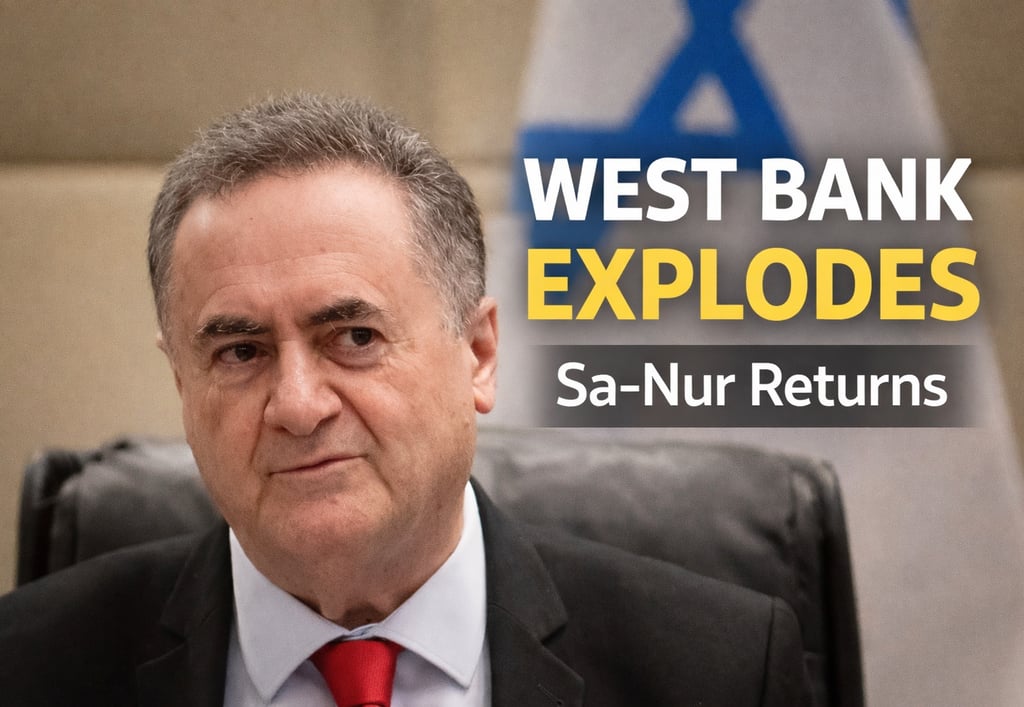
On 20 April 2026, the West Bank once again became the focal point of international attention after senior Israeli ministers celebrated the reestablishment of the controversial Sa-Nur settlement. The celebration was followed within hours by demolition orders targeting 15 Palestinian shops in the nearby village of Al-Fandaqumiya, escalating tensions in an already fragile region.
This development is not an isolated incident but part of a long-standing geopolitical conflict rooted in decades of territorial disputes, legal disagreements, and competing national claims over land and sovereignty.
To understand the current escalation, it is essential to revisit the historical foundation of the conflict. The turning point came during the 1967 Six-Day War, when Israel gained control over the West Bank, East Jerusalem, Gaza, the Golan Heights, and Sinai Peninsula. Since then, the West Bank has remained under Israeli military control, while Palestinians and most of the international community view it as occupied territory intended for a future Palestinian state.
Following the war, the region entered a prolonged phase of military administration, during which Palestinian movement, land access, and political sovereignty became increasingly restricted. Over time, this created a fragmented territorial landscape where Palestinian communities became isolated from one another.
During the 1970s and 1980s, Israel began establishing settlements across the West Bank. Initially justified on security grounds, these settlements gradually expanded into a structured network of residential zones, bypass roads, and military checkpoints. This system significantly altered the geography of the region, dividing Palestinian land into disconnected enclaves.
A major shift occurred in 2005 during the Israeli disengagement from Gaza, when Israel evacuated several settlements, including Sa-Nur. At the time, the move was seen internationally as a step toward de-escalation. However, within Israel’s political right wing, the withdrawal remains a deeply controversial decision and is often viewed as a historical mistake.
In 2026, Sa-Nur has been re-established as part of a renewed settlement policy. The event was attended by Israel’s Defence Minister Israel Katz, Finance Minister Bezalel Smotrich, and Foreign Minister Gideon Saar. During the ceremony, Smotrich reiterated calls for expanded Israeli sovereignty over the West Bank, reflecting an increasingly assertive political stance within the ruling coalition.
Reports indicate that 126 new housing units have been approved in Sa-Nur, and several settler families have already begun returning to the area. This marks a shift from symbolic celebration to active resettlement on the ground, reversing aspects of the 2005 disengagement policy.
Within 24 hours of the ceremony, Palestinian authorities in Al-Fandaqumiya received demolition notices for 15 commercial shops. According to local officials, business owners were given only one month to comply. These shops serve as a critical part of the local economy, and their destruction is expected to impact multiple families.
This escalation highlights a broader issue often described as an access-to-land crisis. For Palestinians in the West Bank, land is not only an economic resource but also a core element of identity and survival. Increased settlement expansion has led to restricted access to farmland, blocked roads, and heightened reliance on permits and checkpoints.
Palestinian Authority official Amir Daoud described the situation as “de facto annexation,” arguing that Israel is effectively extending permanent control over land without formal declaration. This, he warned, is steadily undermining the feasibility of an independent Palestinian state.
Israel has also resumed a land registration process for the West Bank for the first time since 1967, a move that critics argue could reshape ownership rights and further complicate legal claims over territory.
According to Peace Now, the current Israeli government has approved 102 settlement expansions, marking an 80 percent increase compared to previous years. Meanwhile, United Nations data indicates that thousands of demolition orders have been issued to Palestinian residents since the current administration took office.
Violence has also intensified across the region. Since the start of 2026, more than 580 settler-related attacks have been recorded, resulting in approximately 1,800 Palestinian displacements. Human rights organizations, including Human Rights Watch, have described the situation as consistent with patterns of forced displacement, while Israel rejects such characterizations.
The enforcement of law against settler violence remains limited. Israeli rights group Yesh Din reports that prosecutions are rare, contributing to a growing sense of legal imbalance and insecurity among Palestinian communities.
In several villages such as Umm al-Khair, physical barriers including barbed wire fences have restricted children’s access to schools, further illustrating the humanitarian impact of the ongoing conflict.
Politically, the timing of these developments is significant as Israel approaches elections scheduled for October 2026. Parties such as Likud and Religious Zionism are reportedly experiencing declining support in polls and are increasingly relying on settler constituencies, which strongly influence their policy direction.
Smotrich has also made broader statements advocating Israeli presence not only in the West Bank but also in parts of Gaza, Lebanon, and Syria, signaling a wider ideological framework that extends beyond current borders.
Most of the international community considers Israeli settlements in the West Bank illegal under international law, while Israel disputes this interpretation, arguing historical and security justifications.
Overall, the revival of Sa-Nur settlement and the simultaneous demolition orders in Al-Fandaqumiya represent two interconnected dimensions of the same policy trajectory: territorial expansion on one hand and increasing restrictions on Palestinian land access on the other.
If current trends continue, analysts warn that tensions in the West Bank may escalate further, potentially triggering a broader humanitarian and political crisis with regional implications that extend far beyond the immediate conflict zone.
As of April 21, 2026, the US–Iran crisis has reached a decisive stage as the temporary ceasefire nears expiry, with critical negotiations expected in Islamabad. The talks focus on Iran’s nuclear program, sanctions relief, and preventing further military escalation, while Pakistan plays a key mediating role. Tensions have already disrupted global oil markets, with Brent crude fluctuating sharply, raising fears of inflation and economic instability worldwide. The situation also includes threats to strategic infrastructure such as water and electricity systems, increasing the risk of a broader humanitarian crisis. With global powers like China and European allies closely watching, the next 24–48 hours are crucial for international stability. For full coverage and updates, read more here: https://blinknews.blog/us-iran-crisis-2026-islamabad-talks-global-impact
Stay informed with the latest national and international news.
© 2026. All rights reserved.