
US–Iran Crisis 2026 Nears Breaking Point: Ceasefire Deadline, Islamabad Talks, Global Economic Impact
US–Iran tensions reach a critical stage on April 21, 2026, with ceasefire expiry looming and key talks expected in Islamabad. Full global impact, oil prices, and geopolitical risks explained.
Raja Awais Ali
4/21/20265 min read
US–Iran Crisis 2026: Critical Turning Point as Ceasefire Nears Expiry, Islamabad Talks Intensify, Global Economy Under Pressure
As of April 21, 2026, the ongoing conflict between the United States and Iran has reached a highly sensitive and critical turning point, where the next 24 to 48 hours could determine the future of not only the Middle East but also the global economy. A two-week temporary ceasefire is approaching its end, while preparations for potential peace talks in Islamabad, the capital of Pakistan, are at their peak. The United States has expressed confidence that negotiations will move forward, while Iran has indicated that it is “seriously considering” participation. However, the situation remains uncertain and could shift at any moment.
This crisis is no longer limited to the Middle East. It is directly affecting global energy markets, financial systems, and the overall balance of international security. As a result, global attention is now focused on Islamabad, where diplomatic activity has increased to an extraordinary level.
US President Donald Trump is seeking to resolve the crisis through an agreement that would not only prevent further military escalation but also reduce rising oil prices and stabilize global stock markets. Washington’s primary demand is clear: Iran must be completely prevented from acquiring nuclear weapons capability. According to White House spokesperson Karoline Leavitt, the United States is “extremely close” to reaching a potential deal with Iran. However, significant obstacles remain, including a lack of trust, disagreements over monitoring mechanisms, and the phased removal of sanctions.
At the same time, Iran appears to be using the situation to its advantage. In particular, it is leveraging its strategic control over the Strait of Hormuz as a pressure point. By signaling the possibility of disrupting global energy supply routes, Tehran aims to increase pressure on the United States and its allies in order to secure sanctions relief while maintaining its nuclear program.
According to sources, key negotiations are expected to take place in Islamabad on Wednesday. Pakistan has implemented extraordinary security measures for this purpose, including the deployment of approximately 20,000 personnel. Reports suggest that US Vice President JD Vance may travel to Pakistan to attend these talks. There is also speculation that President Trump himself could become involved if a major agreement is within reach. Pakistan is currently playing a crucial mediating role, continuously working to bring both sides to the negotiating table amid intense diplomatic pressure, regional political dynamics, and global attention.
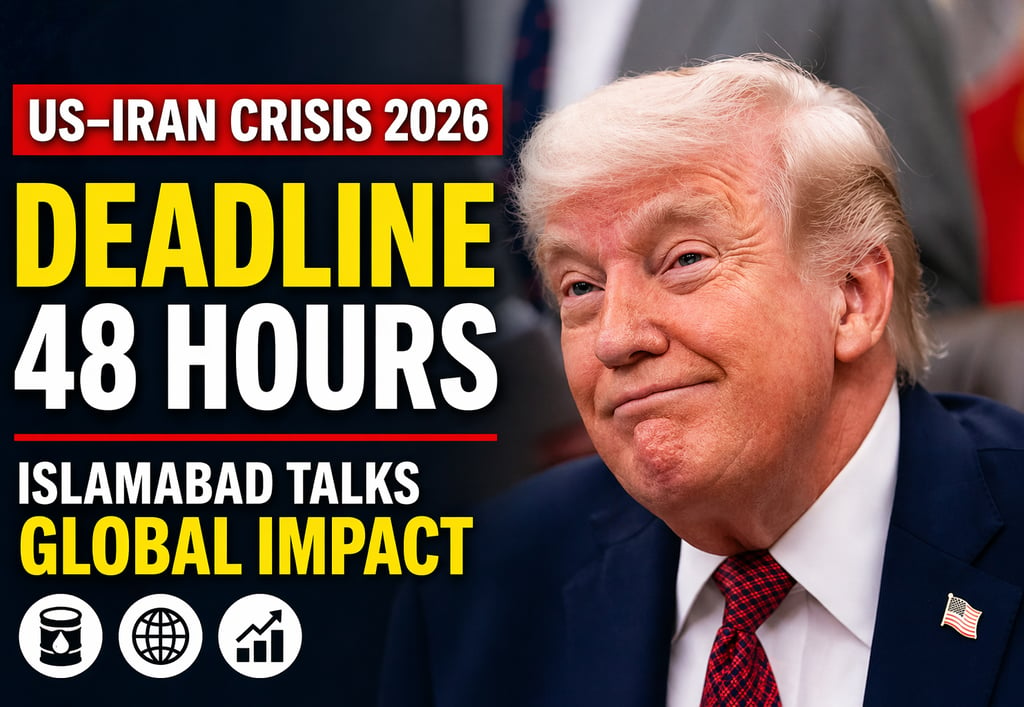
To fully understand the current situation, it is important to note that earlier talks held in Islamabad on April 11 failed to produce any results. Fundamental disagreements between the two sides remained unresolved. The main points of contention included Iran’s nuclear program, uranium enrichment levels, access for international inspectors, and the process for lifting US sanctions. This is why the upcoming negotiations are being seen as a decisive opportunity, particularly as only around 48 hours remain before the ceasefire expires. Experts believe that instead of a comprehensive peace agreement, an interim deal may be considered to reduce immediate tensions and allow more time for further negotiations.
The economic impact of the crisis is already clearly visible at the international level. Oil prices have shown significant volatility, with Brent crude trading around $94 to $95 per barrel and West Texas Intermediate close to $88. This indicates that markets are cautiously optimistic about the outcome of the negotiations. Previously, prices had surged by nearly 6% due to concerns about potential disruptions in the Strait of Hormuz, which created panic in global markets.
Experts warn that if tensions persist, oil prices could rise to as high as $110 per barrel. In such a scenario, full recovery of supply could take months, directly impacting global economies, increasing inflation, and disrupting industrial production.
At the same time, the global energy crisis has intensified, putting stock markets under pressure as investors adopt a “wait-and-see” approach. A slight dip in gold and other safe-haven assets reflects cautious optimism around potential US–Iran talks.
As of April 21, 2026, gold prices are trading around $4,780–$4,810 per ounce, influenced by a stronger US dollar and improving sentiment. However, analysts warn that any escalation in tensions could quickly drive gold prices higher again as investors return to safe-haven assets.
However, the most dangerous aspect of this crisis is no longer limited to oil or nuclear issues. It has now escalated to open threats targeting water and electricity infrastructure. According to international media reports, Iran has clearly warned that if the United States attacks its power plants or energy facilities, it may target water supply systems across the Middle East, particularly desalination plants, as well as electricity infrastructure.
Experts highlight that Gulf countries rely on desalination plants for approximately 70% to 90% of their water supply. Any attack on these facilities could immediately trigger a massive humanitarian crisis, potentially leaving millions of people without access to drinking water.
Furthermore, these desalination plants are typically connected to power grids. Therefore, any attack on electricity systems could instantly disrupt water supply as well, severely affecting urban life, hospitals, industries, and food supply chains. Some analysts argue that such actions could be considered serious violations of international law and may even qualify as war crimes. However, in practical terms, preventing such attacks could be extremely difficult if tensions escalate further.
On the ground, the situation remains extremely tense. A recent incident involving the US interception of an Iranian commercial vessel, identified as “Tosca,” has further increased tensions. Iran has strongly condemned the action, calling it a violation of international law, and has warned that the United States would be responsible for any further escalation. Iranian officials have demanded the immediate release of the vessel, its crew, and their families. Meanwhile, US authorities claim that the ship was carrying potential dual-use materials and failed to comply with repeated warnings.
China, the largest buyer of Iranian oil, has also expressed concern over the incident and has described it as forced interference. This highlights that the conflict is no longer purely regional but is now directly affecting global powers. European allies have also raised concerns that any rushed agreement could be weak and ineffective, potentially leading to larger conflicts in the future.
Since the war began on February 28, 2026, casualty figures reported by various international sources have varied. However, overall, the conflict has been extremely devastating. In Iran, thousands of people have been killed or injured, with some estimates placing the death toll above 3,600, including a significant number of civilians. In Lebanon, more than 1,400 people have been killed, while deaths have also been reported in Iraq and Israel. This clearly shows that the conflict has engulfed the entire region.
Following intense fighting, a temporary ceasefire was established between the parties. However, tensions have not fully subsided. President Trump has stated that Iran will eventually return to negotiations, but has also warned that if US conditions are not accepted, stronger measures will be taken, including targeting infrastructure. In response, Iran has warned that any attack on its energy or power systems would lead to strikes on energy, water, and electricity facilities across the region, potentially escalating the conflict to a far more dangerous level.
Global economic concerns continue to grow. Experts warn that if the conflict intensifies again, the risk of a global recession could increase. The energy crisis may deepen further, while disruptions in fertilizer supply could reduce agricultural production and lead to food shortages. At the same time, water scarcity could worsen significantly, particularly in dry regions such as the Middle East.
The deadline for the ceasefire is approaching rapidly. If no agreement is reached before its expiration, the situation could deteriorate quickly, and the region may once again fall into full-scale war.
Overall, the situation remains highly uncertain and volatile, with the potential to change at any moment. The next 24 to 48 hours will be decisive not only for the United States and Iran but for the entire world. On one hand, diplomacy may succeed in reducing tensions, while on the other, the risk of a large and prolonged conflict remains clearly present—one that could significantly disrupt the global order.
Stay informed with the latest national and international news.
© 2026. All rights reserved.