
Israel–Lebanon War 2026: Bint Jbeil Battle Intensifies Ahead of Critical U.S. Peace Talks
Israel intensifies assault on Bint Jbeil as Lebanon seeks ceasefire in U.S.-hosted talks. Full April 13, 2026 war update, casualties, and analysis.
Raja Awais Ali
4/13/20265 min read
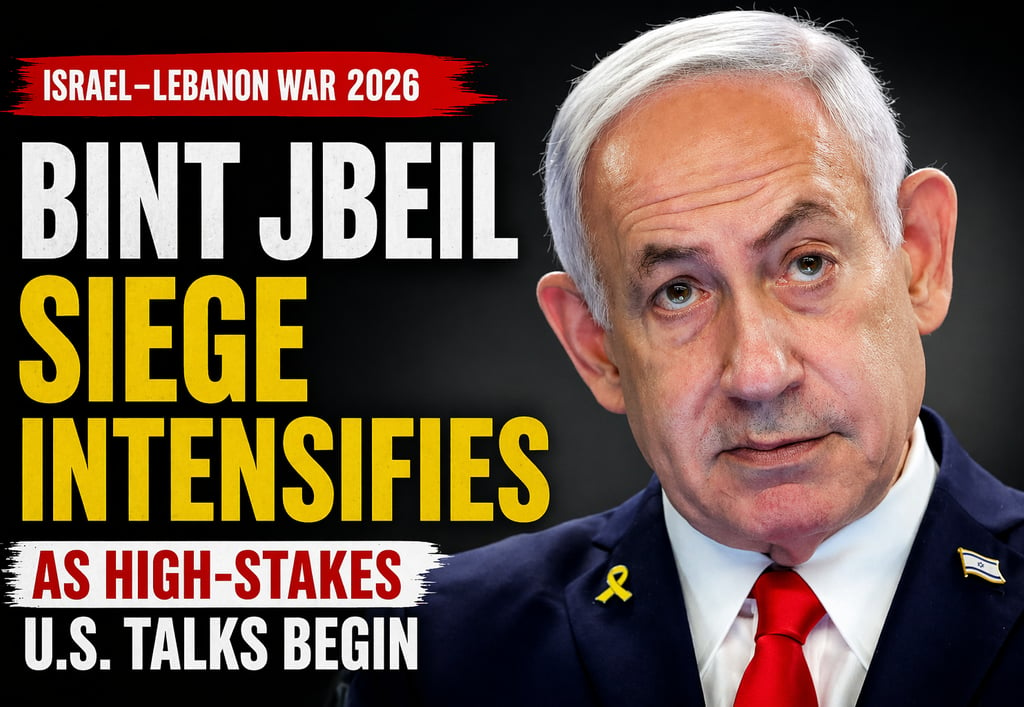
Israel–Lebanon War Escalates: Bint Jbeil Siege Intensifies as High-Stakes U.S. Talks Begin
On April 13, 2026, the ongoing Middle East conflict reached a critical turning point as Israel intensified its ground offensive on the strategic southern Lebanese town of Bint Jbeil, while rare and high-level diplomatic talks between Israeli and Lebanese officials were being prepared in Washington. This moment highlights a stark contrast: escalating military operations on the battlefield alongside fragile diplomatic efforts behind closed doors.
On the ground, Israeli forces have completed the encirclement of Bint Jbeil, tightening their grip around the city as part of a broader military push. According to Israeli military officials and security sources, a full-scale ground assault is now underway, with troops attempting to enter and secure control of the town. Israeli authorities claim the operation has entered its final phase and that “full operational control” could be achieved within days. They also state that only a limited number of militants remain inside.
However, Bint Jbeil is far more than just a border town. It is widely regarded as a major Hezbollah stronghold, a district capital, and a key gateway to surrounding villages. For Israel, capturing the town would represent not only a tactical victory but also a symbolic blow to Hezbollah’s long-standing narrative of resistance. According to a foreign security source, control of Bint Jbeil would give Israel dominance over much of southeastern Lebanon’s border strip, although the western sector—largely forested—would remain difficult to fully secure.
On the other side, Lebanese security sources report that Hezbollah fighters inside the town are putting up fierce resistance and are prepared to fight “to the last man.” The symbolic importance of Bint Jbeil has intensified the battle, turning it into more than just a military confrontation. On Sunday, Hezbollah announced that it had launched rockets, artillery fire, and suicide drones targeting Israeli forces in and around the town, significantly escalating the intensity of the conflict.
Israel’s broader military objective extends beyond Bint Jbeil. The Israeli army aims to establish a “security zone” in southern Lebanon up to the Litani River, approximately 30 kilometers from the Israeli border and stretching to the Mediterranean Sea. This buffer zone is intended to prevent Hezbollah rocket attacks and cross-border incursions, forming a long-term defensive barrier.
Israeli Prime Minister Benjamin Netanyahu reinforced this stance on April 13, stating that the war is far from over. “We have achieved a lot, but there is still more to do—and we are doing it,” he said, signaling that Israel is not currently considering a ceasefire and remains committed to achieving its military objectives.
Meanwhile, the humanitarian situation in Lebanon continues to deteriorate rapidly. According to Lebanese authorities, more than 2,000 people have been killed since the escalation began, including children, women, and medical personnel. Over 1 million people have been displaced, marking one of the most severe humanitarian crises in Lebanon’s recent history. Entire towns and villages in southern Lebanon have been heavily bombarded, leaving infrastructure devastated and essential services severely disrupted.
Several recent incidents have further intensified international concern. An Israeli strike reportedly killed a Lebanese Red Cross paramedic during a rescue mission. In another attack in Qana, five civilians—including three women—lost their lives. Additionally, the United Nations Interim Force in Lebanon (UNIFIL) reported that Israeli tanks damaged its vehicles, raising alarms at the international level.
Israel maintains that Hezbollah is operating within civilian areas, including near hospitals and residential buildings, which it says complicates military targeting. However, human rights organizations have called for independent verification of these claims and have raised serious concerns about civilian casualties and potential violations of international law.
The current conflict escalated sharply on March 2, 2026, when Hezbollah launched attacks on Israel in support of Iran following U.S.-Israeli strikes. In response, Israel initiated large-scale military operations in southern Lebanon, effectively opening a new front in the broader Iran–U.S.–Israel confrontation that is now reshaping the entire region.
Against this backdrop, the upcoming Washington talks have taken on critical importance. The meeting, scheduled for Tuesday, will be hosted by U.S. Ambassador to Lebanon Michel Issa and will bring together Israeli Ambassador Yechiel Leiter and his Lebanese counterpart Nada Hamadeh Moawad. The encounter marks a rare face-to-face engagement between representatives of two countries that remain technically in a state of war.
Lebanon has made it clear that its primary objective in these talks is to secure an immediate ceasefire. Lebanese Culture Minister Ghassan Salameh stated that the delegation has been authorized to discuss only one issue: ending the war. In contrast, Israel has explicitly ruled out discussing a ceasefire with Hezbollah and instead views the talks as the beginning of a broader “formal peace process.”
Lebanese Foreign Minister Youssef Raggi, who is politically opposed to Hezbollah, emphasized that Lebanon is attempting to achieve a ceasefire through direct negotiations. He also indicated that this diplomatic track aims to separate the Lebanese conflict from the broader Iranian issue, reflecting a strategic effort to isolate the crisis.
However, internal divisions within Lebanon are complicating the situation. Hezbollah and its allies, including Parliament Speaker Nabih Berri, strongly oppose negotiations with Israel while fighting continues. Their stance reflects a broader sentiment that engaging in talks under ongoing military pressure undermines national dignity. A senior Lebanese source stated bluntly, “We cannot sit at the negotiating table while our people are being killed.”
These internal divisions are weakening Lebanon’s negotiating position and raising doubts about the success of the Washington talks. At the same time, both Israel and the United States have stated that military operations in Lebanon fall outside the scope of the fragile Iran–U.S. ceasefire framework, despite earlier suggestions from some mediators that Lebanon might be included.
Globally, the ripple effects of the conflict are becoming increasingly evident. The United States’ announcement of a potential naval blockade in the Strait of Hormuz has triggered volatility in global markets, pushing oil prices sharply higher. European nations and the United Nations have repeatedly called for de-escalation, warning that prolonged conflict could have devastating consequences for the global economy.
Israeli media and military analysts increasingly describe the battle for Bint Jbeil as a potential turning point. They argue that capturing the town would significantly weaken Hezbollah’s operational capabilities while also damaging its symbolic standing as a resistance force.
The developments of April 13, 2026, underscore a pivotal moment in the Middle East. Israel is pressing forward with its military campaign to secure strategic dominance, while Lebanon is attempting to halt the violence through diplomatic channels. Yet, the gap between these two approaches remains wide.
With intense fighting continuing in Bint Jbeil, rising casualties, and deep political divisions within Lebanon, there is little indication that the conflict will end soon. What began as a localized escalation has now evolved into a broader regional crisis with global implications.
The coming days will determine whether diplomacy can succeed in containing the situation—or whether the conflict will expand further, drawing in more actors and pushing the region toward an even more dangerous and unpredictable future.
Israel’s economy has shown a strong post-war recovery, recording 3.1% GDP growth in 2025, a sharp rise from just 1% in 2024, according to verified global economic assessments released on 16 February 2026. This rebound reflects improving stability after wartime disruptions and a gradual return of investor confidence. Growth was mainly driven by a 7%+ rise in investment, especially in infrastructure, construction, and the high-tech sector, alongside nearly 6% export growth from technology products, defense equipment, and services. Government spending on reconstruction and defense also supported short-term demand, while per capita income increased by around 1.7%, indicating broader household recovery.
Looking ahead, forecasts for 2026 remain positive, with the Bank of Israel projecting growth above 5%, while the IMF and OECD estimate expansion between 4.8% and 5.2%, assuming relative regional stability. Inflation has also eased to around 1.8%, helping strengthen purchasing power and financial stability. Although security risks and fiscal pressures still exist, Israel’s strong technology sector, skilled workforce, and global trade integration continue to support its economic resilience. Overall, the data suggests that Israel is transitioning from post-war stabilization to a sustained growth phase, with 2026 expected to be a key year for long-term economic recovery and investor confidence.
👉 Read full details here: https://blinknews.blog/israel-post-war-economy-growth-2026
Stay informed with the latest national and international news.
© 2026. All rights reserved.