
Israel’s Post-War Economy Set to Accelerate in 2026 After 3.1% Growth in 2025
Israel’s economy rebounded with 3.1% growth in 2025 after war disruptions. Stronger recovery is expected in 2026 with GDP growth above 5%.
Raja Awais Ali
2/16/20263 min read
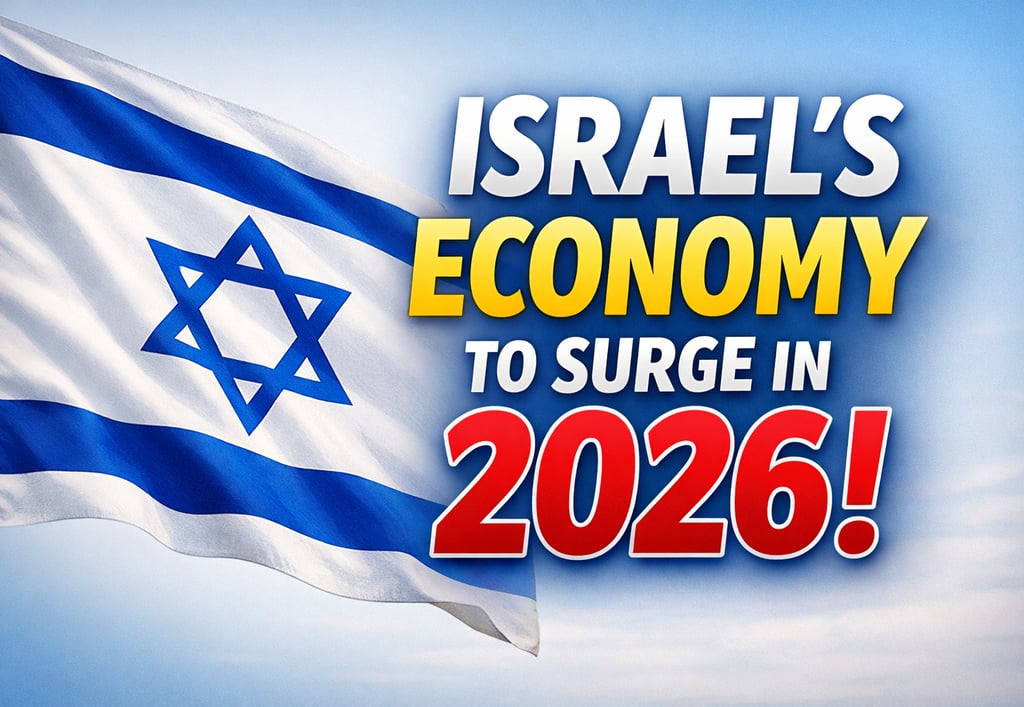
Israel’s Post-War Economic Recovery: Stronger Growth Expected in 2026 After 3.1% Expansion in 2025
According to the latest credible global economic assessments released on 16 February 2026, Israel’s economy has entered a clear phase of recovery following the disruptions caused by war. Official data and evaluations by international financial institutions confirm that Israel’s economy recorded a robust 3.1% growth in 2025, a sharp improvement compared to just 1% growth in 2024. This turnaround reflects the economy’s resilience and its ability to stabilize despite prolonged security challenges and wartime pressures. Analysts attribute this recovery to the gradual normalization of economic activity, improved investment flows, and renewed access to global markets.
Several key factors contributed to the economic rebound in 2025. The most significant driver was a rise in investment, with both public and private investment increasing by more than 7%. New projects in construction, infrastructure development, and the technology sector played a major role in accelerating overall economic activity. At the same time, exports grew by nearly 6%, led by high-tech products, defense equipment, and service-based industries. As global demand gradually improved after the conflict, Israel’s production sectors regained momentum, strengthening foreign exchange inflows and trade performance.
Government spending also played a critical role in supporting recovery. Increased expenditures on defense, reconstruction, and social services boosted short-term demand, although they temporarily widened the fiscal deficit. Economists note that this expansionary approach helped prevent a deeper slowdown and supported economic stabilization. As a result, per capita income rose by approximately 1.7% in 2025, indicating that the benefits of recovery began reaching households alongside broader macroeconomic improvement.
Looking at the broader five-year context, Israel’s economy has experienced significant fluctuations. In 2021, following the pandemic, economic activity rebounded strongly with growth of around 8%, driven by consumer demand and technology exports. In 2022, despite global inflation and an energy crisis, the economy expanded by roughly 6.5%, supported by resilient exports and financial services. Growth slowed sharply in 2023 to around 2% due to global economic headwinds and domestic uncertainty. 2024 proved the most challenging year, as war-related disruptions limited growth to just 1%. Against this backdrop, the 3.1% growth in 2025 is widely viewed as a decisive turning point toward recovery.
The outlook for 2026 appears even more encouraging. According to the Bank of Israel, if security conditions remain relatively stable, GDP growth is expected to exceed 5%. This forecast is based on continued growth in private consumption, sustained investment momentum, and stronger export performance. Similarly, projections from the IMF and the OECD suggest that Israel’s economy could expand by approximately 4.8% to 5.2% in 2026, placing it among the stronger performers in the region.
Inflation trends further support this optimistic outlook. By early 2026, inflation eased to around 1.8%, one of the lowest levels seen in recent years. Lower inflation has helped stabilize household purchasing power and reduce cost pressures for businesses. As a result, expectations are growing that monetary policy could become more accommodative, potentially lowering borrowing costs and further stimulating investment. Meanwhile, the relative strength of the Israeli shekel has contributed to financial stability and reinforced investor confidence.
Despite these positive indicators, experts caution that security risks and fiscal pressures remain key challenges. Any renewed escalation could disrupt economic momentum. However, current data suggests that Israel’s economic fundamentals—particularly its technology sector, skilled workforce, and strong global trade links—have made the economy more resilient to short-term shocks.
Overall, the combination of 3.1% growth in 2025 and stronger expansion expected in 2026 clearly demonstrates that Israel is moving beyond post-war stabilization toward a new phase of economic growth. Based on verified data available as of 16 February 2026, this recovery is grounded in credible trends rather than speculation. If current conditions hold, 2026 is likely to become one of the most decisive and economically significant years for Israel since the conflict, marking a return to sustained growth and renewed investor confidence.
Stay informed with the latest national and international news.
© 2026. All rights reserved.