
Iran War 2026 After One Month: Global Power Clash, Oil Crisis, Thousands Dead and Trillions Lost
One month into the Iran War 2026, global oil supply is collapsing, thousands are dead, and trillions are lost. Full analysis, timeline, casualties & impact.
Raja Awais Ali
3/28/20267 min read
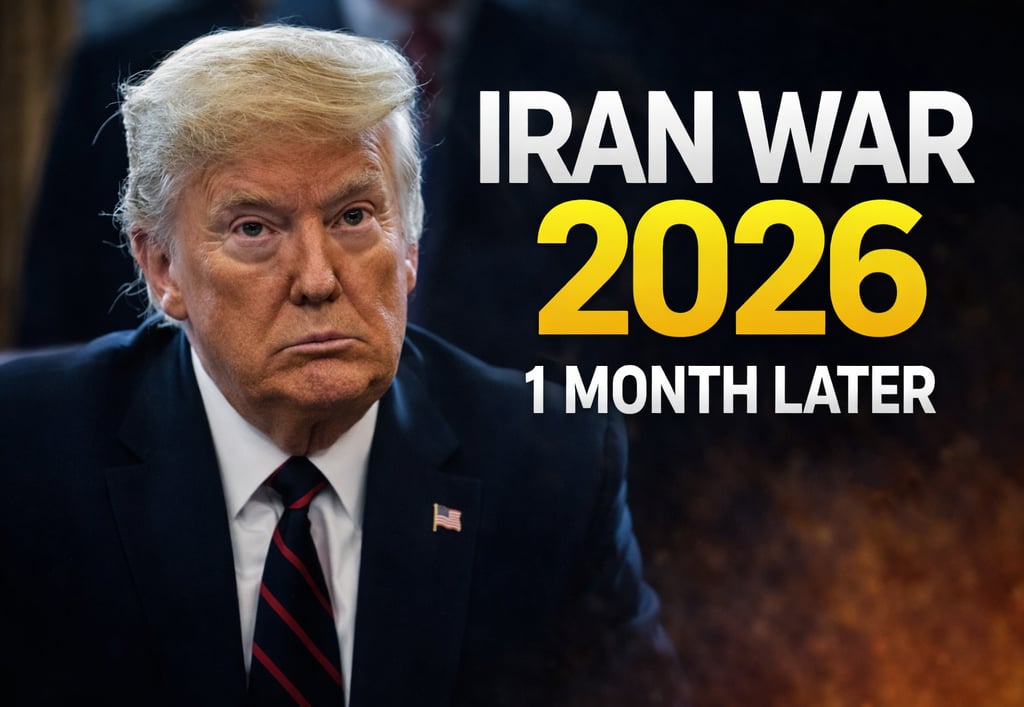
Iran War 2026: One Month Later – Global Power Clash, Oil Collapse, Thousands Dead, and Trillions Lost — Where Is the World Heading?
The war against Iran launched by the United States and Israel on February 28, 2026, captured global attention within hours. However, few could have imagined that within just one month, this conflict would evolve into one of the most significant geopolitical, economic, and energy crises of the 21st century. By March 28, 2026, it has become clear that this is no longer a limited military operation, but a full-scale strategic confrontation reshaping global power dynamics, where every decision carries consequences for the future of the world.
When analyzed through a timeline, the escalation becomes even more striking. Initial strikes began on February 28. Between March 1 and 3, global markets reacted sharply. By March 6, shipping through the Strait of Hormuz had nearly halted. By March 10, casualties had already reached into the thousands. By mid-March, the energy crisis peaked. By the end of the month, it became evident that this war was not only ongoing but had already engulfed the global system.
The war began with a sudden but highly coordinated joint offensive by the United States and Israel targeting Iran’s nuclear, missile, and military infrastructure. Within the first 48 to 72 hours, over 40 strategic targets were struck, including Natanz, Fordow, and other sensitive facilities. U.S. stealth bombers and advanced Israeli fighter jets deployed bunker-buster munitions to destroy underground facilities. These strikes damaged an estimated 15–20% of Iran’s missile launch infrastructure, yet it quickly became clear that Iran’s true strength lies in its vast underground networks and decentralized military structure.
Iran responded forcefully within the first week. Reports indicate that over 200 ballistic missiles and more than 450 drones were launched. Targets included major Israeli cities, U.S. military bases, and strategic assets across the Gulf region. While Israel’s air defense systems intercepted many projectiles, significant damage still occurred in Tel Aviv, Haifa, and other areas. Within the first two weeks, Israel suffered approximately 140–180 fatalities and over 900 injuries.
The situation in Gulf countries also became critical. U.S. bases in Bahrain, Qatar, and the United Arab Emirates were targeted, resulting in approximately 80–120 deaths and over 300 injuries. In Saudi Arabia, drone strikes on oil facilities caused a temporary 15% reduction in production.
Iran’s most decisive move was the blockade of the Strait of Hormuz, through which nearly one-fifth of the world’s oil supply passes. In the first week, Iran deployed naval mines, used fast attack boats to disrupt shipping, and conducted drone surveillance. By mid-March, oil tanker traffic had dropped by 70–80%, eventually coming to a near standstill. Reports suggest that over 20 tankers were seized, 8 damaged, and 3 completely destroyed. This disruption impacted not only oil but also a significant portion of global trade.
The global shipping industry faced severe consequences. More than 150 vessels were stranded outside the Strait, insurance costs surged dramatically, and global supply chains were disrupted. Trade between Asia and Europe slowed, increasing prices of industrial and imported goods.
The oil market experienced immediate and severe shock. Brent crude rose from approximately $85 per barrel at the end of February to $120–130 by late March, with peaks reaching $135. Global supply dropped by 11–13 million barrels per day—one of the largest supply shocks in modern history. Analysts warn that prices could surge to $180–220 per barrel if the conflict escalates further.
This crisis is already being compared to, and in some cases considered worse than, the 1973 oil crisis and the 1990 Gulf War, due to the scale and uncertainty of supply disruption. Its impact extends far beyond fuel, affecting the entire global economy.
The natural gas market has also been severely impacted. Qatar, responsible for nearly 20% of global LNG supply, reduced exports by 25–35%. Gas prices in Europe surged by up to 45%, while LNG prices in Asia rose by 30–40%. As a result, electricity, fertilizer, and food prices have all increased, accelerating global inflation.
Fertilizer prices rose by 30–40%, affecting agriculture worldwide. Developing nations are experiencing rising food prices, and the United Nations has warned of a potential global food crisis if the situation persists.
In terms of human cost, the situation has become extremely grave within just one month. Intelligence and media estimates place total fatalities between 4,000 and 6,000. In Iran, approximately 2,500–3,000 people have been killed, including IRGC commanders, military personnel, and civilians, with over 8,000 injured. In Israel, fatalities range between 300–400, with over 1,800 injured. In Gulf states and U.S. bases, around 200 deaths and more than 500 injuries have been reported. Maritime attacks have left over 50 sailors dead or missing.
Military infrastructure losses have been extensive. Iran has suffered damage to over 30 military bases, 15 missile sites, and 4 nuclear facilities. Israel has experienced damage to both defense installations and civilian areas. Oil refineries and gas plants in Saudi Arabia and the UAE have also been affected, reducing energy output.
Cyber warfare has emerged as a critical dimension of the conflict. Iran has targeted Israeli financial systems and banking networks, while the United States has attacked Iran’s power grid and communication infrastructure. Power outages have been reported across Iranian cities, while Israeli digital systems have faced disruptions.
Financial costs are staggering. The United States is spending an estimated $2.5–3.5 billion per day, totaling approximately $80–100 billion in one month. Israel’s daily war expenditure is estimated at $1–1.5 billion, amounting to $35–45 billion monthly. Iran has suffered infrastructure, energy, and military losses estimated between $60–80 billion.
The global economy has already incurred losses of $1.5–2 trillion. Stock markets have declined sharply, with the S&P 500 falling by approximately 15%, while European and Asian markets also suffered losses. Gold prices surged to $4,500 per ounce as investors shifted toward safe-haven assets.
Politically, this war has become the biggest test for Donald Trump. His approval rating has dropped to 36%, posing a serious threat to his political future. A majority of Americans oppose the war, particularly due to rising fuel costs and inflation. In this context, a critical question continues to emerge: who is truly responsible for this war?
An objective assessment of the conflict’s origins reveals that the initial large-scale strike was carried out by the United States and Israel, which escalated tensions into full-scale war. Based on this, many analysts conclude that primary responsibility lies with Donald Trump and Benjamin Netanyahu, whose decisions transformed a limited standoff into a major military confrontation. Critics have described it as a “war of choice,” meaning a conflict that could have been avoided through diplomacy but instead escalated through the use of force.
However, there is another side to the argument. The United States and Israel maintain that Iran’s missile program, regional influence, and potential nuclear capability posed an immediate security threat that necessitated action. From their perspective, this war is framed as preemptive defense rather than aggression.
Even so, it cannot be ignored that the decision to launch the initial attack triggered a chain reaction that resulted in thousands of deaths, massive economic damage, and a global crisis. From this perspective, the primary burden of responsibility falls on the political decisions that opened the door to war, while Iran’s role is largely viewed as reactive resistance.
At present, Trump faces three major options: pursue negotiations and exit through a compromise deal, launch a final large-scale military strike and declare victory, or escalate into a ground war that could last for years.
Iran has rejected the U.S. 15-point peace proposal and has made it clear that it is prepared for a prolonged conflict. Its strategy appears to focus on exhausting its adversaries through economic pressure and control over the Strait of Hormuz.
Diplomatic efforts continue but remain complex. Backchannel negotiations are ongoing through Pakistan, Qatar, and Oman, but no significant breakthroughs have been achieved. European nations are reluctant to become directly involved, while China and Russia are leveraging the situation for strategic advantage.
The war could expand further at any moment. Iran-backed groups in Lebanon, Syria, Iraq, and Yemen are already active. If these fronts fully open, the conflict could escalate into a full-scale regional war.
Three main scenarios are currently being discussed: a limited war ending in diplomacy, a major military strike followed by U.S. withdrawal, or a prolonged conflict lasting years.
However, a fourth scenario is increasingly being considered—an economic collapse scenario in which prolonged war and rising energy prices push the global economy into severe recession.
After one month, the most important reality is that there is no clear winner. Iran continues to resist, while the United States and Israel have yet to achieve their full objectives, leaving the world in a state of uncertainty.
This is not just a war of the present, but one that will shape the future. If it continues, global power balances could shift, new alliances may emerge, and the world economy could enter a new era.
Ultimately, this war is not only about weapons—it is a war of endurance, economics, politics, and global power. Its true outcome will likely be determined not only on the battlefield, but in the transformation of the global order itself.
Iran and China are reportedly in the final stages of a major defense agreement involving the CM-302 supersonic anti-ship missile, a development that could significantly reshape naval power dynamics across the Middle East and South Asia. The missile, believed to travel at Mach 2–3 with a range of around 290 km, uses a sea-skimming flight path, making it harder to detect and intercept. If acquired by Iran, it would strengthen its maritime strike capability, especially in strategic waterways like the Persian Gulf and the Strait of Hormuz, where tensions remain high. The deal comes amid Iran’s growing missile activity, including its large-scale 2024 strike on Israel, which highlighted its expanding long-range capabilities. In South Asia, comparisons are already being drawn with missile systems operated by India and Pakistan, while China’s role as a key defense supplier adds another layer of geopolitical complexity. Analysts say the agreement could intensify regional arms competition and further strain relations between Iran and Western powers.
👉 Read full details here: https://blinknews.blog/iran-china-supersonic-missile-deal-2026
Stay informed with the latest national and international news.
© 2026. All rights reserved.