
Carmakers Shift to Battery Storage Systems as EV Demand Slows (April 15, 2026)
Carmakers are shifting from EV batteries to energy storage systems amid falling EV demand. Explore costs, challenges, Tesla’s lead, and market impact in 2026.
Raja Awais Ali
4/15/20264 min read
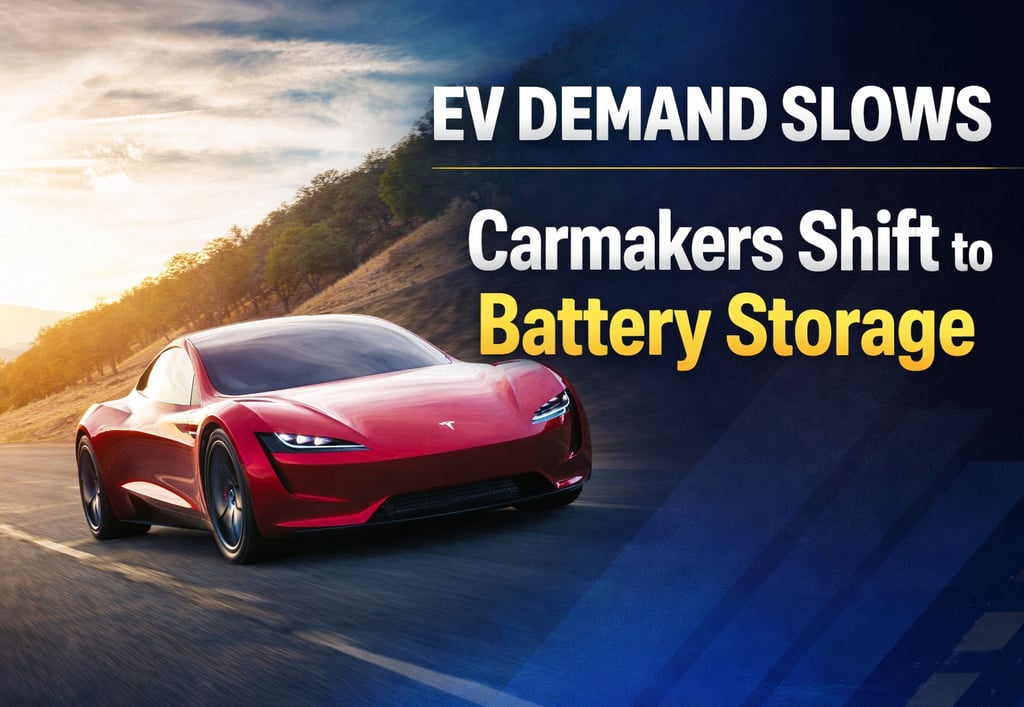
Carmakers Shift to Battery Storage Systems as EV Demand Slows
The global automotive industry is undergoing a major transformation in 2026. For years, carmakers invested heavily in electric vehicles (EVs), expecting rapid growth and widespread adoption. However, the reality has shifted. Slowing EV demand in the United States is now forcing companies to rethink their strategies and explore alternative opportunities, particularly in battery energy storage systems.
Over the past decade, major companies such as General Motors, Ford Motor, Panasonic Holdings, Samsung SDI, and LG Energy Solution collectively invested more than $100 billion in building battery factories across the United States. These investments were based on strong expectations that EV sales would continue to surge. Instead, the market has slowed significantly.
One of the primary reasons behind this slowdown is the expiration of the $7,500 federal EV tax credit, which made electric vehicles more affordable for consumers. Without this incentive, many buyers are reconsidering their options. Additionally, concerns about charging infrastructure, battery range limitations, and high upfront costs continue to discourage potential customers. As a result, EV sales have declined by more than 25% over the past six months.
This decline has created a serious imbalance in the industry. Battery factories that were built to meet high demand are now operating below capacity. In North America alone, total battery production capacity is estimated at around 275 gigawatt-hours (GWh), far exceeding current demand. This situation, known as overcapacity, is putting financial pressure on both automakers and battery manufacturers.
To address this issue, companies are shifting their focus toward battery energy storage systems. These systems store electricity—often generated from renewable sources such as solar and wind power—and release it when demand rises. They play a crucial role in stabilizing power grids and ensuring a consistent energy supply, especially as electricity demand continues to grow.
In 2026, demand for energy storage systems in North America is expected to reach approximately 76 GWh. While this represents a significant increase, it is still far below the existing production capacity. Even with projections suggesting demand could rise to 125 GWh over the next five years, the gap between supply and demand will remain substantial.
However, transitioning from EV batteries to storage systems is not a simple process. The two types of batteries are built differently. EV batteries in North America are typically nickel-based, while most storage systems rely on lithium iron phosphate (LFP) technology. LFP batteries are more affordable, safer, and have a longer lifespan, making them better suited for stationary storage applications.
Converting factories to produce LFP batteries is both costly and time-consuming. Industry experts estimate that such conversions can take up to 18 months and require hundreds of millions of dollars in investment. Companies must also upgrade equipment, modify production lines, and retrain workers, adding further complexity to the transition.
LG Energy Solution is already taking action by converting three of its North American factories to produce storage batteries. Despite this effort, the company still expects challenges due to ongoing overcapacity in the market. Executives have described the situation as a “fallout” from the EV slowdown, indicating that recovery may take time.
Another major challenge is China’s dominance in LFP battery technology and its supply chain. U.S. companies often rely on Chinese materials to produce these batteries, but geopolitical and economic factors complicate this dependency. The United States has imposed tariffs of around 35% on Chinese battery components such as cathodes and anodes, increasing production costs.
At the same time, U.S. government incentives encourage domestic manufacturing, but only if companies reduce their reliance on Chinese materials. This creates a difficult balancing act, as companies must choose between lower costs and eligibility for tax benefits.
In response, Ford Motor has announced a $2 billion investment over the next two years to expand its battery storage business. The company aims to create a new revenue stream and reduce its dependence on EV sales.
Similarly, General Motors is working with LG under the Ultium Cells joint venture to convert an EV battery plant in Tennessee into a facility for storage battery production. The project includes a $70 million investment in retraining workers and adapting manufacturing processes.
While traditional automakers are just beginning this transition, Tesla has already established a strong presence in the energy storage market. The company has spent nearly a decade developing its storage business, which has become one of its fastest-growing segments.
Tesla’s Megapack systems are now widely used in large-scale energy projects, including data centers and utility grids. In 2025, Tesla’s energy storage division achieved profit margins of around 30%, significantly higher than the approximately 15% margins from its automotive business. This highlights the growing profitability of energy storage compared to EV manufacturing.
Demand for Tesla’s storage solutions has surged, driven in part by the rapid expansion of artificial intelligence and cloud computing. For instance, Elon Musk’s AI company xAI purchased approximately $430 million worth of battery storage systems last year. This demonstrates how increasing energy demands from AI infrastructure are directly influencing the battery market.
In simple terms, the automotive industry is undergoing a strategic shift. Slowing EV demand has created excess capacity, forcing companies to explore new opportunities in energy storage. While this market offers potential, it cannot fully absorb the existing surplus in battery production.
The transition is complex, requiring significant investment, technological adaptation, and long-term planning. Companies must navigate supply chain challenges, policy changes, and evolving market dynamics to remain competitive.
Ultimately, the next few years will be critical. Carmakers that successfully adapt to this changing landscape will emerge as leaders in both the automotive and energy sectors. Those that fail to adjust may struggle to survive in an increasingly competitive and rapidly evolving industry.
Alongside the EV-to-storage transition, another major shift is taking place in the automotive industry: the rise of Level-3 autonomous driving systems. These systems enable vehicles to operate independently under specific conditions, while still requiring the driver to take immediate control when necessary. This technology is redefining modern transportation by reshaping concepts of safety, responsibility, and legal accountability.
In this context, one of the most important questions is: if an accident occurs, who is responsible—the driver or the company behind the AI system and manufacturer? This legal and ethical debate is still not fully resolved, and different countries apply different regulations and interpretations regarding liability in autonomous driving incidents.
As automakers continue investing in both electrification and AI-driven mobility, questions around system reliability, sensor failures, and liability in accident scenarios are becoming increasingly significant.
To explore this topic in detail, including risks, regulations, and real-world implications, you can read the full analysis here:
👉 https://blinknews.blog/level-3-self-driving-safety-liability-2026
Stay informed with the latest national and international news.
© 2026. All rights reserved.