
Eyes Off the Road: How Level‑3 Self-Driving Cars Raise Safety & Liability Concerns in 2026
Explore the latest 2026 insights on Level‑3 autonomous cars, safety risks, legal liability, and automakers’ push toward “eyes-off” driving.
Raja Awais Ali
2/23/20263 min read
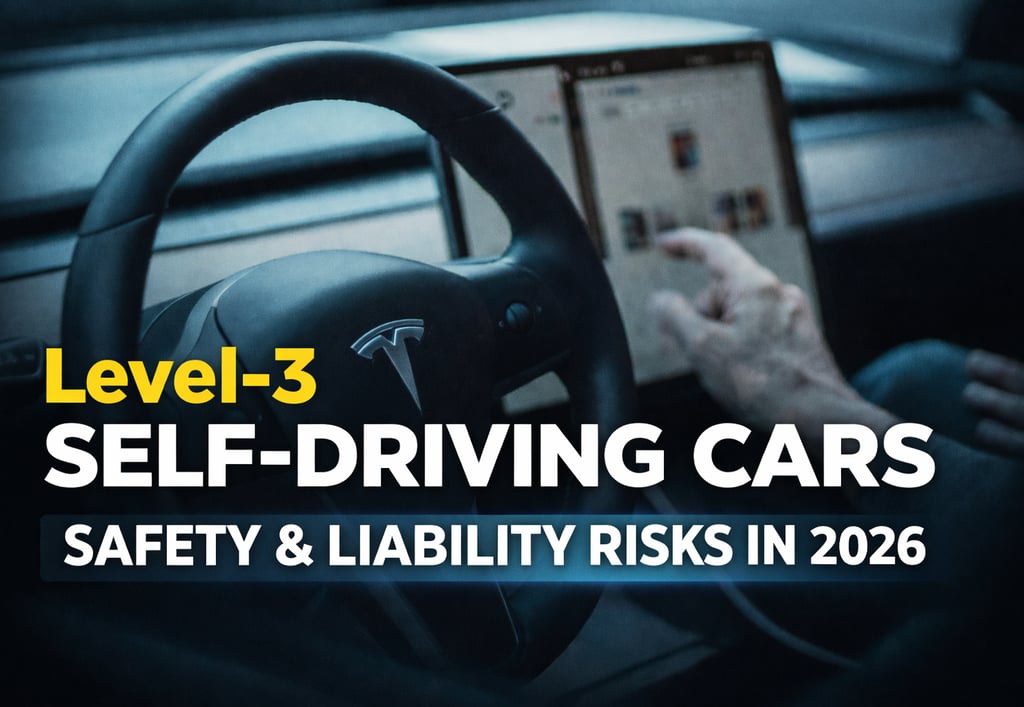
Eyes Off the Road! Are Cars Driving Themselves? Truth, Risks, and Legal Responsibility
Automakers worldwide are rapidly advancing Level‑3 autonomous driving systems, where vehicles can operate themselves under certain conditions while the driver takes their eyes off the road. This technology aims to reduce driver workload and enhance road safety, but the key questions remain: is it truly safe, reliable, and legally accountable, and if an accident occurs, who is responsible? Level‑3 represents the stage where a vehicle can control steering, braking, and speed independently while the driver intervenes only in emergency situations. Autonomous driving is categorized from Level‑1 to Level‑5: Level‑1 includes basic features such as cruise control; Level‑2 allows partial automation while the driver maintains full attention; Level‑3 enables “eyes-off” driving, and Levels‑4/5 approach full automation with minimal to zero human involvement. Level‑3 is critical because it involves control handoff between human and AI, raising major safety, liability, and legal challenges.
Automakers like Ford, General Motors, and Honda have invested heavily in Level‑3 systems, and it is expected that by 2028, this technology will become relatively affordable and widely accessible. Investment is not just for technological advancement but also for market leadership, continuous revenue, and strategic advantage in future vehicles. Level‑3 technology offers companies not only higher vehicle pricing but also the opportunity for subscription models, software updates, and data services, creating recurring revenue streams. Some companies, such as Mercedes‑Benz and Stellantis, have slowed or scaled back their Level‑3 programs due to low consumer demand, high development costs, and limited market adoption.
Despite these advances, the risks of Level‑3 autonomy are evident. The greatest risk is human response and control. If the system misjudges a complex situation, the driver must immediately take over, but human reaction times are often slower than machines, increasing the likelihood of accidents. The second risk is system or sensor failure. Autonomous vehicles rely on cameras, radar, and LiDAR sensors, and AI systems make hundreds of decisions every second. Even a minor technical fault can cause a serious accident. The third risk is driver overconfidence. Research has shown that Advanced Driver Assistance Systems (ADAS) such as Lane Departure Warning and Super Cruise can give drivers a false sense of security, potentially reducing safety.
The most critical question remains: who is liable if a self-driving car is involved in a crash? Current laws are not explicit about whether responsibility falls on the automaker or the driver. Courts and legal experts are debating whether liability lies with the manufacturer of the AI system or the human operating the technology. Legal frameworks vary across countries, emphasizing the need for global regulatory harmonization. Governments and regulatory bodies are working to understand this emerging technology. China has implemented strict Level‑3 regulations to ensure driver attention, Europe through Euro NCAP and other crash safety organizations is introducing rules requiring physical controls to prevent full driver disengagement, and in the United States, investigations are ongoing into Ford and Mercedes Advanced Assist systems, especially when features like Automatic Emergency Braking (AEB) are involved in accidents.
Level‑3 systems make thousands of decisions per second, yet these decisions are not always aligned with human ethics and priorities. For instance, if two paths present different levels of risk to passengers, which path should the AI prioritize? This question is under active discussion in legal and ethical forums worldwide. Additionally, these systems are complex and expensive, requiring trained drivers capable of understanding and responding to alerts. Future vehicles will increasingly adopt Level‑3 and higher autonomous features, but they must be integrated with safety, legal accountability, and regulatory compliance. Technical, legal, and ethical questions remain, and automakers are advancing rapidly — but are we keeping pace with safety and legal safeguards?
Key figures highlight the scale and stakes: each major automaker spends approximately $1.5 billion developing Level‑3 systems, and the global autonomous vehicle market is projected to reach $15.5 billion by 2030. Public trust remains low, with only about 13% of drivers fully confident in Level‑3 systems, while an estimated 75% of new vehicles will feature AI-assisted or autonomous driving in the near future. Companies like Ford, General Motors, Honda, Mercedes‑Benz, and Stellantis lead the field and are poised for further global market penetration. Level‑3 self-driving technology represents the future of mobility, but without safety, accountability, ethics, and clear laws, it can also be dangerous. Automakers are advancing quickly, but consumers, regulators, and legal authorities must adopt these systems alongside a robust safety and legal framework.
Stay informed with the latest national and international news.
© 2026. All rights reserved.