
Apple at 50: From Garage Startup to Global Tech Empire | Complete Evolution & Future Strategy
Discover Apple’s 50-year journey from a small garage startup to a trillion-dollar tech giant. Explore key innovations like iPhone, iMac, iPod, Vision Pro, and Apple’s future in AI, ecosystem strategy, and global dominance.
Raja Awais Ali
4/2/202621 min read
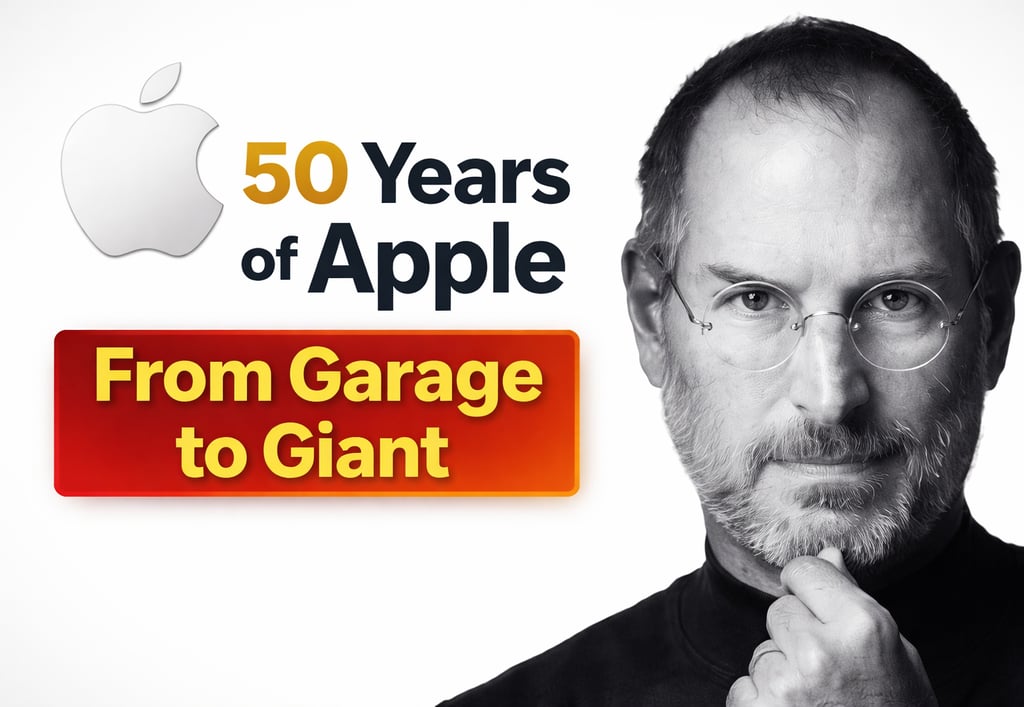
Apple: From Garage Startup to Global Tech Empire – 50 Years of Innovation, Growth & Future Vision
In 1980, Apple Inc. made a historic entry into the stock market through its Initial Public Offering (IPO), marking a defining moment not only for the company but also for the entire technology industry. At the time of the IPO, Apple’s stock was priced at $22 per share, and the company successfully raised nearly $100 million from public investors. This capital injection played a crucial role in strengthening Apple’s financial foundation and was primarily invested in research and development (R&D), manufacturing expansion, and global market growth. The IPO instantly increased Apple’s market capitalization and positioned the company as one of the most promising players in the emerging personal computer industry.
However, this rapid financial and market success also introduced a series of internal challenges. As Apple expanded quickly, issues related to leadership coordination, product strategy, and organizational focus began to emerge. During the early 1980s, Apple’s product lineup became increasingly fragmented and over-diversified, which created confusion both within the company and in the market. Instead of maintaining a focused product strategy, Apple attempted to target multiple segments simultaneously, which diluted its efficiency and clarity.
One of the most significant product failures during this period was the Apple III, launched in 1980 for the business computing market. It was designed to compete with IBM’s growing dominance in enterprise systems. The Apple III featured a Synertek 6502C processor running at 2 MHz and came with 128 KB of RAM, expandable for advanced use cases. It also included the ProDOS operating system and integrated business software features intended to attract corporate users. Despite these technical specifications, the product suffered from serious hardware design flaws, particularly overheating issues caused by the lack of a cooling fan. These reliability problems severely impacted its reputation and led to poor market adoption. The Apple III failure became a major learning experience for Apple, highlighting the importance of quality control, product testing, and engineering reliability.
In 1984, Apple attempted to redefine personal computing with the launch of the Macintosh. This product introduced a revolutionary graphical user interface (GUI), powered by a Motorola 68000 processor running at 8 MHz, along with 128 KB of RAM and a 9-inch black-and-white display. The Macintosh was designed to make computing more accessible to everyday users by replacing complex command-line operations with visual icons and interactive elements. It also laid the foundation for desktop publishing, especially when paired with peripherals like the LaserWriter printer.
Despite its technological innovation, the Macintosh faced challenges in achieving mass-market adoption. Its high price of $2,495 limited accessibility for many consumers, while the lack of sufficient software applications restricted its practical usability. Although Apple’s marketing campaign, including the iconic “1984” Super Bowl advertisement, generated massive attention and brand recognition, it did not immediately translate into strong sales. Many users were still unfamiliar with graphical interfaces, and developers had not yet built a strong software ecosystem around the platform.
By 1985, Apple’s internal situation became increasingly unstable. Conflicts between executives and the board of directors led to major leadership changes, including the departure of Steve Jobs from the company. His exit created a significant leadership vacuum and disrupted Apple’s long-term vision and strategic direction. In his absence, competitors such as Microsoft and IBM rapidly expanded their market share, strengthening their dominance in the personal computer industry.
Financially, Apple began to experience pressure due to declining profit margins and inconsistent product performance. While earlier products like the Apple II continued to generate revenue, the slow adoption of the Macintosh affected overall revenue predictability. Additionally, poor coordination between departments and unclear product roadmaps led to delays, inefficiencies, and missed opportunities in the market. Investor confidence also fluctuated as Apple’s stock experienced volatility during this period.
Despite these challenges, Apple’s engineering and design teams continued to innovate. Projects like the LaserWriter printer and advancements in desktop publishing software laid the groundwork for future recovery. These innovations demonstrated Apple’s ability to think beyond traditional computing and explore new technological possibilities.
Overall, the IPO and early growth phase of Apple was a combination of extraordinary financial success and significant operational challenges. While the company achieved rapid expansion and global recognition, it also faced internal instability, product failures, and strategic confusion. These experiences ultimately shaped Apple into a more disciplined, focused, and resilient organization, preparing it for future transformation and long-term success in the global technology market.
Steve Jobs’ Comeback and the iMac Revolution
In 1997, the return of Steve Jobs marked one of the most important turning points in the history of Apple Inc.. At that time, Apple was struggling both financially and strategically. The company had lost its clear direction, product line complexity was increasing, and internal decision-making had become slow and inconsistent. Jobs immediately recognized that Apple needed radical simplification and a strong return to core innovation.
One of his first major actions was to drastically reduce Apple’s product portfolio. At that time, Apple was producing too many overlapping and confusing product lines, including devices such as the Apple Newton and Performa series. Jobs discontinued many of these underperforming products and redirected the company’s entire focus toward a smaller number of high-impact innovations. This strategy helped eliminate internal confusion, reduce operational waste, and rebuild clarity across the organization. His vision was simple: Apple should make fewer products, but each product should be exceptional in design, performance, and user experience.
A key outcome of this renewed focus was the launch of the iMac G3 in 1998. This product completely changed how personal computers were perceived in the market. Unlike traditional beige-colored desktop computers of that era, the iMac G3 featured a transparent, colorful design that immediately stood out. It was not just a technical device but also a design statement. The system was powered by a PowerPC G3 233 MHz processor, came with 32 MB RAM (expandable up to 128 MB), a 4 GB hard drive, and a 15-inch CRT display. These specifications, combined with its futuristic design, made it both powerful and visually appealing.
The iMac G3 also introduced several important design decisions that shaped the future of computing. One of the most significant was the removal of the floppy disk drive, which signaled a shift toward modern connectivity standards. In its place, Apple emphasized USB ports as a universal connection method, which simplified peripheral compatibility and made the system more future-ready. This decision helped accelerate the adoption of USB technology across the industry.
The market response to the iMac G3 was extremely positive. Within the first 100 days of launch, Apple sold nearly 800,000 units, a remarkable achievement that significantly improved the company’s financial position. This success restored investor confidence and re-established Apple as an innovative force in the technology industry. The iMac was not just a product success; it was a symbolic comeback for Apple as a whole.
Alongside product innovation, Jobs also redefined Apple’s marketing strategy. The famous “Think Different” campaign became a global phenomenon, positioning Apple as a brand for creative thinkers, innovators, and non-conformists. The campaign featured influential personalities such as Albert Einstein and Martin Luther King Jr., reinforcing the idea that Apple stood for creativity, imagination, and breaking conventional boundaries. This branding shift helped Apple reconnect emotionally with consumers.
Another important transformation during this period was Apple’s focus on ecosystem thinking. The iMac was integrated with software solutions such as Mac OS 8 and the iLife suite, creating a more seamless and user-friendly digital experience. This integration of hardware and software became a core principle of Apple’s future strategy. At the same time, improvements in internet connectivity and multimedia capabilities made the iMac suitable for both home and professional use.
From an operational perspective, Jobs also improved Apple’s supply chain strategy by working closely with manufacturing partners, particularly in Asia. This approach helped reduce production costs while maintaining high-quality standards. This model later became the foundation for Apple’s scalable production system, which was essential for future products like the iPod, iPhone, and MacBook.
Financially, the success of the iMac G3 contributed significantly to Apple’s recovery, with annual revenue growth estimated at 15–20%. It also helped stabilize the company’s stock performance and rebuild trust among investors. More importantly, it marked the beginning of a new era where Apple was once again seen as a leader in innovation.
Overall, Steve Jobs’ comeback and the iMac revolution reshaped Apple’s identity. It established the principles of simplicity, design excellence, ecosystem integration, and user-centric innovation—principles that continue to define Apple’s success even today.
iPod and iTunes: The Music Revolution
In 2001, Apple Inc. initiated a major transformation in the digital entertainment industry with the launch of the iPod. At that time, music consumption was still heavily dependent on physical CDs and early-generation MP3 players that were bulky, limited in storage, and often difficult to use. Apple introduced a simple yet powerful idea: “1000 songs in your pocket.” This concept was revolutionary because it completely changed how people accessed, stored, and experienced music in their daily lives.
The first-generation iPod, known as the iPod Classic, featured a 5 GB hard drive, FireWire connectivity, and a mechanical scroll wheel for navigation. Despite its relatively simple hardware compared to modern standards, it delivered a breakthrough experience by allowing users to carry their entire music library in a single compact device. Its minimalist design and ease of use reflected Apple’s strong focus on user-centric product development. Unlike competitors at the time, Apple prioritized simplicity, speed, and seamless interaction.
As the product evolved between 2002 and 2003, Apple introduced larger storage capacities such as 10 GB and 20 GB models, along with improvements in user interface design. One of the most important innovations was the introduction of the Click Wheel, which replaced the mechanical scroll wheel and made navigation significantly more intuitive. This improvement enhanced usability and reinforced Apple’s philosophy of combining hardware precision with software simplicity.
In 2003, Apple expanded the ecosystem by launching iTunes software and the iTunes Store. iTunes served as a digital media management platform that allowed users to organize, store, and synchronize their music libraries across devices. The iTunes Store, however, became the real game-changer. It introduced a legal and convenient way to purchase digital music, allowing users to buy individual songs instead of entire albums. This disrupted the traditional music industry model and provided a fair and accessible alternative to widespread music piracy.
The iTunes Store also allowed users to build personalized playlists and manage their digital libraries with ease. It became a central hub for music consumption, bridging the gap between artists and consumers. Record labels and independent artists gained a global platform to distribute their music, while users benefited from instant access to a vast digital catalog. This shift marked a fundamental transformation in how music was produced, distributed, and consumed worldwide.
Over time, Apple expanded the iPod product line with several variants, including the iPod Mini, iPod Nano, iPod Shuffle, and iPod Touch. Each version targeted different user needs. The iPod Nano introduced flash storage and a slim, lightweight design, making it highly portable and durable. The iPod Shuffle focused on simplicity with a screenless interface designed purely for music playback. Meanwhile, the iPod Touch introduced a touch-based interface, Wi-Fi connectivity, and later compatibility with the App Store, effectively bridging the gap between traditional music players and smartphones.
The integration between iPod hardware and iTunes software created a seamless ecosystem that became one of Apple’s strongest competitive advantages. Users could easily sync their devices, purchase music, and manage libraries without technical complexity. This tight integration reinforced Apple’s identity as a premium digital lifestyle brand and significantly increased user loyalty and engagement.
Financially, the success of the iPod contributed substantially to Apple’s revenue growth and helped strengthen its market capitalization during the early 2000s. More importantly, it expanded Apple’s customer base and introduced millions of users to its ecosystem, many of whom later adopted other Apple products.
Culturally, the iPod became more than just a device—it became a symbol of modern digital lifestyle. Its iconic white earbuds and sleek design made it a status symbol among young consumers and music enthusiasts. It influenced global consumer electronics design trends by emphasizing minimalism, portability, and intuitive control systems.
Overall, the iPod and iTunes revolution fundamentally reshaped the music industry and established a new standard for digital media consumption. This innovation demonstrated Apple’s ability to combine hardware, software, and services into a unified ecosystem. It laid the foundation for future breakthroughs such as the iPhone, iPad, and Apple Watch, solidifying Apple’s position as a global leader in technology and digital innovation.
iPhone: Mobile Revolution and App Ecosystem
In 2007, Apple launched the iPhone, marking a revolutionary turning point in mobile technology. It was not just a phone but an all-in-one personal computing device that combined a touchscreen interface, internet browsing, media playback, camera functionality, and app integration. The iPhone fundamentally transformed how people communicate, consume entertainment, and perform daily productivity tasks.
The original iPhone (iPhone 2G) was introduced in 2007 with a 3.5-inch display, 320×480 resolution, 4GB and 8GB storage options, EDGE connectivity, a 2 MP rear camera, and a multi-touch interface. Its capacitive touchscreen was revolutionary, allowing users to interact through gestures like pinch, swipe, and tap. This innovation eliminated the need for a physical keyboard and introduced a fully intuitive user experience.
The design of the iPhone was sleek and minimalistic, featuring a glass front and aluminum back. Apple successfully achieved seamless integration between hardware and software, delivering a smooth and premium user experience. The introduction of the mobile Safari browser brought desktop-level web browsing to smartphones for the first time.
In 2008, Apple launched the App Store, which became a major turning point in the iPhone ecosystem. The App Store created a global digital marketplace for developers, allowing them to build, distribute, and monetize applications. Millions of apps were developed across categories such as productivity, entertainment, education, and lifestyle. This platform established a new mobile economy and created recurring revenue opportunities for developers worldwide.
Successive iPhone generations—iPhone 3G, 3GS, 4, 4S, 5, 5S, 6, 6S, 7, 8, X, 11, 12, 13, 14, 15, and the latest models—introduced continuous improvements in processing power, camera quality, display technology, battery performance, and artificial intelligence features. The iPhone 4 introduced the Retina Display, FaceTime, and a glass sandwich design. The iPhone 5 brought a thinner body, LTE connectivity, and the Lightning connector. The iPhone X set a new industry benchmark with its edge-to-edge OLED Super Retina display and Face ID technology.
Modern iPhone models, including the latest iPhone series, are powered by advanced A-series Bionic chips with enhanced AI capabilities, improved battery efficiency, and cinematic-grade camera systems. Features like Night Mode, Cinematic Mode, and computational photography have significantly enhanced mobile photography and videography.
The iPhone ecosystem integrates deeply with services such as iCloud, Apple Music, Apple Pay, and Continuity features, enabling seamless data synchronization across devices. This integration has created a unified digital experience where users can easily move between devices without disruption.
The launch of the iPhone and its continuous evolution have set global standards for the smartphone industry. It has significantly contributed to Apple’s revenue growth and strengthened its brand value. The iPhone camera and AI capabilities have redefined mobile photography, while features like Siri and smart suggestions have improved productivity and user interaction.
Apple’s strong focus on hardware-software integration has also ensured high levels of security, privacy, and performance, which further differentiates its ecosystem from competitors.
The iPhone has established Apple’s core model of combining hardware, software, and services into a unified ecosystem. Today, users rely on a single device for communication, entertainment, productivity, and creativity.
Beyond technology, the iPhone has become a global cultural and lifestyle symbol. Its success laid the foundation for future Apple products such as the iPad, Apple Watch, and Vision Pro, where ecosystem integration remains the central driving force.
iPad and MacBook: Productivity and Mobility
In 2010, Apple launched the iPad, redefining the traditional concept of personal computing. The iPad was designed as a tablet computing device that set new standards in portability, performance, and user-friendly interaction. Its lightweight and sleek design featured a 9.7-inch LED-backlit display with a 1024×768 resolution, Apple A4 chip, and storage options ranging from 16GB to 64GB. With its multi-touch interface and built-in accelerometer, the iPad offered a highly intuitive and responsive user experience.
The iPad quickly transformed education and creative industries. Schools and universities adopted it as a digital learning tool, replacing traditional textbooks with interactive apps, e-books, and digital note-taking systems. This shift made learning more engaging, efficient, and accessible. In the creative sector, designers, illustrators, and video editors embraced the iPad—especially with the introduction of the iPad Pro and Apple Pencil—which enabled unprecedented flexibility in digital art and content creation. Features like multitasking and split-screen functionality further enhanced productivity and streamlined workflows.
Apple strengthened the iPad ecosystem through deep integration with its other devices. iCloud synchronization, Handoff, Continuity, and AirDrop allowed users to seamlessly share files, media, and tasks across multiple Apple devices. With continuous improvements in iPadOS, the iPad evolved from a consumption device into a powerful productivity platform. Apple also introduced different variants such as iPad Mini, iPad Air, and iPad Pro, catering to different user needs and price segments. The iPad Pro, in particular, brought professional-grade features like Liquid Retina XDR display, M1/M2 chips, LiDAR sensor, and advanced camera systems, making it a high-performance tool for professionals.
Alongside the iPad, Apple’s MacBook lineup established itself as a leader in the premium laptop market. Designed for professionals and creative users, MacBook Air and MacBook Pro models combined performance, efficiency, and elegant design. These devices featured high-performance Intel processors in earlier generations and later transitioned to Apple’s custom M-series chips, along with Retina displays, fast SSD storage, and up to 64GB RAM in advanced configurations.
The introduction of Apple Silicon, especially the M1 and M2 chips, significantly improved CPU and GPU performance while maintaining exceptional energy efficiency. This advancement enabled smooth handling of demanding tasks such as video editing, 3D rendering, software development, and AI-based applications. The MacBook’s long battery life and lightweight design further enhanced mobility for professionals who required high performance on the go.
The integration between iPad and MacBook represents one of Apple’s strongest ecosystem advantages. Features like Handoff, AirDrop, and Universal Control allow users to move seamlessly between devices, creating a unified and efficient workflow. Documents, media, and applications can be shared effortlessly, making multitasking across devices smooth and intuitive.
This strong ecosystem integration has significantly increased user loyalty and device stickiness within the Apple ecosystem. Students, professionals, and enterprises widely adopt these devices due to their reliability, performance, and seamless connectivity. Regular hardware innovations and software updates have helped Apple maintain its competitive edge in both tablet and laptop markets.
iPad and MacBook have become essential productivity tools within Apple’s ecosystem. They have redefined how people work, learn, and create by combining power, portability, and intelligent design. With continuous advancements in M-series chips, AI capabilities, and accessory integration, Apple is expected to further enhance these devices, strengthening its position as a leader in premium computing and digital innovation.
Apple Watch and AirPods: Wearables and Wireless Era
In 2015, Apple launched the Apple Watch, setting a new benchmark in wearable technology. It was not just a timepiece but a health, fitness, and connectivity device designed to enhance users’ daily lifestyle and productivity. The first-generation Apple Watch came in 38mm and 42mm sizes, featuring a Retina display, Digital Crown, and customizable watch faces. It also included a heart rate sensor, accelerometer, and gyroscope, enabling accurate fitness tracking and activity monitoring.
Apple Watch quickly transformed the wearable technology and health industry. Features such as heart rate monitoring, ECG functionality, fall detection, and activity tracking made health management more accessible and mainstream. Users were encouraged to adopt healthier lifestyles through daily fitness goals and real-time health insights. With continuous updates in watchOS and integration with the Apple Health app, Apple expanded the scope of personal health monitoring into a comprehensive digital system.
Later models, including Apple Watch Series 4 and beyond, introduced advanced features such as ECG capability, blood oxygen monitoring, always-on display, and cellular connectivity. These innovations allowed users greater independence from their iPhones while still staying connected. The Apple Watch became a powerful tool for both health tracking and real-time communication.
A key strength of the Apple Watch lies in its deep ecosystem integration. It works seamlessly with iPhone and other Apple devices, allowing users to manage calls, messages, notifications, and apps directly from their wrist. Apple Pay integration further enhanced convenience by enabling secure, contactless payments. Additionally, third-party app support expanded the device’s capabilities in productivity, fitness, and entertainment.
In 2016, Apple introduced AirPods, revolutionizing the wireless audio experience. The original AirPods featured Bluetooth connectivity, effortless pairing with Apple devices, dual beamforming microphones, and a compact charging case. They delivered a new level of convenience and set a global trend for wireless earbuds.
Over time, Apple expanded the AirPods lineup with AirPods Pro and AirPods Max. These models introduced advanced features such as Active Noise Cancellation, Spatial Audio, Adaptive EQ, and Apple-designed H1 and M-series chips. These enhancements significantly improved sound quality and provided an immersive, personalized listening experience.
The combination of Apple Watch and AirPods strengthened Apple’s ecosystem even further. Seamless device switching, automatic pairing, and synchronized user experiences increased customer dependency on Apple products. This high level of integration created strong ecosystem lock-in, making it difficult for competitors to replicate the same user experience.
Apple’s wearables segment also played a major role in strengthening its recurring revenue model. Accessories and services became an important part of the company’s growth strategy, reinforcing brand loyalty and long-term profitability. The global adoption of Apple Watch and AirPods positioned Apple as a leader in the premium lifestyle technology segment.
Both devices have become symbols of modern digital living, combining technology with lifestyle and fashion. Continuous hardware improvements, advanced sensors, and software updates have ensured that Apple remains ahead in the wearable and wireless market.
Models like Apple Watch Series 8 and AirPods Pro 2 introduced further refinements in battery life, audio performance, and user experience. These upgrades helped Apple maintain its dominance while continuously improving user satisfaction.
Overall, Apple Watch and AirPods represent the perfect blend of innovation, design, and ecosystem integration. They have redefined how users interact with technology in daily life by merging communication, health tracking, and entertainment into a single connected experience. With ongoing advancements in AI, sensors, and health-focused technologies, Apple’s wearables are expected to play an even greater role in the future of personal computing and digital lifestyle ecosystems.
Vision Pro and Future Devices: AR/VR and Mixed Reality Era
Apple’s 50-year journey has always been driven by innovation and deep ecosystem integration, and the Vision Pro represents its most advanced step into the future of computing. The Apple Vision Pro is a mixed reality headset that combines virtual reality (VR) and augmented reality (AR), creating an immersive computing environment where entertainment, education, and professional workflows come together in a seamless experience.
The hardware of Vision Pro is highly advanced and designed for next-generation spatial computing. It includes dual 4K micro-OLED displays, LiDAR sensors, eye-tracking technology, and a powerful Apple silicon chip. This combination delivers ultra-low latency, high frame rates, and extremely realistic visuals, allowing users to experience digital environments in a highly immersive and natural way.
The design of Vision Pro focuses on comfort and usability. It features adjustable headbands and a soft facial interface that allow users to customize fit for extended usage. Despite its advanced technology, Apple has ensured that the device remains ergonomic and suitable for long sessions in both professional and personal use cases.
A major feature of Vision Pro is its spatial audio system, which creates a realistic and responsive sound environment based on user surroundings. Combined with 3D audio and advanced microphones, it enhances communication, collaboration, and gaming experiences. Users can interact with virtual monitors, 3D models, and digital content, effectively building a flexible and immersive workspace.
Apple has prioritized ecosystem integration in Vision Pro, making it a natural extension of its existing devices. It connects seamlessly with iPhone, iPad, Mac, and Apple Watch, allowing users to synchronize apps, data, and workflows effortlessly. Continuity features ensure a smooth transition between devices, creating a unified digital experience across the Apple ecosystem.
Through ARKit and developer tools, Apple enables developers to create custom AR and VR applications. This opens new opportunities across industries such as business, education, healthcare, and entertainment. Developers can build immersive applications that expand Vision Pro’s capabilities far beyond traditional computing.
The impact of Vision Pro spans multiple industries. In education, it enables interactive 3D learning environments and virtual labs that improve engagement and understanding. In healthcare, it supports surgeons and medical professionals with simulations, training modules, and advanced visualization tools. In creative industries, architects, designers, and artists benefit from enhanced 3D modeling and visualization workflows.
In enterprise environments, Vision Pro introduces a new level of productivity through virtual workspaces. Users can manage multiple applications, presentations, and digital assets simultaneously in a spatial environment, improving efficiency and multitasking capabilities. This makes the device suitable for both professional and personal applications.
Looking ahead, Apple’s future roadmap is expected to integrate AI-driven features, predictive analytics, and advanced interaction systems such as improved eye-tracking and gesture control. These technologies will make interaction more natural, intuitive, and personalized. Machine learning and sensor-based intelligence will allow the device to adapt to user behavior over time.
Vision Pro marks Apple’s entry into spatial computing, the next major computing platform. It strengthens Apple’s position in the AR/VR industry and provides a strong competitive advantage due to its tightly integrated hardware and software ecosystem. This level of seamless integration remains difficult for competitors to replicate.
Ultimately, Vision Pro is more than a product—it represents a foundation for the future of computing. By combining AI, mixed reality, and ecosystem integration, it redefines how users interact with digital environments. Its premium positioning and deep ecosystem connectivity further strengthen Apple’s brand loyalty and long-term growth model.
As Apple moves forward, Vision Pro and future mixed reality devices are expected to play a central role in shaping the next era of digital experiences. This evolution will define Apple’s innovation strategy, technological leadership, and global impact for decades to come.
Financials, Market Strategy, Ecosystem and Brand Loyalty
Apple’s financial success is primarily driven by its innovative product lineup and highly integrated ecosystem. In 2026, Apple’s annual revenue is expected to approach around $465 billion, with the iPhone remaining its core revenue driver. However, in recent years, the Services segment—including the App Store, Apple Music, iCloud, and streaming services—has emerged as a major high-margin and recurring revenue source, significantly strengthening overall profitability. This segment alone is estimated to contribute around $90–95 billion in revenue.
Alongside services, Apple’s hardware portfolio—including MacBook, iPad, AirPods, and Apple Watch—continues to generate consistent global demand. In 2025, strong sales of M-series MacBooks and iPad Pro models contributed an estimated $60 billion in revenue. Meanwhile, wearables such as AirPods and Apple Watch generated approximately $30–35 billion, driven by strong ecosystem integration and continuous user adoption.
Apple’s market strategy has successfully maintained growth despite saturation in mature markets like the United States. The company has significantly expanded its focus on emerging regions such as China and India, where demand for premium smartphones and ecosystem-based devices is rapidly increasing. Strategic localization, improved supply chain management, and optimized production facilities have helped Apple ensure both cost efficiency and product availability in these regions.
A key strength of Apple is its ecosystem integration, which serves as a powerful competitive advantage. Devices such as iPhone, iPad, MacBook, Apple Watch, and AirPods work seamlessly together, providing users with a unified digital experience. Features like iCloud synchronization, Handoff, and Continuity allow effortless switching between devices while maintaining data consistency. This deep integration creates a high switching cost for users, making it difficult for competitors to replicate the same experience.
Brand loyalty plays a central role in Apple’s long-term success. The company consistently maintains premium pricing and high-quality product standards, which strengthens customer trust and retention. Loyal users tend to adopt new Apple products immediately upon launch, including devices like the latest iPhone series, MacBooks, and Vision Pro, contributing to strong early sales performance and sustained market demand.
Apple has also significantly expanded its subscription and services ecosystem. Revenue streams from App Store commissions, Apple Music, iCloud storage, and streaming platforms now represent a growing portion of the company’s overall income. This diversification has reduced Apple’s dependency on hardware sales and improved long-term financial stability.
Global expansion remains a key part of Apple’s growth strategy. In emerging markets, rising demand for iPhone and iPad devices has been supported by localized marketing efforts, flexible financing options, and ecosystem-based bundles. These strategies have improved accessibility and accelerated adoption, particularly in price-sensitive regions where Apple continues to strengthen its premium positioning.
Another critical factor behind Apple’s success is its strong investment in research and development. The company allocates tens of billions of dollars annually to R&D, focusing on areas such as artificial intelligence, custom silicon, AR/VR technologies, and next-generation devices. This continuous investment ensures that Apple maintains a competitive edge in innovation and product differentiation.
Overall, Apple’s financial performance and ecosystem strategy are deeply interconnected. Its combination of hardware sales, services growth, and strong brand loyalty creates a self-reinforcing business model that supports long-term sustainability and market leadership. By focusing on premium user experience, seamless integration, and continuous innovation, Apple remains well-positioned for future growth in AI-driven and next-generation computing technologies.
Artificial Intelligence Challenges and Conclusion
Artificial Intelligence represents both the biggest challenge and the most significant opportunity for Apple in the modern technology era. Major tech companies such as Microsoft, Alphabet, and OpenAI have invested heavily in advanced AI systems, launching powerful generative AI tools, large language models, and intelligent assistants that have rapidly reshaped user expectations. Compared to this fast-moving landscape, Apple has taken a relatively cautious approach, which has raised questions among industry analysts and investors.
One of Apple’s key challenges is the evolution of Siri and its AI ecosystem. While Siri was once a pioneering voice assistant, it has not yet reached the level of advanced reasoning, contextual understanding, and personalization offered by modern AI systems. This gap highlights the need for Apple to accelerate its AI capabilities to ensure seamless and intelligent user experiences across iPhone, iPad, and Mac devices.
To address this, Apple is focusing on privacy-centric, on-device AI. The company has integrated Neural Engines into its chips since 2017, enabling efficient machine learning directly on devices. With Apple Silicon (including M-series chips), AI performance has significantly improved, supporting tasks such as real-time image processing, predictive typing, and intelligent app behavior. Apple’s approach prioritizes user privacy through on-device computation, secure processing, and data protection frameworks.
Another important area for Apple’s AI development is spatial computing and immersive devices. Vision Pro and future mixed reality products are expected to rely heavily on AI-driven features such as eye tracking, gesture recognition, and real-time environment mapping. These capabilities will enhance productivity, entertainment, and professional applications, making interaction more natural and intuitive.
Despite these advancements, Apple faces strong competition from companies that are rapidly integrating AI into search, productivity tools, and everyday applications. This shift is changing how users interact with technology, potentially reducing dependency on traditional smartphone-centered ecosystems. To stay competitive, Apple must accelerate innovation, expand AI capabilities, and strengthen ecosystem integration across all devices and services.
Looking forward, Apple’s strength lies in its ability to reinvent itself. From personal computers to smartphones, wearables, and now spatial computing, the company has consistently defined new industry standards. Its future success in AI will depend on how effectively it integrates intelligence into its ecosystem while maintaining its core principles of design, simplicity, and user experience.
In conclusion, Apple stands at a critical turning point in its 50-year journey. The company has evolved from a garage startup into a global technology empire, but the next phase will be shaped by artificial intelligence, augmented reality, and next-generation computing platforms. The question is no longer just about innovation, but about adaptation in a rapidly changing AI-driven world.
Apple’s future will depend on how it balances innovation with privacy, ecosystem strength, and user experience. With products like Vision Pro and its expanding silicon capabilities, Apple is positioned to play a major role in shaping the next era of technology. However, maintaining leadership will require faster AI development and deeper integration of intelligent systems across its ecosystem.
Ultimately, Apple’s journey shows that long-term success comes from continuous innovation, strong ecosystem design, and user-focused thinking. The company’s next chapter will determine whether it can maintain its dominance in an era defined by artificial intelligence and rapidly evolving digital experiences.
Russia has launched a major criminal investigation into Pavel Durov, founder of Telegram, accusing him of assisting terrorist activities under strict national security laws. Authorities, including the Federal Security Service, claim the platform has been used by extremist groups and foreign actors, even linking it to past attacks and broader “hybrid threats” involving Western alliances. However, critics argue the move is less about security and more about tightening control over digital communication, especially as Telegram remains one of the few platforms where dissent against Vladimir Putin is still visible. Durov has strongly denied all allegations, warning that the investigation reflects growing state surveillance and pressure to shift users toward government-controlled alternatives. Amid the ongoing Russia-Ukraine war, where digital platforms play a key strategic role, this crackdown highlights a deeper global debate over privacy, censorship, and freedom of expression. If restrictions intensify, it could reshape Russia’s digital landscape and set a precedent affecting tech companies and online freedoms worldwide.
👉 Read full details here: https://blinknews.blog/russia-targets-telegram-founder-durov-digital-freedom-2026
Stay informed with the latest national and international news.
© 2026. All rights reserved.