
World War II (1939-1945): Full Historical Overview, Battles, Causes & Global Impact
Explore World War II (1939-1945): causes, key battles, leaders, human & economic losses, Holocaust, and global political impact.
Raja Awais Ali
1/4/20264 min read
World War II (1939-1945): A Complete Historical Overview
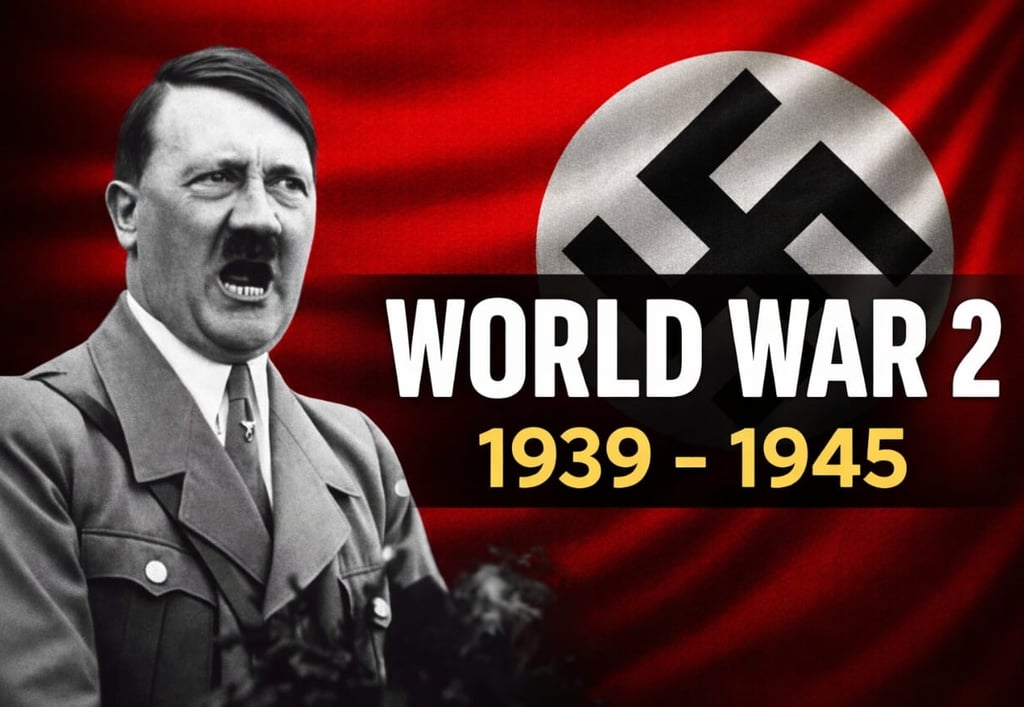
World War II, one of the deadliest conflicts in human history, lasted from 1 September 1939 to 2 September 1945. It involved over 100 million people from more than 30 countries, making it a truly global war. The conflict reshaped the political, economic, and social landscape of the world, led to the rise and fall of empires, and caused unprecedented human and material losses. Unlike World War I, WWII was marked not only by large-scale military engagements but also by strategic bombing, total war, and widespread atrocities against civilians. The war fundamentally altered the course of the 20th century.
The roots of World War II can be traced to unresolved issues from World War I. The Treaty of Versailles (1919) imposed severe penalties on Germany, including reparations, territorial losses, and military restrictions. These conditions created economic hardship, political instability, and widespread resentment among Germans, paving the way for extremist ideologies. The global economic depression of the 1930s further destabilized Europe, enabling Adolf Hitler and the Nazi Party to rise to power in 1933, promoting nationalist sentiment and anti-Semitic propaganda. Meanwhile, Benito Mussolini established a fascist regime in Italy, and Japan pursued imperial expansion in East Asia.
The immediate cause of the war was Germany’s aggressive territorial expansion. In March 1938, Germany annexed Austria in the Anschluss, violating the Treaty of Versailles. The Munich Agreement (1938) later allowed Germany to annex the Sudetenland region of Czechoslovakia. Despite these concessions, Hitler continued his expansionist policies. On 1 September 1939, Germany invaded Poland using the Blitzkrieg (“lightning war”) strategy, combining rapid movement of infantry, tanks, and air support. In response, Britain and France declared war on Germany on 3 September 1939, officially starting World War II.
In the early years, Germany achieved rapid victories. Poland fell within a month, followed by Denmark and Norway in April 1940. In May 1940, Germany invaded France, Belgium, the Netherlands, and Luxembourg. France fell in just six weeks, leading to the establishment of the Vichy government under German supervision. Britain, however, resisted through the Battle of Britain (1940), where the Royal Air Force successfully defended the skies against the Luftwaffe, marking Hitler’s first major defeat.
The Axis powers expanded aggressively in other regions. Italy invaded Ethiopia (1935) and later engaged in prolonged campaigns in North Africa against British forces. Japan pursued imperial ambitions in Asia, occupying Manchuria (1931) and launching a full-scale invasion of China in 1937. The Tripartite Pact (1940) formally aligned Germany, Italy, and Japan as the Axis powers, while Allied nations including Britain, France, China, the Soviet Union, and eventually the United States mobilized to oppose them.
A major turning point occurred in June 1941, when Germany launched Operation Barbarossa, invading the Soviet Union with over 3 million troops. While Germany initially made deep advances, harsh winter conditions, logistical challenges, and fierce Soviet resistance halted the offensive. The Eastern Front became the largest theater of war in history, resulting in millions of military and civilian casualties. Battles such as Stalingrad (1942-43) and Kursk (1943) marked the beginning of Germany’s retreat and the Soviet advance westward.
In the Pacific, Japan sought dominance through rapid conquests. On 7 December 1941, Japan attacked the U.S. naval base at Pearl Harbor, prompting American entry into the war. The Pacific theater witnessed intense naval and island battles, including Midway (1942), Guadalcanal (1942-43), and the Philippine liberation campaigns (1944-45). The U.S. adopted the “island-hopping” strategy, bypassing heavily fortified positions to advance closer to Japan.
The Allied response in Europe included the North African Campaign (1940-43), culminating in the defeat of German and Italian forces, followed by the invasion of Italy (1943) and the fall of Mussolini. The D-Day invasion (6 June 1944) marked the liberation of Western Europe, with over 156,000 Allied troops landing on Normandy’s beaches. Following D-Day, Allied forces advanced through France and into Germany, culminating in the fall of Berlin (May 1945) and Hitler’s suicide on 30 April 1945.
World War II was distinguished by its scale of destruction and human suffering. Estimates indicate 70-85 million deaths, including 25 million military personnel and around 50 million civilians, many due to bombing, massacres, forced labor, and starvation. The Holocaust led to the systematic murder of approximately 6 million Jews, alongside millions of others including Romani people, disabled individuals, and political dissidents. The atomic bombings of Hiroshima and Nagasaki in August 1945 contributed to Japan’s surrender and the war’s end.
Economically, Europe’s economies were devastated, while the United States emerged as a global superpower with a strong industrial base. The war accelerated technological advancements, including radar, jet aircraft, and nuclear weapons. Socially, women took on unprecedented roles in industry and military auxiliary services, and anti-colonial movements gained momentum as European powers weakened.
Politically, the war’s conclusion saw the establishment of the United Nations (1945) to prevent future global conflicts. Germany and Japan were occupied, restructured, and democratized under Allied supervision. The Soviet Union expanded its influence in Eastern Europe, setting the stage for the Cold War (1947-1991). The United States and USSR emerged as dominant superpowers, shaping international politics for decades.
World War II fundamentally reshaped the global order. It demonstrated the catastrophic consequences of totalitarianism, unchecked aggression, and global conflict while emphasizing the importance of international cooperation, human rights, and global governance. Its legacy continues to influence military strategy, diplomacy, and historical memory worldwide.
The war was not merely a military conflict but a transformative historical event, altering political, economic, and social structures globally. It serves as a stark reminder of the human cost of war, the dangers of extremism, and the necessity of international collaboration and diplomacy to maintain peace.
Stay informed with the latest national and international news.
© 2026. All rights reserved.