
World War I (1914-1918): Complete Historical Overview with Causes, Battles & Impact
Explore World War I (1914-1918) in detail: causes, key battles, human & economic losses, political changes, and global historical impact.
Raja Awais Ali
1/4/20264 min read
World War I (1914-1918): A Comprehensive Historical Overview
World War I, often referred to as "The Great War," was one of the deadliest and most destructive conflicts in human history. It began on 28 July 1914 and lasted until 11 November 1918, profoundly reshaping the political, economic, and social structures of the world. Nearly 30 nations participated, leading to the collapse or significant weakening of several major empires. The war emerged from a complex set of causes. European powers were engaged in imperial rivalries, particularly Britain, France, Germany, and Russia, competing for colonial influence and resources. Nationalist movements were also gaining momentum, especially in the Balkans, where Serbian nationalists sought to challenge Austro-Hungarian rule. At the same time, militarism escalated, with Germany and Britain expanding their armies and stockpiling modern weaponry. The complex system of alliances further heightened tensions, with two major blocs emerging: the Triple Entente (Britain, France, Russia) and the Central Powers (Germany, Austria-Hungary, Ottoman Empire, Bulgaria). Amid these tensions, a single event triggered a global conflict: on 28 June 1914, Austro-Hungarian heir Archduke Franz Ferdinand was assassinated by a Serbian nationalist in Sarajevo, sparking the outbreak of war.
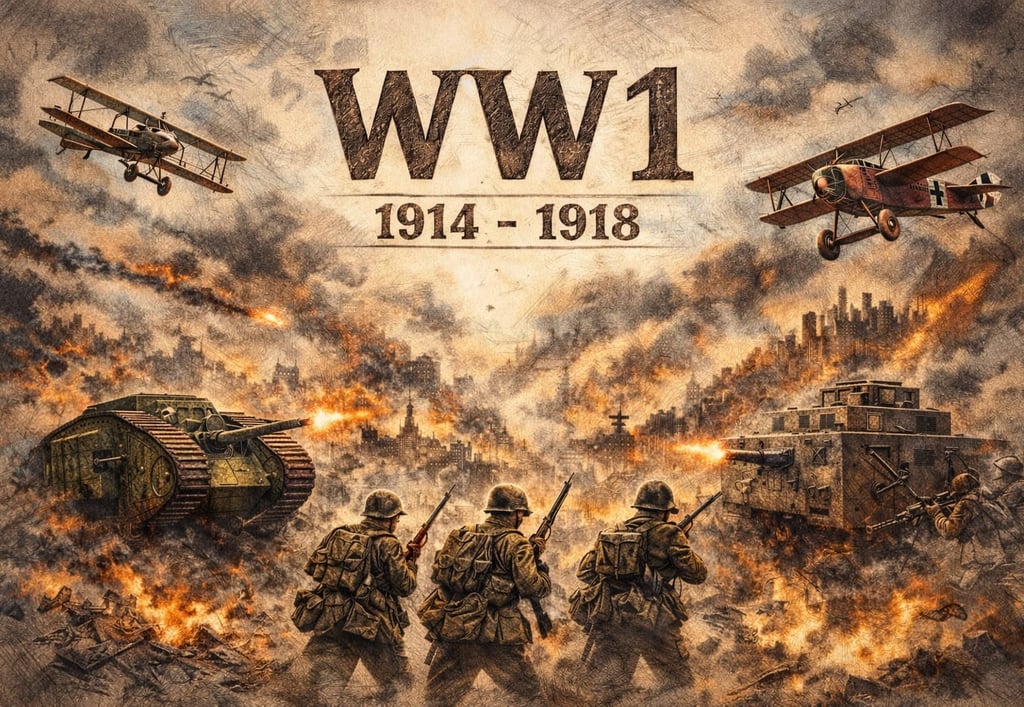
The war began in Europe but soon spread worldwide. Germany launched attacks on both eastern and western fronts under the Schlieffen Plan, invading France through Belgium. This violation of Belgian neutrality brought Britain into the war. The conflict saw multiple deadly fronts, with the Western Front witnessing some of the fiercest fighting in France and Belgium. The First Battle of the Marne (1914) halted Germany’s advance, while the Battle of the Somme (1916) resulted in nearly 1.2 million casualties, marking one of the bloodiest episodes in human history. On the Eastern Front, Germany decisively defeated Russia at the Battle of Tannenberg (1914). Italy joined the war against the Central Powers in 1915, while the Ottoman Empire fought British and Russian forces on several fronts, including the infamous Gallipoli campaign (1915-16). The war marked the first large-scale use of modern technology, including machine guns, tanks, chemical weapons, and airplanes. Trench warfare slowed movements and caused massive casualties, while aerial reconnaissance and bombing introduced a new dimension to combat.
The human cost of World War I was staggering. Approximately 16 million people—both soldiers and civilians—were killed, with an additional 21 million wounded. In Germany and Austria-Hungary, famine and disease claimed millions more lives. Economically, European nations were devastated, while the United States emerged as a global power due to its wartime industrial production, becoming the largest creditor nation. Food shortages and rising prices caused widespread hardship and social unrest. Politically and geographically, the war reshaped nations. Austria-Hungary disintegrated, giving rise to new states like Czechoslovakia and Yugoslavia, while the Ottoman Empire dissolved, and modern Turkey emerged. Germany, defeated, was forced to sign the Treaty of Versailles (1919), which imposed heavy reparations and territorial losses.
The war also brought significant social and cultural changes. Women entered factories and other wartime occupations, enhancing their social and economic roles. Literature and art reflected the devastating realities of the war, giving rise to modernist and anti-war movements. For the first time, ordinary people experienced the global scale of warfare, which heightened awareness of human rights and international peace initiatives. The war altered global power dynamics: the United States and Japan emerged as influential players, while the 1917 Russian Revolution led to the rise of the Bolsheviks and the global spread of communism. Germany’s economic hardships and the Treaty of Versailles set the stage for the rise of Nazism in the following decades.
World War I imparted crucial lessons about the dangers of militarism and unchecked nationalism. Advanced weaponry and industrial capacity amplified the destructive potential of war, and political disputes, if unresolved peacefully, could escalate into global catastrophes. This conflict was not merely a military engagement but a transformative event that changed the political map, economies, societies, and cultures of the world. With 16 million lives lost and billions of dollars in economic damage, it emphasized the importance of international cooperation, diplomacy, and the establishment of global laws to prevent future conflicts. The war serves as a reminder that sustainable peace can only be achieved through negotiation and collaboration, not through destruction and violence.
Globally, World War I opened a new chapter in human history. Germany’s economy was weakened, and postwar reparations fueled political instability. The Bolshevik Revolution in Russia introduced communism as a major factor in world politics. The collapse of Austria-Hungary and the Ottoman Empire reshaped Europe and the Middle East, creating new nations and political challenges. Culturally, literature, art, and journalism began to reflect the harsh realities of industrialized warfare. Women’s expanded role in wartime industries laid the groundwork for future movements toward gender equality. The war illustrated the devastating human, economic, and political consequences of large-scale conflict, underscoring the vital importance of peaceful solutions and international cooperation.
World War I was a defining moment in modern history. It was not just a military conflict but a global event that reshaped the trajectory of nations and societies. It highlighted the lethal consequences of nationalism, imperial ambition, and militarism. The lessons of this war resonate even today: conflicts should be resolved through dialogue and diplomacy, and the preservation of human life and global stability must remain a priority. Its legacy continues to shape international relations, military strategy, and cultural memory, reminding humanity of the profound costs of global warfare.
Stay informed with the latest national and international news.
© 2026. All rights reserved.