
World Leaders Caution Trump’s Board of Peace Plan Amid UN Role Fears | Jan 18, 2026
World leaders react cautiously to Donald Trump’s proposed Board of Peace, raising concerns over the UN’s role in global conflict resolution.
Raja Awais Ali
1/18/20263 min read
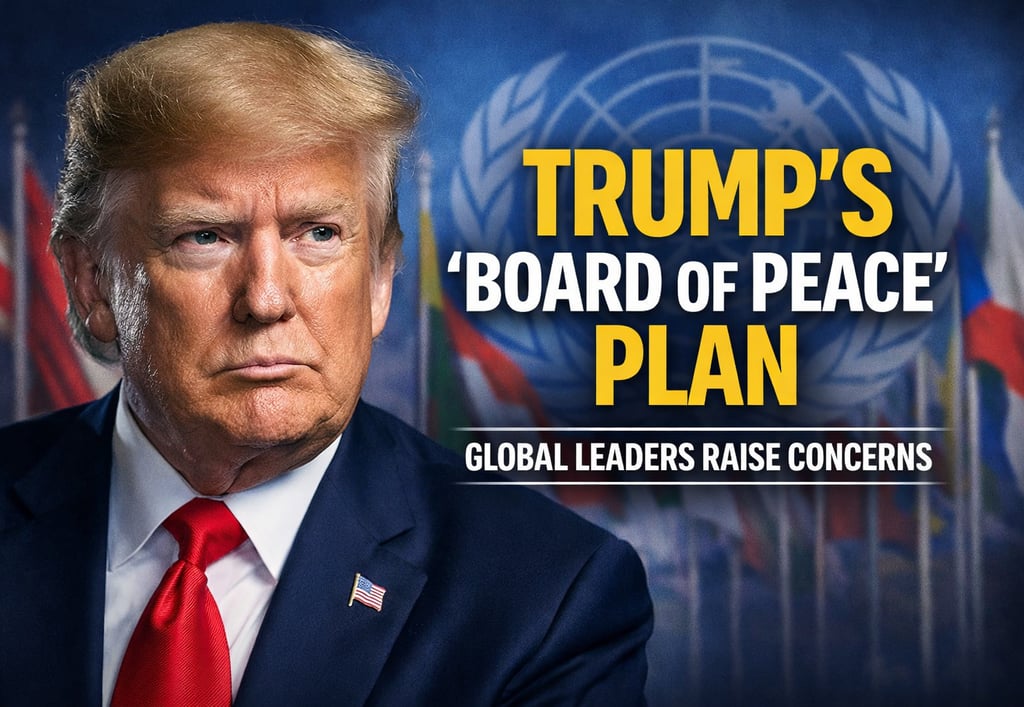
World Leaders Show Caution Over Trump’s Proposed “Board of Peace” Amid Growing UN Concerns
World leaders across Europe, North America, the Middle East, and Asia have reacted cautiously to U.S. President Donald Trump’s proposal to establish a global “Board of Peace,” raising concerns that the initiative could undermine the long-standing role of the United Nations in managing international conflicts. The proposal, revealed on 18 January 2026, has sparked intense diplomatic debate at a time of heightened global instability.
According to diplomatic sources, Trump has sent invitations to nearly 60 countries to join the proposed board, which would initially focus on ending the Gaza conflict before expanding its mandate to other global disputes. Trump has publicly argued that existing international institutions, particularly the United Nations, have become slow, ineffective, and constrained by bureaucracy, insisting that a new structure is needed to deliver “real peace through decisive leadership.”
Under the proposal, Trump would reportedly serve as chairman of the Board of Peace, while senior political figures such as U.S. Secretary of State Marco Rubio, former White House adviser Jared Kushner, and former UK Prime Minister Tony Blair are expected to play advisory roles. Draft documents circulating among diplomats also indicate that countries seeking permanent membership may be required to contribute up to $1 billion toward a proposed peace fund—an element that has drawn significant criticism.
Mixed Global Responses
Reactions from world capitals have varied widely. Hungary, led by Prime Minister Viktor Orbán, has emerged as one of the strongest supporters of the initiative. Hungarian officials described the plan as “a fresh opportunity to break diplomatic deadlocks” and welcomed Trump’s leadership role.
In contrast, Italy’s Prime Minister Giorgia Meloni adopted a more measured tone, stating that Italy supports peace efforts in Gaza but will carefully review the legal and political framework of the proposed board before making any commitment.
Canada, under Prime Minister Mark Carney, expressed conditional openness. Canadian officials emphasized that while Ottawa supports initiatives aimed at ending violence, any engagement must align with international law and existing UN resolutions. “The United Nations remains the cornerstone of global peace and security,” a Canadian government source said.
Several European Union member states have so far refrained from issuing official statements. However, EU diplomats speaking anonymously warned that parallel peace structures could weaken the UN’s authority and fragment international diplomacy. “Global peace cannot be managed through selective forums dominated by a few powerful actors,” one senior European diplomat noted.
Middle East and Asia Weigh In
In the Middle East, responses have been cautious and, in some cases, skeptical. Israeli Prime Minister Benjamin Netanyahu reportedly expressed concern that Israel was not formally consulted prior to the announcement. Israeli officials stressed that any peace framework must prioritize national security considerations and regional realities.
Pakistan also received an invitation to join the proposed Gaza peace board. Islamabad responded carefully, stating that Pakistan remains committed to peace efforts but believes that any sustainable solution must be rooted in United Nations resolutions and internationally recognized legal frameworks. The Pakistani Foreign Office emphasized that unilateral or alternative mechanisms cannot replace collective global consensus.
United Nations Concerns
Although the United Nations has not officially criticized the proposal, senior UN-affiliated diplomats have privately voiced unease. One senior official warned that bypassing the UN could erode decades of established peacekeeping norms. “The UN is the only institution where all nations—large and small—have an equal voice. Weakening that system could have dangerous long-term consequences,” the official said.
Analysts also point out that the financial requirement for participation could exclude developing nations, raising questions about inclusivity and legitimacy. Critics argue that peace initiatives must be based on diplomacy and consensus rather than financial capacity.
A Dividing Moment in Global Diplomacy
Trump’s “Board of Peace” has clearly exposed divisions in the international community. While some leaders view it as a bold attempt to shake up a stagnant system, many fear it represents a shift toward personalized diplomacy that could sideline established global institutions.
As of now, no country beyond Hungary has formally committed to full participation. Most governments appear to be waiting for clearer details regarding governance, legal authority, and coordination with the United Nations.
With global tensions running high, the coming weeks will determine whether Trump’s proposal evolves into a serious diplomatic mechanism or remains a controversial political statement. For now, world leaders are proceeding with caution, signaling that while peace is universally desired, the path toward it must remain credible, inclusive, and legally grounded.
Stay informed with the latest national and international news.
© 2026. All rights reserved.