
Winston Churchill: Complete Biography of Britain’s Legendary Leader
Explore the full life of Winston Churchill – childhood, military career, politics, WWII leadership, literary works, personal life, and legacy in one detailed biography.
Raja Awais Ali
1/5/20264 min read
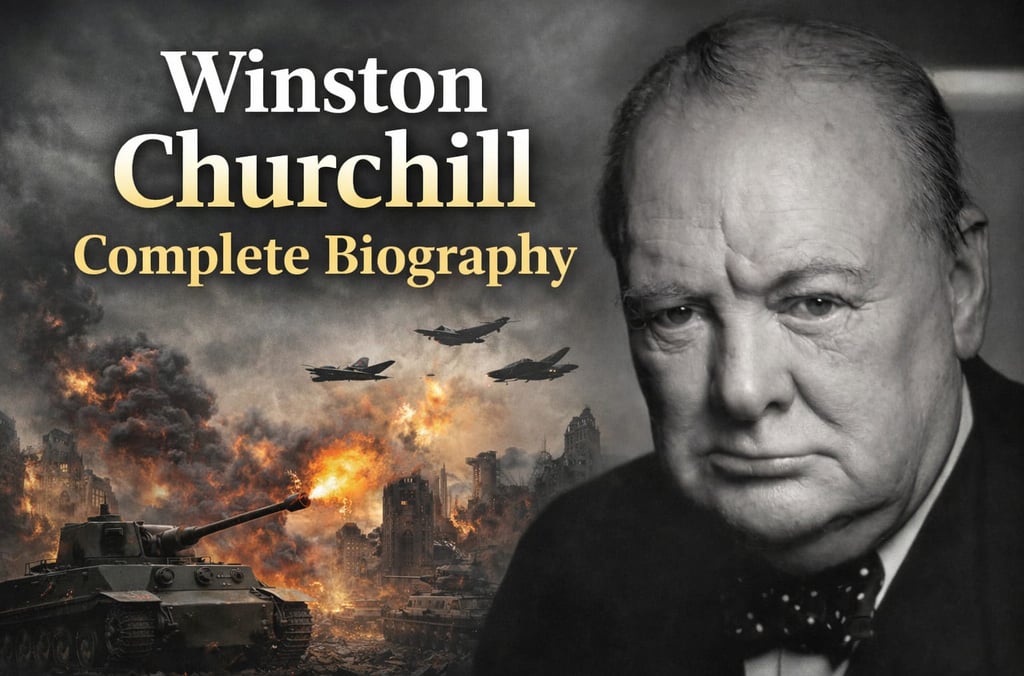
Winston Churchill: A Complete Biography
Sir Winston Leonard Spencer Churchill (1874–1965) was one of the most influential leaders of the 20th century, leaving an indelible mark on British politics, military strategy, world history, literature, and public oratory. His life story spans nearly a century of global events, wars, and political transformations, reflecting his relentless determination, vision, and leadership. Born on 30 November 1874 at Blenheim Palace, Oxfordshire, England, Churchill was the son of Lord Randolph Churchill, a prominent British politician, and Jennie Jerome, an American socialite. His early childhood was largely solitary as his parents were often absent due to political and social obligations, leaving him in the care of his nanny. Despite these challenges, his early exposure to books, history, and culture shaped his intellectual abilities and laid the foundation for his future as a leader.
Churchill’s school years at Harrow School were marked by academic struggle. He often ranked low in exams, which concerned his teachers, but he excelled in history, geography, and public speaking. His curiosity and independent spirit were evident early, and he often spent hours reading and reflecting on world affairs. Despite setbacks, he demonstrated a remarkable capacity for perseverance, which would define his future career. He later entered the Royal Military Academy, Sandhurst, where rigorous military training honed his strategic thinking, artillery skills, and leadership. Sandhurst provided him the skills and discipline necessary for his future military and political endeavors.
In 1895, Churchill joined the British Army and was commissioned into the Fourth Queen’s Own Hussars. His early postings included India, Cuba, and South Africa, where he gained practical military experience and observed international politics firsthand. In 1899, during the Second Boer War, Churchill worked as a war correspondent for The Morning Post. During this assignment, he was captured by Boer forces but managed a daring escape, earning him international fame and demonstrating courage, ingenuity, and resilience.
Churchill’s early military career gave him not only practical battlefield experience but also insights into leadership and strategy, which proved crucial in his later political and military roles. After the Boer War, he continued to serve in various military and journalistic capacities, observing campaigns in India and South Africa and reporting on conflicts, building both his reputation and practical knowledge.
In 1900, Churchill was elected to the British Parliament for the first time. Initially a Conservative, he later joined the Liberal Party. Over his political career, he held multiple significant offices, including First Lord of the Admiralty, Chancellor of the Exchequer, and finally Prime Minister in 1940. Churchill’s political vision emphasized military preparedness, national unity, and strong foreign policy. He frequently warned against the rising threat of Nazi Germany when many contemporaries preferred appeasement.
As Prime Minister during World War II, Churchill became the face of British resilience. His speeches, including the famous “We shall never surrender”, inspired the nation during its darkest hours. He coordinated with Allied leaders, including Franklin D. Roosevelt and Joseph Stalin, to develop strategies that ultimately led to the defeat of Nazi Germany. Major military operations under his leadership included the Battle of Britain, the North African campaign, D-Day, and the Italian campaign. His strategic insight and insistence on unity and determination saved Britain from potential defeat and reinforced its status as a global power.
Churchill’s speeches remain legendary for their rhetorical power and motivational quality. Quotes such as, “History will be kind to me for I intend to write it”, and “Never, never, never give in” exemplify his indomitable spirit. These orations not only strengthened British morale but continue to serve as a model for leadership worldwide.
Apart from politics, Churchill was an accomplished writer and historian. His six-volume series, The Second World War, is a masterpiece of historical analysis, blending personal experience with rigorous research. He also authored A History of the English-Speaking Peoples and numerous other works. In recognition of his literary contribution, he was awarded the Nobel Prize in Literature in 1953. Churchill was also an avid painter, completing over 500 artworks during his lifetime, which are still exhibited globally.
Churchill’s personal life was equally rich. He married Clementine Hozier in 1908, and together they had five children. Churchill enjoyed painting, reading, gardening, and other intellectual pursuits. His relationship with the British monarchy, particularly Queen Elizabeth II, was characterized by mutual respect, though occasionally marked by differences due to his assertive personality. Personal accounts suggest that the Queen valued his counsel but sometimes found his outspokenness challenging.
Churchill’s health declined in his later years, exacerbated by his intense lifestyle and the pressures of leadership. He suffered several strokes and other age-related illnesses. On 24 January 1965, at the age of 90, he passed away, with the official cause being stroke-related complications. His final days were spent reflecting with family and close friends. His state funeral at St. Paul’s Cathedral was attended by millions, and world leaders honored him as one of history’s greatest statesmen.
Churchill’s legacy endures as a symbol of courage, leadership, and intellect. He left behind a profound impact on military strategy, political leadership, literature, and public life. His life demonstrates that determination, vision, and resilience can shape nations and leave a lasting mark on history. From the battlefields of South Africa to the corridors of Downing Street, Winston Churchill’s story remains a testament to the power of unwavering leadership and the pursuit of principles in the face of adversity.
Stay informed with the latest national and international news.
© 2026. All rights reserved.