
Venezuela Responds to Trump’s Controversial Post with Symbolic Social Media Campaign | January 20, 2026
Venezuela launches a symbolic social media campaign to assert national sovereignty after Trump’s controversial post. Full analysis of Jan 20, 2026 events.
Raja Awais Ali
1/20/20262 min read
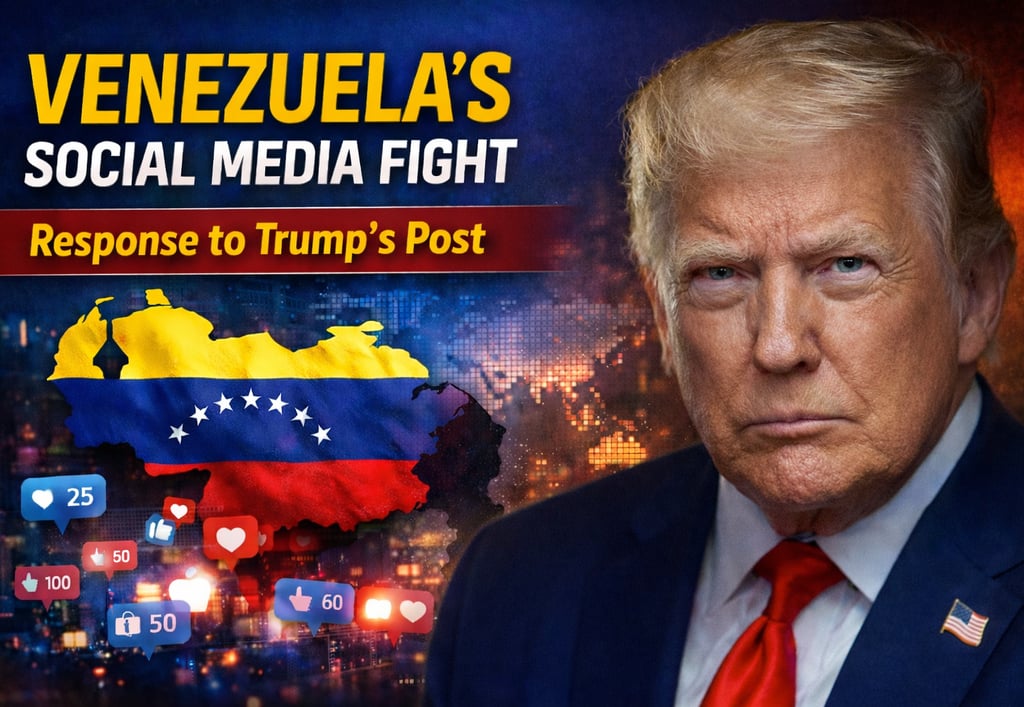
Venezuela Launches Symbolic Social Media Campaign in Response to Trump Post
January 20, 2026 — Venezuela has announced a symbolic social media initiative following a controversial post by U.S. President Donald Trump. The campaign aims to highlight Venezuela’s national identity and territorial sovereignty online. The government has urged citizens to share official maps and national symbols on social media to assert the country’s stance on the international stage.
Trump’s post included an altered map depicting Venezuela, Canada, and Greenland as part of the United States. This post caused global political reactions and drew widespread criticism. Venezuela’s government condemned the post as a violation of international norms, emphasizing that the nation’s borders and sovereignty are inviolable.
This symbolic campaign gained prominence after President Nicolás Maduro and his wife Cilia Flores, were detained and transported to New York, sparking political tensions both domestically and internationally. Venezuela has always held a significant position in global politics due to its abundant natural resources, particularly oil, possessing some of the world’s largest oil reserves. This has made Venezuela’s political future a key concern for major global powers.
The U.S. intervention has further intensified the political crisis in Venezuela. Trump not only announced his intention to govern Venezuela temporarily following Maduro’s detention but also shared content on social media that raised political and constitutional debates.
This incident has also highlighted a growing cyber and media information war. It has become evident that posts shared by Trump, including images and maps, are not always factually accurate and may include content generated by artificial intelligence. Such misinformation can directly influence public opinion, political pressure, and international diplomatic relations.
Internationally, reactions have been mixed. Some countries criticized U.S. policies, while others voiced support for Venezuela’s sovereignty and constitutional government. European nations and international organizations have refrained from recognizing interim or unverified governments, advocating for peaceful negotiations and diplomatic solutions instead of military intervention.
Venezuela’s symbolic social media campaign aims not only to respond to Trump but also to amplify the country’s voice globally. Official maps and symbols serve as a cultural and political statement, emphasizing that the nation’s borders and identity are recognized under international law and must be protected.
This initiative comes at a time when global politics are increasingly complex, media-driven, and influenced by emotional debates. Public and online reactions can play a significant role in shaping governmental policies and diplomatic relations.
Venezuela’s action is more than just symbolic. It sends a strong political message, asserting the country’s sovereignty, national identity, and territorial integrity on a global scale. The campaign has united Venezuelan citizens while drawing international attention to the country’s political and territorial stance.
Stay informed with the latest national and international news.
© 2026. All rights reserved.