
U.S. Supreme Court Tackles U.S.–Cuba Business Disputes: Billions at Stake | 2026
Supreme Court reviews Helms‑Burton Act cases on Cuban property claims. ExxonMobil & cruise lines face $ billions lawsuits. Latest update 22 Feb 2026.
Raja Awais Ali
2/22/20263 min read
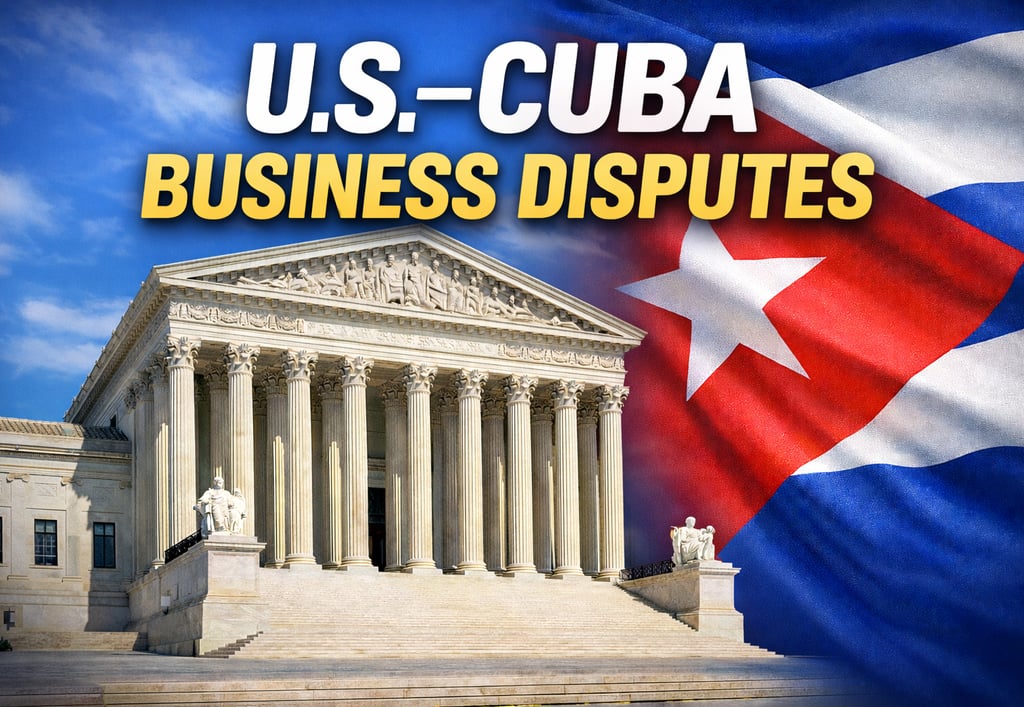
U.S. Supreme Court Tackles U.S.–Cuba Business Disputes: Billions at Stake
On February 22, 2026, the U.S. Supreme Court took a decisive step into a long-standing dispute that has both financial and geopolitical consequences: the conflict over property seized by Cuba decades ago and the lawsuits emerging from that. At the heart of the matter is the Helms‑Burton Act of 1996, a U.S. law allowing American citizens and companies to seek compensation for property confiscated by Cuba after the 1959 revolution. Though the law has existed for more than three decades, its most controversial section — Title III — remained suspended by multiple presidents until 2019, when its activation ignited a wave of lawsuits now reaching the Supreme Court.
The current cases are about far more than money. They involve questions of sovereignty, corporate accountability, and the reach of U.S. law over foreign entities. How the Supreme Court rules will determine whether American claimants can pursue billions in damages from Cuban state-owned enterprises or foreign companies doing business in Cuba.
Two cases are particularly prominent. The first involves ExxonMobil, whose oil and gas facilities in Cuba were seized in 1960. ExxonMobil claims these assets, now controlled by CIMEX, a Cuban state-owned company, have generated profits that rightfully belong to the original owners. The company is seeking more than $1 billion in compensation, challenging prior rulings that shielded CIMEX under the doctrine of foreign sovereign immunity. This case raises complex legal questions: Can foreign state-owned companies be sued in U.S. courts? How should historical expropriation be evaluated decades after the fact?
The second case centers on Havana Docks Corporation, which owned port facilities in Havana before the revolution. Havana Docks alleges that four major cruise companies — Carnival, Royal Caribbean, Norwegian Cruise Line, and MSC Cruises — “trafficked” in confiscated property when they used these docks between 2016 and 2019. Initially, Havana Docks was awarded $440 million, but an appeals court overturned this decision. The Supreme Court is now tasked with clarifying whether Title III allows claimants to pursue damages from foreign companies profiting indirectly from seized property.
Legal experts have highlighted several key questions: Can non-U.S. companies be held accountable in U.S. courts for using confiscated property? Must claimants prove they would still hold the property today if it hadn’t been seized? How broadly can the Supreme Court interpret Title III without violating international legal norms? The answers could reshape global business strategy, particularly for companies investing in countries with a history of nationalization or confiscation.
The financial implications are substantial. Cuba’s confiscated properties — including oil refineries, factories, power plants, and agricultural land — are collectively valued in the billions of dollars. For example, ExxonMobil’s claim alone exceeds $1 billion, while Havana Docks’ alleged losses from cruise line use could reach several hundred million dollars. If the Court rules in favor of claimants, it could create a ripple effect, prompting foreign companies worldwide to reassess investments in countries with contested property histories.
The cases also carry diplomatic weight. Countries with companies operating in Cuba, such as Canada and Spain, have historically criticized Title III, arguing that it risks violating international norms and creating uncertainty for global investors. While the Supreme Court focuses strictly on the application of U.S. law, its ruling will inevitably influence U.S.–Cuba relations, potentially affecting future trade and investment agreements.
Moreover, the cases touch on the human and ethical dimension. For American citizens whose property was confiscated decades ago, these lawsuits represent a long-awaited pursuit of justice and recognition of rights. For companies facing claims, the ruling will shape how they approach foreign investments involving disputed assets, balancing legal risk with ethical responsibility.
This dispute is also historically significant. The confiscations date back to the Cuban Revolution of 1959, which saw widespread nationalization of U.S.-owned properties, including oil refineries, sugar plantations, and port facilities. The Helms-Burton Act was enacted in 1996 to give U.S. citizens a legal avenue for restitution, but Title III remained dormant for decades due to presidential suspensions aimed at avoiding international tensions. The reactivation in 2019 revived these dormant claims and has now brought them to the highest court in the land.
The Supreme Court’s decision will have far-reaching implications. Legally, it could redefine how Title III is applied and whether U.S. claimants can hold foreign companies accountable. Economically, it could alter the investment landscape for multinational corporations and influence global business risk calculations. Politically, it could send signals about the U.S.’s stance on property rights, international law, and relations with Cuba.
In practical terms, these rulings will likely guide how companies navigate historical property disputes in the future. Investors may become more cautious, especially in regions where governments have a history of seizing foreign-owned assets. At the same time, successful claims could encourage more individuals and businesses to pursue restitution under Title III, potentially unlocking billions in compensations.
In conclusion, the Supreme Court is not simply deciding two lawsuits. It is interpreting decades-old property law, assessing historical grievances, and setting a precedent at the intersection of law, commerce, and diplomacy. Observers expect a decision by mid-2026, which could redefine U.S. jurisdiction over foreign entities, influence global investment decisions, and shape U.S.–Cuba relations for years to come.
Stay informed with the latest national and international news.
© 2026. All rights reserved.