
US Supreme Court Blocks Trump Global Tariffs | February 20, 2026 Landmark Ruling Explained
Supreme Court strikes down Trump’s global tariffs in a historic 6–3 ruling. Full analysis, affected countries, revenue impact, and constitutional implications.
Raja Awais Ali
2/20/20263 min read
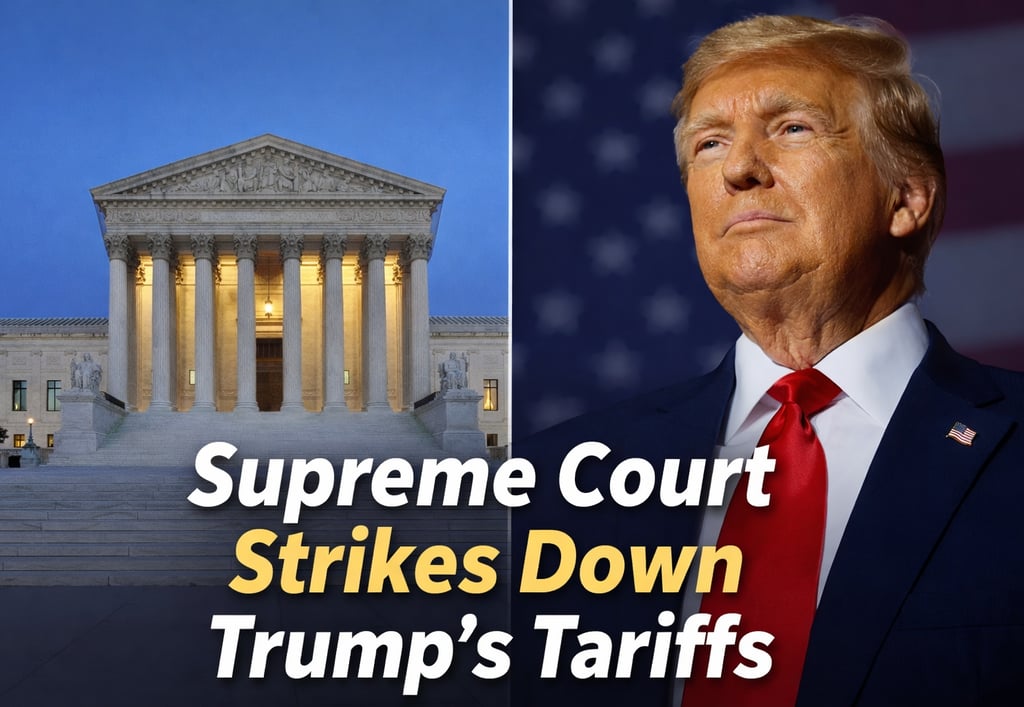
US Supreme Court Strikes Down President Trump’s Global Tariffs: Full Analysis, Economic Impact, and Global Trade Effects
On February 20, 2026, the US Supreme Court issued a landmark ruling, declaring President Donald Trump’s expansive global tariff program unconstitutional. In a 6–3 decision, the Court determined that the President had exceeded his authority under the International Emergency Economic Powers Act (IEEPA) by imposing tariffs on a wide range of imports without explicit congressional approval. The ruling emphasizes that taxation and tariffs fall primarily under congressional authority, and executive actions with major economic consequences require clear legislative authorization.
Background of the Tariffs
The tariffs, introduced by President Trump as “Reciprocal Tariffs,” were designed to address the U.S. trade deficit, which reached $948 billion in 2025, and to protect domestic industries. The administration argued that several countries imposed disproportionately high tariffs on American exports, justifying a proportional response.
Tariffs were imposed on a variety of countries, targeting key trading partners:
China: 25–35% tariffs on industrial goods, technology products, and electronics.
European Union: 20% tariffs on automobiles, steel, aluminum, and machinery.
Canada: 15% tariffs on automotive components and selected agricultural products.
Mexico: 18% tariffs on manufacturing parts, steel, and agricultural exports.
Japan: 12–20% tariffs on vehicles, electronics, and industrial machinery.
South Korea: 10–22% tariffs on steel, semiconductors, and consumer electronics.
India: 10–18% tariffs on textiles, steel, and electronics.
The White House claimed these measures would protect U.S. jobs, encourage domestic manufacturing, and pressure other nations to negotiate fairer trade deals. Critics, however, warned that the tariffs increased costs for U.S. consumers and disrupted supply chains, particularly for small and medium-sized businesses.
Economic Impact
According to the Penn-Wharton Budget Model, the tariff program generated approximately $175–182 billion in additional revenue. If the Supreme Court ruling mandates refunds, the federal government could face significant financial obligations, potentially exceeding $180 billion. Such repayments could affect federal budgeting and planned infrastructure investments.
Consumers and businesses bore the cost of higher import prices, with studies indicating that goods such as vehicles, electronics, and industrial machinery saw price increases of 6–9% on average. Small manufacturers faced increased production costs, which in some cases led to layoffs or reduced investment.
Market Reactions
Following the Supreme Court announcement, U.S. stock markets reacted positively, particularly in sectors previously burdened by tariffs. Automotive, industrial manufacturing, and technology stocks experienced gains, reflecting investor optimism about reduced trade tensions. European and Asian markets also benefited, with financial analysts noting that the decision could restore predictability in global trade.
The ruling’s effect on global commerce is considerable. Economists expect a reduction in trade conflicts and a more balanced negotiation environment for international trade agreements. Multinational companies may adjust their supply chains in response to the removal of certain U.S. tariffs, potentially improving efficiency and reducing costs.
Constitutional Significance
Beyond economics, the ruling reinforces the constitutional separation of powers. The Court clarified that emergency powers under IEEPA cannot be used to unilaterally impose major tariffs with global implications. The three dissenting justices argued that the President requires flexibility to protect the national economy from unfair trade practices, but the majority ruled that large-scale tariffs are major policy decisions that must originate in Congress.
This precedent has long-term implications for future administrations. Any attempt to impose sweeping trade measures without congressional approval is now legally constrained, reinforcing legislative oversight in matters of taxation, tariffs, and trade policy.
Global Implications
Countries affected by the tariffs are closely monitoring the ruling. China and the European Union, the two largest trade partners targeted, could see adjustments in trade volumes and tariff negotiations. Canada, Mexico, and other nations with closely integrated supply chains with the U.S. may experience relief in import costs, which could stabilize cross-border commerce.
Trade experts predict that the removal of these tariffs may slightly reduce inflationary pressures in the U.S., particularly on imported goods. It also signals to international markets that U.S. trade policy will be more predictable, potentially encouraging foreign investment.
Conclusion
The Supreme Court’s ruling represents a major legal, economic, and political turning point. It limits executive power, reinforces congressional authority over taxation and trade, and reshapes the framework for U.S. global trade policy. While the immediate impact involves refunds and market adjustments, the long-term effect establishes clear boundaries for future presidents and provides stability for domestic and international stakeholders.
This decision not only affects President Trump’s current trade strategy but also sets a precedent for all future administrations. Economists, policymakers, and investors alike will be closely watching its effects on markets, industries, and global commerce in the months and years ahead.
Stay informed with the latest national and international news.
© 2026. All rights reserved.