
Exclusive: US Held Secret Talks With Hardline Venezuelan Minister Diosdado Cabello Months Before Raid
Exclusive report reveals the US held quiet talks with Venezuelan powerbroker Diosdado Cabello months before a major raid, highlighting Washington’s covert strategy.
Raja Awais Ali
1/17/20262 min read
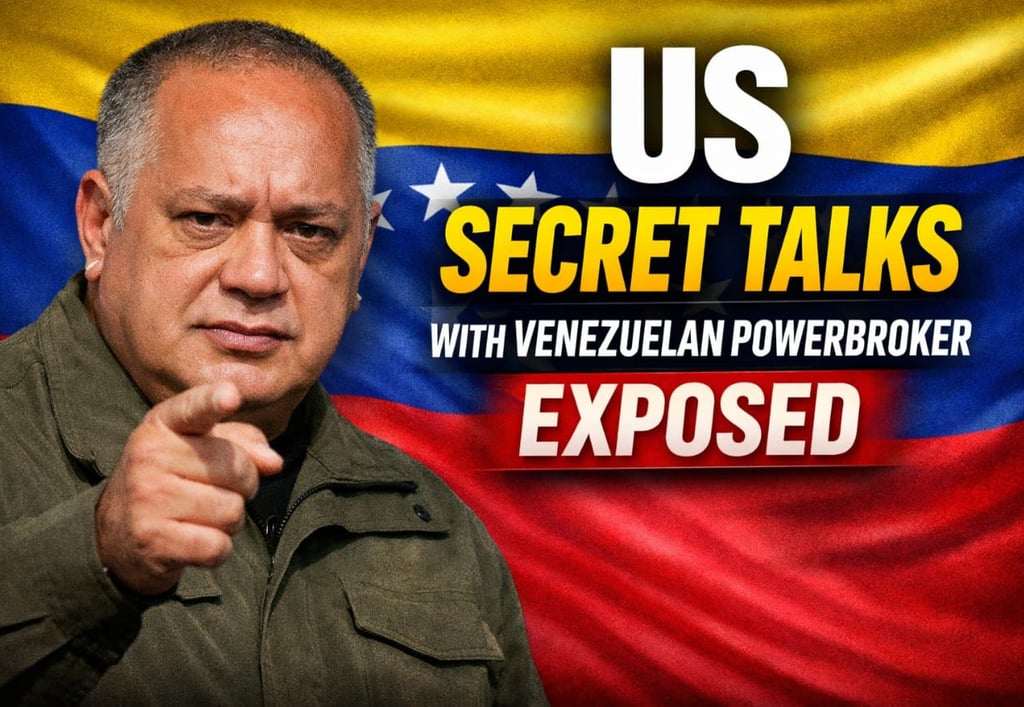
Exclusive: US Held Secret Talks With Hardline Venezuelan Minister Diosdado Cabello Months Before Raid
An exclusive revelation has emerged showing that the United States quietly initiated backchannel talks with Venezuela’s hardline interior minister and influential political figure, Diosdado Cabello, months before a sensitive security operation that later drew international attention. The disclosure sheds new light on Washington’s behind-the-scenes strategy during Venezuela’s prolonged political crisis.
According to well-informed diplomatic and security sources, the contacts were neither formal negotiations nor publicly acknowledged diplomatic meetings. Instead, they were discreet communications designed to prevent large-scale violence, contain institutional collapse, and manage the risk of uncontrolled escalation during a critical phase of Venezuela’s power struggle.
Diosdado Cabello is widely regarded as one of the most powerful figures within Venezuela’s political and security structure. A longtime ally of the late Hugo Chávez, Cabello has retained deep influence over police units, intelligence networks, and armed civilian groups. His reach inside the country’s security apparatus made him a key figure that US officials believed could not be ignored.
Sources indicate that the US approach was driven by pragmatic concerns rather than ideological alignment. American officials reportedly conveyed clear warnings about the consequences of widespread repression, civilian casualties, and the use of armed loyalist groups against political opponents. The discussions emphasized restraint within security forces and the importance of avoiding a spiral into mass violence or civil conflict.
These contacts reportedly began well before the January security raid that reshaped Venezuela’s political landscape. The timing suggests that Washington’s strategy extended beyond immediate operational goals and included contingency planning for a post-crisis environment. Officials sought to understand internal power dynamics and prevent chaos during any transition.
Despite Cabello’s long history of anti-American rhetoric and accusations of human rights abuses, US policymakers viewed engagement as a necessary step to address realities on the ground. Diplomatic insiders stress that the talks did not signal endorsement, concessions, or immunity, but rather reflected an attempt to mitigate worst-case scenarios.
Even after the establishment of an interim leadership framework in Venezuela, Cabello’s position has not fully eroded. Analysts note that he continues to wield influence across segments of the security sector, posing a challenge for stabilization efforts. This ongoing leverage explains why international actors remain attentive to his role despite official denials.
Publicly, Cabello has dismissed any claims of secret engagement, accusing Washington of interference in Venezuela’s internal affairs. He has reiterated that Venezuela will not accept foreign pressure and insists that national sovereignty remains non-negotiable. His statements, however, contrast with mounting evidence of behind-the-scenes communication.
Political analysts argue that the episode illustrates a broader pattern in US foreign policy, where strategic necessity sometimes overrides public posture. While Washington has consistently criticized authoritarian governance in Venezuela, it has also shown willingness to quietly engage powerful insiders to prevent humanitarian disaster and regional instability.
The revelation has sparked debate over whether such covert diplomacy undermines stated commitments to democracy and accountability. Supporters argue it helped avert large-scale bloodshed, while critics warn it risks legitimizing figures accused of repression.
Ultimately, the disclosure highlights how modern geopolitics often unfolds far from public view. As Venezuela continues to navigate an uncertain political future, the long-term impact of these secret contacts remains unclear. What is evident, however, is that power, influence, and security calculations continue to shape decisions more than public declarations.
Stay informed with the latest national and international news.
© 2026. All rights reserved.