
U.S.–Israel Air War Escalates: Iran, Hezbollah, and Gulf Crisis – March 2026 Update
Explore the latest verified news on the U.S.–Israel air campaign against Iran. Iran retaliates with missiles and drones, Hezbollah strikes Israel, Kuwait downs U.S. jets. Full analysis, casualties, and global impact.
Raja Awais Ali
3/2/20262 min read
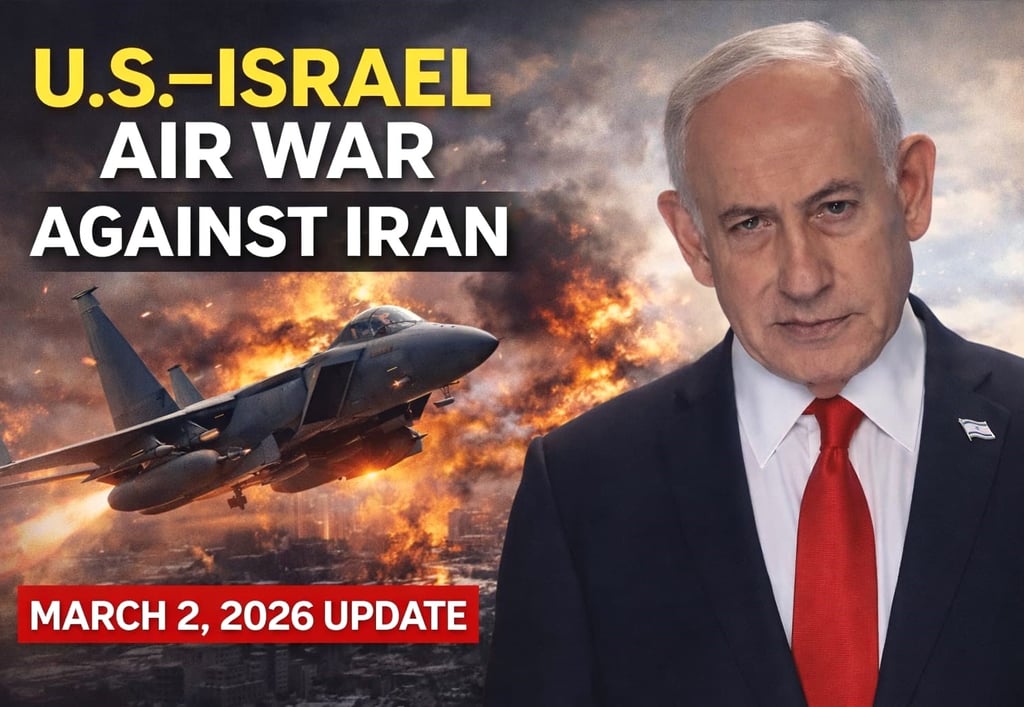
U.S.–Israel Air War Against Iran Escalates: March 2, 2026 Update
The U.S.–Israeli air campaign against Iran has reached unprecedented intensity as of March 2, 2026, with no clear end in sight. Israel retaliated against Hezbollah strikes by targeting southern Lebanon, while Iran responded with missile and drone attacks across Gulf states and even European U.S. bases. The escalating conflict has disrupted global energy markets and threatened the pace of economic recovery worldwide.
Over the weekend, Iran’s Supreme Leader, Ayatollah Ali Khamenei, aged 86, was killed in targeted airstrikes. Khamenei, who had ruled Iran for 37 years and directed national security forces, leaves behind a nation in political and social turmoil, with reactions ranging from celebration to fear and uncertainty.
Kuwait Friendly Fire Incident
In a major operational complication, Kuwait mistakenly shot down three U.S. F‑15E fighter jets amid Iranian attacks in the region. All six U.S. aircrew survived and were safely recovered, highlighting the dangers of friendly fire during complex military operations.
Iranian Retaliation Across Gulf States
Iran launched a wave of ballistic missiles, drones, and aircraft targeting Gulf allies, including Kuwait, Qatar, Saudi Arabia, Bahrain, and the UAE. Explosions and fires were reported across key urban centers, raising civilian alarm. Qatar halted its LNG production, while Saudi Arabia shut down its largest refinery after drone strikes caused a fire.
Hezbollah Opens a New Front in Lebanon
Hezbollah launched missiles and drones toward northern Israel, prompting Israeli airstrikes in southern Beirut. Reports indicate at least 31 killed and 149 injured, while Hezbollah deputy leader Naim Qassem was named a “target for elimination.” Lebanon’s government has restricted Hezbollah military activity, although a ground invasion remains unlikely at this stage.
U.S. Military Objectives and Timeline
Pentagon officials emphasized that the air campaign is not a short-term operation. According to General Dan Caine, over 1,000 targets were hit in the first 24 hours, and additional forces are being deployed. Defense Secretary Pete Hegseth stated that the campaign’s duration depends on presidential decisions, highlighting the complex and prolonged nature of the operation.
Nuclear Claims and Political Messaging
Iran continues to deny pursuing nuclear weapons, asserting that it was ready to negotiate reductions in its nuclear program before the U.S. launched attacks. President Donald Trump urged Iranian citizens to rise against their leaders, warning that airstrikes could continue for weeks.
U.S. Casualties and Regional Risk
The U.S. Central Command confirmed the deaths of four American service members, with initial casualties occurring at a base in Kuwait. Political risks loom large in the U.S., where only about 25% of Americans approve of the ongoing operation, signaling potential domestic consequences.
Global Economic Implications
Disruptions to oil shipments through the Strait of Hormuz—critical for approximately 20% of global oil trade—sent oil prices soaring. Stock markets declined, and the U.S. dollar strengthened amid mounting uncertainty. Iran’s Revolutionary Guards reported targeting three U.S. and U.K. oil tankers, while major international airports remained closed, heavily affecting global air travel.
International Responses
European allies, initially cautious, are now offering support to limit Iran’s retaliatory capabilities while advocating for diplomatic solutions. Iran, however, maintains its stance, with senior advisers, including Ali Larijani, refusing negotiations with the U.S. under current conditions.
Conclusion
As of March 2, 2026, the conflict has expanded beyond Iran, involving Lebanon, Gulf states, and U.S. assets in Europe. While airpower dominates the battlefield, experts caution that without ground operations, achieving total control over Iran’s military and political infrastructure will be challenging. The situation underscores the urgent need for diplomatic intervention to prevent further regional destabilization.
The human, political, and economic consequences of this multi-front war are poised to reshape Middle Eastern geopolitics and reverberate globally.
Stay informed with the latest national and international news.
© 2026. All rights reserved.