
US-Iran Talks in Islamabad 2026: Frozen Funds, Strait of Hormuz Crisis, Lebanon War & Major Diplomatic Breakthrough
US and Iran hold high-level talks in Islamabad over frozen funds, Strait of Hormuz tensions, and Lebanon conflict amid global energy crisis 2026.
Raja Awais Ali
4/11/20264 min read
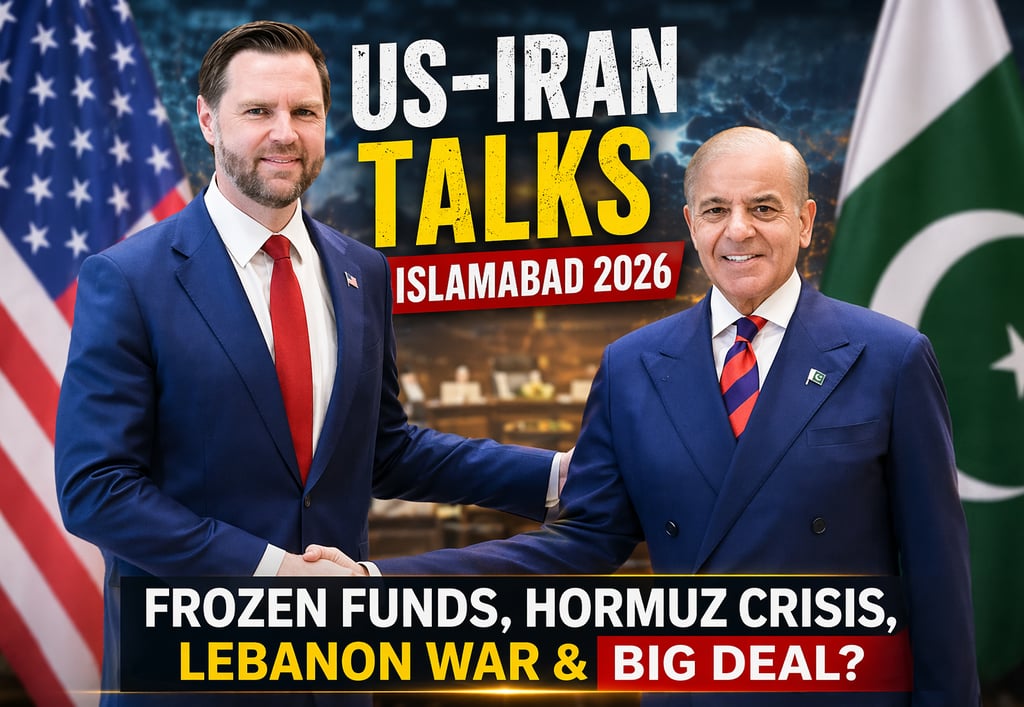
US-Iran Talks 2026: Frozen Funds, Strait of Hormuz Crisis, Lebanon War and Historic Diplomatic Engagement in Islamabad
On April 11, 2026, global politics has entered a highly sensitive and decisive phase as the United States and Iran engage in high-level negotiations in Islamabad, Pakistan, aimed at ending a six-week-long conflict. The talks, held in the capital Islamabad, represent not only an attempt to end the war but also a critical effort to stabilize global energy markets, international trade routes, and regional security dynamics.
A major and controversial development has added complexity to the diplomatic process. A senior Iranian source claimed that the United States has agreed in principle to unfreeze Iranian assets held in Qatar and other foreign banks. However, a US official quickly denied the claim, stating that no confirmed agreement has been made.
According to the Iranian source, the issue was part of messages already communicated to the United States prior to formal negotiations. Tehran reportedly views this possible move as a sign of Washington’s seriousness in reaching a broader agreement.
A second Iranian source further claimed that the US may release approximately 6 billion dollars in frozen Iranian funds held in Qatar. However, Qatar’s foreign ministry has not issued any official response, leaving the situation uncertain.
These funds were originally frozen in 2018 when Donald Trump withdrew from the nuclear agreement and reimposed strict sanctions on Iran. The money originated from Iranian oil sales to South Korea, which were later blocked in international banking channels due to US sanctions.
In September 2023, under a Qatar-mediated prisoner swap agreement, the funds were transferred into Qatari bank accounts. The deal included the release of five US citizens held in Iran in exchange for five Iranian prisoners held in the United States.
At that time, US authorities stated that the funds could only be used for humanitarian purposes, including food, medicine, medical equipment, and agricultural imports, under strict US Treasury oversight.
However, the Biden administration re-froze the assets after the October 7, 2023 regional escalation involving Iran’s allied groups, particularly following the Hamas attack on Israel, and in coordination with Qatar moved to block Iran’s access to the funds held in restricted accounts, stating that Iran would not regain access in the near future.
Iran has linked the potential release of these funds directly to guarantees over safe navigation in the Strait of Hormuz, which has become a central issue in the negotiations.
The Strait of Hormuz is one of the world’s most critical energy routes, responsible for nearly 20 percent of global oil shipments. Iran is reported to have increased its influence over the region and is also seeking the ability to impose transit fees on commercial shipping, raising global concerns.
As a result, global oil prices have surged by nearly 50 percent, significantly increasing inflation and placing pressure on the global economy.
The Islamabad talks are considered historically significant as they represent the highest-level US-Iran engagement since the 1979 Iranian Revolution. If direct negotiations take place, it would mark the first major diplomatic breakthrough since the 2015 nuclear agreement.
The US delegation is led by Vice President JD Vance and includes Steve Witkoff and Jared Kushner. The delegation arrived in Islamabad aboard US Air Force aircraft and was received by Pakistan’s Army Chief Asim Munir and Foreign Minister Ishaq Dar.
The Iranian delegation is led by Mohammad Baqer Qalibaf and Foreign Minister Abbas Araghchi. The delegation arrived a day earlier and was seen wearing black attire as a sign of mourning for Iran’s Supreme Leader Ali Khamenei and other casualties of the ongoing conflict.
Reports also indicate that the Iranian delegation brought symbolic items, including shoes and bags belonging to students killed in a school strike, highlighting the humanitarian dimension of the conflict.
Pakistan has played a key mediating role in facilitating communication between both sides. Preliminary discussions were held with advance teams from both delegations. According to a source, Pakistan is expected to deliver the initial US response to Iran, and if Tehran accepts it, direct negotiations may begin.
A Pakistani official stated that there is no fixed timeline for the talks, and it remains unclear when or whether they will conclude.
Iran has clearly stated that negotiations cannot begin unless there is a confirmed commitment to a ceasefire in Lebanon and easing of economic sanctions.
The Lebanon conflict remains a major obstacle, with Hezbollah and Israeli forces engaged in intense fighting that has reportedly resulted in around 2,000 deaths since March.
Heavy strikes continue in southern Lebanon, while in Beirut, Israeli drones were reportedly heard overnight, and warplanes broke the sound barrier twice, indicating ongoing escalation.
Hezbollah has also claimed multiple military operations targeting Israeli positions both inside Lebanon and across the northern border.
Israel and Lebanon are expected to hold talks in Washington on Tuesday, although both sides differ on whether the talks are aimed at a ceasefire or the beginning of formal peace negotiations.
Bilawal Bhutto Zardari stated that successful negotiations require all allied parties to be included in the ceasefire framework to ensure meaningful dialogue.
Meanwhile, Donald Trump announced a two-week ceasefire earlier in the week, after which US and Israeli strikes were paused. However, tensions in the Strait of Hormuz and the Lebanon conflict remain unresolved.
Trump also stated that Iran has “no leverage” and accused it of using international waterways for strategic pressure, adding that Iran’s survival is tied to negotiations.
Vice President JD Vance stated that the US expects a positive outcome but warned that if Iran attempts to delay or manipulate talks, the American team will not respond favorably.
The war began on February 28, 2026, when the United States and Israel launched strikes on Iran, prompting retaliatory actions from Iran’s regional allies, including Hezbollah and Yemen’s Houthis.
The conflict has severely disrupted global energy supply chains, with the Strait of Hormuz blockade creating one of the largest energy disruptions in modern history, with effects expected to last for months.
Iran’s newly reported Supreme Leader, Mojtaba Khamenei, who has not appeared publicly and is reportedly injured in the conflict, has stated that Iran will demand full compensation for war damages, further complicating the negotiations.
The key question now is whether the United States will agree to unfreeze Iranian assets and what concessions Iran will offer in return, particularly regarding the Strait of Hormuz.
If both sides reach a compromise, it could mark a major breakthrough not only for ending the war but also for restoring global stability. However, failure in negotiations could deepen the crisis and push the world toward prolonged instability.
As a result, global attention remains fixed on Islamabad, where these negotiations are expected to shape the future direction of international politics.
Stay informed with the latest national and international news.
© 2026. All rights reserved.