
US–Iran Peace Talks Collapse in Islamabad: Ceasefire at Risk (April 12, 2026 Full Report)
Full detailed report of US–Iran peace talks collapse in Islamabad after 21 hours of negotiations. Ceasefire under threat as Middle East tensions rise and global energy crisis deepens (April 12, 2026).
Raja Awais Ali
4/12/20264 min read
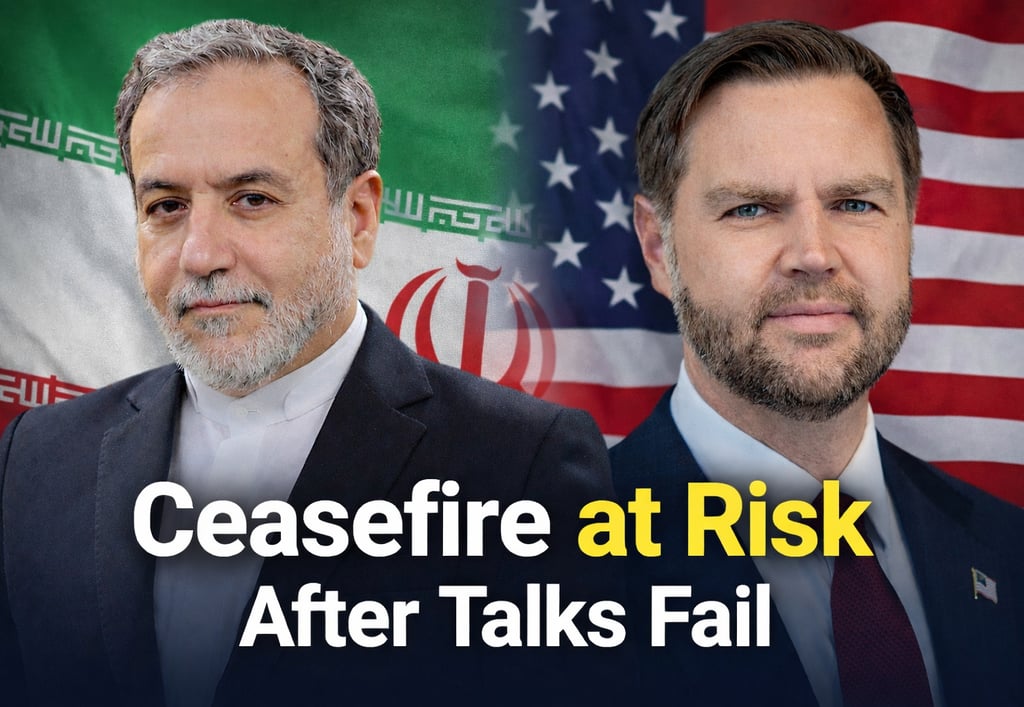
US–Iran Peace Talks Collapse in Islamabad: Ceasefire at Risk as War Escalates — Full Detailed Report (April 12, 2026)
On April 12, 2026, Islamabad once again became a major center of global diplomacy, where highly important, long-duration, and high-stakes peace negotiations between the United States and Iran ended without any final agreement. The talks lasted approximately 21 hours, and global attention remained fixed on whether this dialogue could succeed in ending the war that has been ongoing for more than six weeks. However, the outcome was disappointing. Both countries blamed each other for the failure of the negotiations and returned to their respective nations without any progress, further pushing the already fragile ceasefire into greater uncertainty.
These negotiations were historically significant as they marked the highest-level direct meeting between the United States and Iran since the 1979 Iranian Revolution, and the first such engagement in over a decade. After decades of tension, sanctions, and proxy conflicts, the fact that both sides sat at the same table was itself considered a major diplomatic development. However, deep mistrust and long-standing differences prevented any breakthrough. The US delegation was led by Vice President JD Vance, while Iran was represented by Parliamentary Speaker Mohammad Baqer Qalibaf and Foreign Minister Abbas Araghchi.
At the conclusion of the talks, JD Vance stated that the United States had clearly defined its “red lines,” but Iran refused to accept the conditions. According to him, the US demand was not limited to preventing Iran from developing nuclear weapons, but also included the complete dismantling of any infrastructure, capability, or technological pathway that could allow Iran to develop nuclear weapons in the future. He further emphasized that this position reflects the core policy of US President Donald Trump. He also revealed that he remained in continuous contact with President Trump during the negotiations, showing direct White House involvement in the process.
On the other hand, Iran held the United States responsible for the failure of the talks. Mohammad Baqer Qalibaf stated that the US failed to build trust, despite Iran presenting “forward-looking initiatives.” Iran argued that expecting a comprehensive agreement in a single session was unrealistic. Iranian Foreign Ministry spokesperson Esmaeil Baghaei also stated that these negotiations are part of a long-term diplomatic process, and future engagement—whether direct or remote—remains possible.
The key points of disagreement in the negotiations were Iran’s nuclear program and the Strait of Hormuz. The Strait of Hormuz is one of the most critical energy routes in the world, responsible for nearly 20% of global oil transportation. Since the beginning of the war, Iran has maintained control over this strategic waterway, significantly affecting global energy supply chains. Iran not only seeks to maintain control but has also demanded transit fees from passing ships, which is seen as a major threat to global trade stability. The United States, however, insists on ensuring free navigation through this route and restricting Iran’s nuclear program to prevent any possibility of weapon development.
Iran’s additional demands included war reparations, the return of frozen overseas assets, and a broader regional ceasefire, especially the end of hostilities in Lebanon. Iran maintains that without a ceasefire in Lebanon, any wider peace agreement would have no value. However, the United States and its ally Israel do not agree with this position, treating Lebanon as a separate conflict.
Meanwhile, ground realities remained highly volatile. Hezbollah and Israeli forces continued exchanges of fire. Israeli military strikes targeted rocket launchers in southern Lebanon, while smoke was seen rising over southern Beirut. Sirens continued to sound in Israeli border towns, warning of incoming rocket attacks. Israeli Prime Minister Benjamin Netanyahu confirmed that military operations would continue, while Israeli cabinet member Zeev Elkin stated that “Iran is playing with fire,” further increasing regional tensions.
Pakistan played an important mediating role throughout the process. Foreign Minister Ishaq Dar emphasized the importance of maintaining a two-week ceasefire to prevent further escalation and urged both sides to continue diplomatic engagement toward a sustainable peace framework. Although Pakistan’s efforts were appreciated by both parties, no major breakthrough was achieved.
The war began on February 28, 2026, after US and Israeli airstrikes targeted Iran, despite ongoing Oman-mediated negotiations that were reportedly close to an agreement. The conflict rapidly expanded across the Middle East. So far, several thousand people have been killed across Iran and the wider region, with total casualties reported in the range of approximately 4,000 to 8,000+, according to multiple international sources, while widespread destruction of civilian and military infrastructure has been reported.
The global economic impact has been severe. Disruptions in the Strait of Hormuz have affected oil supply chains, leading to rising global energy prices. Although three supertankers managed to pass through after the ceasefire, hundreds remain stranded in the Gulf, highlighting ongoing risks to global trade and energy security. This situation has created uncertainty in global markets and increased pressure on multiple economies.
During the negotiations, US President Donald Trump maintained a contradictory stance. While supporting diplomatic talks, he also stated that reaching a deal was not essential for the United States, claiming that America had already “won the war.” This statement further complicated the diplomatic atmosphere and was not taken positively by Iran.
It is also important to note that in 2015, the United States and Iran signed a historic nuclear agreement, which was later terminated by Donald Trump during his first presidency. After that decision, relations between the two countries continuously deteriorated, eventually leading to the 2026 war.
The situation in Lebanon also remains highly concerning, where recent Israeli strikes in the Tyre District reportedly killed at least six people, showing that the ceasefire remains limited and fragile.
In conclusion, although the Islamabad negotiations failed to produce an immediate agreement, they did not completely close the door on diplomacy. The core issue remains deep mistrust between the United States and Iran. The US demands full dismantling of Iran’s nuclear capabilities, while Iran insists on protecting its sovereignty, regional influence, and economic interests. This fundamental disagreement continues to be the biggest barrier to any final settlement.
The current situation remains extremely fragile. If the ceasefire collapses, the conflict could escalate further, with serious consequences for the Middle East and the global economy. Energy security, international trade, and regional stability now depend on future developments between Washington and Tehran. The world is now closely watching whether this diplomatic deadlock leads to further escalation or opens the path to a renewed peace process.
Stay informed with the latest national and international news.
© 2026. All rights reserved.