
US–Iran Crisis April 25, 2026: Islamabad Talks, Hormuz Disruption, Oil Prices Surge & Gaza War Updates
US–Iran crisis intensifies: Talks in Islamabad begin but Iran refuses direct negotiations. Hormuz disruption, oil prices jump 16%, and Gaza violence continues—complete April 25, 2026 analysis.
Raja Awais Ali
4/25/20265 min read
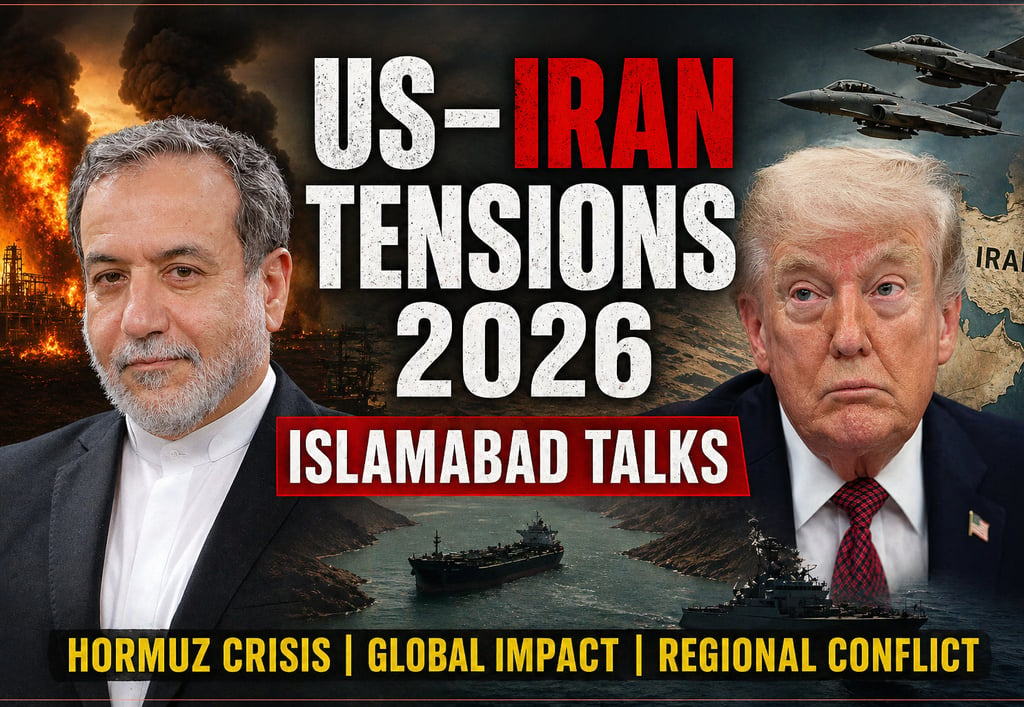
US–Iran Tensions 2026: Islamabad Talks, Hormuz Crisis, Global Economic Impact and Escalating Regional Conflict
On April 25, 2026, global politics has entered an extremely sensitive, complex, and dangerous phase, as ongoing tensions between the United States and Iran have not only engulfed the Middle East but are now impacting the entire world. At the center of this geopolitical storm is Islamabad, the capital of Pakistan, where renewed diplomatic efforts are underway to contain the growing conflict. However, the situation is far from straightforward, as Iran has clearly announced that it will not engage in direct talks with the United States, adding another layer of complexity and increasing global concern. In this context, U.S. President Donald Trump’s special envoy Steve Witkoff and his son-in-law and senior advisor Jared Kushner are scheduled to depart for Islamabad on Saturday morning to explore the possibility of negotiations with Iranian Foreign Minister Abbas Araqchi. According to the White House, this visit is highly significant, as the war has now entered its ninth week, resulting in thousands of deaths and causing severe disruptions in global markets.
Despite this, an Iranian Foreign Ministry spokesperson stated on the social media platform X that Iranian officials do not plan to meet U.S. representatives directly and will instead convey their concerns through Pakistan, which is currently acting as a mediator. The White House did not immediately respond to this statement, but U.S. officials remain cautiously optimistic about potential progress. Meanwhile, U.S. Defense Secretary Pete Hegseth told reporters that Iran still has an “open window” to make a good deal, emphasizing that Tehran must abandon its nuclear weapons program in a meaningful and verifiable manner. On the other hand, President Trump told Reuters that Iran is planning to present an offer that could satisfy U.S. demands, although he admitted he was unaware of the details and declined to specify who Washington is negotiating with, stating, “we’re dealing with the people that are in charge now,” a remark that has further deepened the ambiguity surrounding the situation. White House Press Secretary Karoline Leavitt also noted that the U.S. has observed some positive signals from Iran in recent days and expressed hope for further progress over the weekend, adding that Vice President JD Vance is also prepared to travel to Pakistan if necessary.
These developments highlight the intensity of behind-the-scenes diplomatic efforts. It is worth noting that similar talks were held in Islamabad two weeks ago involving Witkoff, Kushner, Araqchi, and Iran’s Parliament Speaker Mohammad Baqer Qalibaf, but those discussions ended without any conclusive outcome. This time as well, Araqchi arrived in Islamabad on Friday and met Pakistan’s Foreign Minister Ishaq Dar at the Serena Hotel, the same venue where earlier negotiations took place. Pakistani sources confirmed that a U.S. logistics and security team was already present in Islamabad, indicating the seriousness of the American delegation’s visit. Araqchi also announced that he would be visiting Oman and Russia in addition to Pakistan, signaling Iran’s broader diplomatic outreach.
The most alarming aspect of the current crisis is the situation in the Strait of Hormuz, a vital maritime route through which nearly one-fifth of the world’s oil supply typically passes. Due to escalating tensions, Iran has largely restricted movement in the strait, while the United States has blocked Iran’s oil exports. As a result, global energy markets have been severely disrupted, with oil prices reaching multi-year highs. Brent crude prices surged by 16% this week alone, raising serious concerns about inflation and slowing economic growth worldwide.
Shipping data revealed that only five vessels crossed the Strait of Hormuz in the past 24 hours, compared to around 130 ships per day before the war that began on February 28. Among these five vessels was an Iranian oil-products tanker, but none of the large crude supertankers that typically sustain global energy supply chains, highlighting the severity of the disruption. In an effort to create space for diplomacy, President Trump unilaterally extended a two-week ceasefire on Tuesday, yet ground realities suggest that tensions remain high.
In Lebanon, the situation continues to be volatile, with ongoing clashes between Israel and Hezbollah. Although a three-week ceasefire extension between Israel and Lebanon was brokered at a White House meeting, there are still no clear signs of an end to hostilities in southern Lebanon. Israel launched an invasion of its northern neighbor last month to eliminate Iran-backed Hezbollah forces after cross-border attacks intensified. Iran has stated that a ceasefire in Lebanon is a precondition for broader negotiations. Lebanese authorities reported that six people were killed in a recent Israeli strike, while Hezbollah claimed to have downed an Israeli drone. The Israeli military, on the other hand, stated that it had killed six armed Hezbollah members in southern Lebanon.
Inside Iran, the situation remains tense as well. Authorities confirmed the execution of an individual accused of working for Israeli intelligence agency Mossad. According to reports, the individual, identified as Erfan Kiani, was involved in acts of vandalism, arson, and spreading fear during nationwide protests in the central city of Isfahan. Iranian media stated that he damaged public and private property and created an atmosphere of terror. He was executed early Saturday morning after his sentence was upheld by the Supreme Court and all legal procedures were completed. This development underscores Iran’s strict internal security measures amid the broader conflict.
At the same time, Turkey is closely monitoring the evolving situation. Turkish Foreign Minister Hakan Fidan stated that Turkey may consider participating in mine-clearing operations in the Strait of Hormuz if a peace agreement is reached between Iran and the United States. He explained that such operations would be carried out by a technical team comprising multiple countries and described it as a humanitarian responsibility. However, he also cautioned that Turkey would reassess its involvement if any future coalition becomes directly involved in renewed conflict. He further expressed optimism that issues related to Iran’s nuclear program could potentially be resolved in the next round of talks in Pakistan.
Meanwhile, the United States has significantly intensified its naval blockade against Iran. Defense Secretary Hegseth stated that the blockade is now “going global,” asserting that no vessel can travel from the Strait of Hormuz to any part of the world without U.S. Navy approval. According to U.S. military officials, 34 ships have already been turned back, and surveillance operations continue. General Dan Caine emphasized that the United States is prepared to intercept any vessel heading to or from Iranian ports, regardless of nationality.
This blockade, which began on April 13, is aimed at increasing pressure on Tehran. Hegseth also warned that any attempt by Iran to lay mines in the Strait of Hormuz would constitute a violation of the ceasefire. He acknowledged that maritime transit is still ongoing but described it as significantly reduced and increasingly risky due to the presence of small, fast Iranian boats armed with weapons.
Simultaneously, violence continues in Gaza, further intensifying the regional crisis. Israeli strikes killed at least 12 people, including six police officers, across multiple areas such as Gaza City, Beit Lahiya, and Khan Younis. The Israeli military confirmed conducting a strike in Gaza City targeting Hamas militants but did not immediately comment on the other reported incidents. Gaza’s interior ministry stated that the strikes were aimed at the local police force, with one attack in Khan Younis hitting a police vehicle near a wedding hall.
This ongoing violence highlights the fragility of the October 2025 ceasefire, which has failed to bring lasting peace. According to local sources, at least 800 Palestinians have been killed since the ceasefire took effect, while Israel reports that four of its soldiers have been killed during the same period. Overall, more than 72,000 Palestinians have lost their lives since the war began in October 2023, most of them civilians, while the October 7, 2023 attacks resulted in 1,200 deaths according to Israeli figures.
These figures and developments clearly indicate that the region is facing a prolonged and devastating crisis. In conclusion, the ongoing tensions between the United States and Iran are no longer a localized conflict but have evolved into a global crisis affecting energy markets, economic stability, security dynamics, and international diplomacy. If the ongoing negotiations in Islamabad fail to produce a meaningful breakthrough, the situation could escalate even further in the coming days, with potentially severe consequences for the entire world.
Stay informed with the latest national and international news.
© 2026. All rights reserved.