
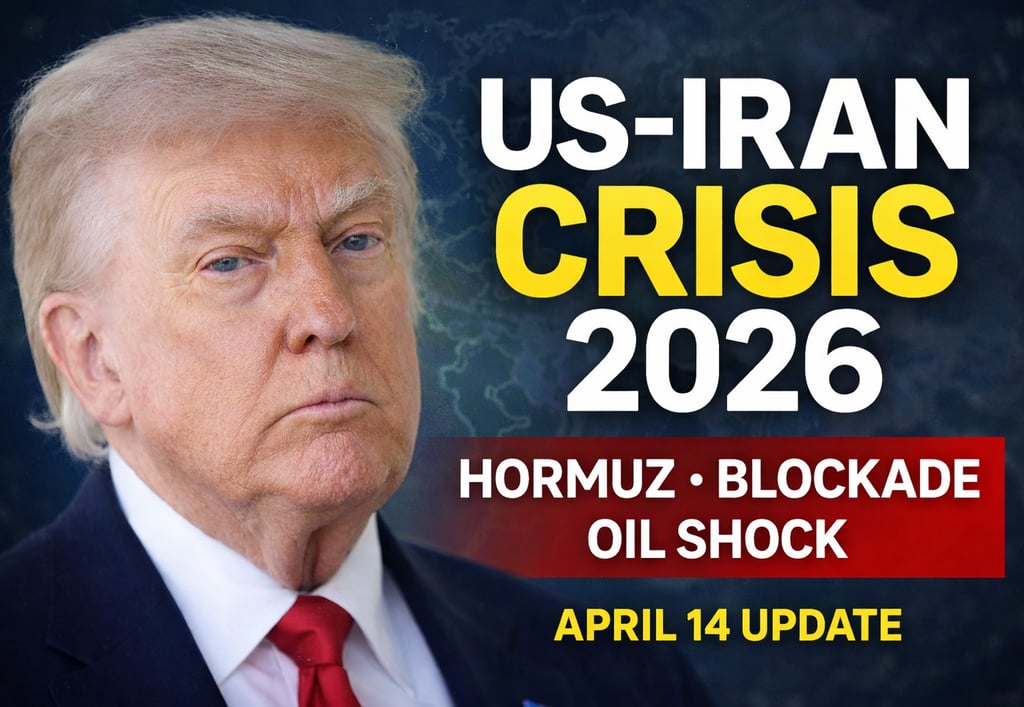
US–Iran Crisis 2026: Islamabad Talks, Hormuz Blockade, Oil Shock & Global Market Reaction (April 14 Update)
US and Iran tensions escalate in 2026 with Islamabad peace talks, Strait Hormuz crisis, naval blockade, and global oil & stock market volatility.
Raja Awais Ali
4/14/20266 min read
US–Iran Crisis 2026: Talks, Blockade, Hormuz & Global Market Impact
The ongoing war and diplomatic tensions between the United States and Iran have entered a highly sensitive and decisive phase on April 14, 2026, where military pressure, economic sanctions, naval blockades, and diplomatic efforts are all simultaneously taking place. This complex situation is significantly affecting global politics and the global economy. According to the latest reports, there is a growing possibility of renewed negotiations between the United States and Iran, and diplomatic sources suggest that delegations from both countries may return to Islamabad by the end of this week, where a new round of talks is expected between Friday and Sunday.
This development comes shortly after a 21-hour long negotiation session ended without any final agreement. Immediately after the collapse of these talks, the United States imposed a naval blockade against Iranian ports, which further increased tensions in the region and created uncertainty in global energy markets.
This conflict originally escalated on February 28, 2026, when the United States and Israel launched joint military operations against Iran. In response, Iran not only increased its military presence in the Gulf but also tightened control over the Strait of Hormuz, which is one of the most important global energy transit routes. In this context, the Islamabad negotiations were considered extremely important, as they were among the few high-level meetings between the two countries since 1979. However, the talks faced fundamental disagreements, particularly regarding Iran’s nuclear program, uranium enrichment, and regional security issues.
The US delegation was led by Vice President JD Vance, while the Iranian delegation was represented by Parliament Speaker Mohammad Bagher Ghalibaf. During the negotiations, both sides showed some flexibility, but a final agreement could not be reached. After this failure, the United States immediately decided to increase pressure. US President Donald Trump announced that Iran would face stricter measures.
In this regard, on April 13, the US Central Command announced the suspension of maritime traffic to and from Iranian ports and effectively imposed a naval blockade in the Persian Gulf and the Gulf of Oman.
However, the actual situation appears slightly different, as within approximately 24 hours of the blockade announcement, there were no clear reports of any major vessels being forcibly stopped. Meanwhile, on April 14, three Iran-linked oil tankers were observed passing through the Strait of Hormuz, although they were not heading toward Iranian ports. This suggests that the United States is currently enforcing a limited-level blockade and is trying to avoid full-scale military confrontation. This aspect is extremely important for global analysts, as it indicates that despite rising tensions, both countries are trying to avoid a full war.
The Strait of Hormuz has become the central point of this crisis because nearly one-fifth of the world’s oil and gas supply passes through it. Iran has tightened control over this important passage and announced that vessels passing through must do so under Iranian supervision and may be required to pay fees. This decision has severely impacted global energy markets and created disruptions in supply chains. In response, the United States adopted a strategy targeting Iranian ports, further increasing regional tensions.
US President Donald Trump, in his recent speech and statements, said that Iran has contacted the United States and wants to reach a deal. However, he clearly stated that the United States will not accept any agreement that allows Iran to possess nuclear weapons. He also said that Iran must completely dismantle its enriched uranium program and establish a strict international monitoring system. Trump had previously made a very strong statement saying that if Iran did not open the Strait of Hormuz, its “entire civilization would be destroyed.” However, later he supported a ceasefire, which shows that US policy contains both strict pressure and diplomatic flexibility.
Vice President JD Vance also stated in his briefing that the United States has placed clear red lines before Iran, including the end of uranium enrichment and international monitoring. He said Iran had shown some flexibility, but it was not enough. On the other hand, Iran strongly condemned the US blockade, calling it “maritime piracy,” and warned that if its ports were threatened, all ports in the Persian Gulf and Gulf of Oman would become unsafe. The Iranian Revolutionary Guard also stated that the presence of any foreign warship would be considered a violation of the ceasefire and would be responded to strongly.
The current ceasefire is playing an important role in preventing this crisis from turning into a full-scale war. Out of the two-week ceasefire, one week has passed, while one week remains. Although no major violations have been reported so far, strong statements and threats continue from both sides, suggesting that the situation could deteriorate at any time if negotiations do not restart.
Global energy markets have been significantly affected by this crisis. Due to disruptions in the Strait of Hormuz, oil prices previously surged to between 115 and 119 dollars per barrel. However, on April 14, prices declined due to hopes of diplomatic talks. Brent crude traded around 97.5 to 98 dollars per barrel, while West Texas Intermediate traded around 96.5 to 97 dollars per barrel. This decline indicates that markets are reacting to expectations of a diplomatic solution.
The International Energy Agency, in its latest report, reduced both supply and demand forecasts. According to the agency, the war may slow down global economic growth, which will also reduce oil demand. This creates a dual impact: supply is affected while demand also declines, creating a complex situation for energy markets.
Global stock markets also reacted immediately and showed improvement on April 14. In the United States, the Dow Jones traded around 48,200 points, the S&P 500 around 6,880 points, and the Nasdaq around 23,100 points. This increase reflects investor optimism that tensions may ease. US stock futures also rose as investors considered possible de-escalation alongside corporate earnings expectations.
European markets also showed positive momentum, with Germany’s DAX rising about 1 percent and France’s CAC 40 rising about 0.6 percent. In Asian markets, Japan’s Nikkei 225 rose about 2.4 percent, and South Korea’s KOSPI increased about 2.7 percent. However, Pakistan’s KSE-100 index declined significantly, reflecting local uncertainty.
Currency and commodity markets also experienced notable changes. The US dollar weakened slightly, while the euro and British pound strengthened. Gold prices reached approximately 4780 to 4785 US dollars per ounce, indicating that investors are still preferring safe-haven assets. Meanwhile, major oil companies recorded unusually high profits due to volatility in oil prices.
On the diplomatic front, the United States is not receiving full international support. The United Kingdom and France have stated that they will not join the US naval blockade but may consider future defensive maritime missions. China has strongly criticized the US action, calling it dangerous and irresponsible, and warned that it could further escalate tensions. China is the largest buyer of Iranian oil, and its economy depends heavily on this supply.
Domestically in the United States, political pressure is increasing due to rising oil prices and inflation. This is why the Trump administration is maintaining a hard stance while also keeping diplomatic doors open to secure a deal that protects US strategic interests and stabilizes the global economy. At the same time, major financial institutions such as JPMorgan, Citi, and Wells Fargo are preparing to release earnings reports, which investors are closely monitoring.
Overall, the situation on April 14, 2026 shows a highly complex balance where war, diplomacy, economy, and global politics are deeply interconnected. On one side, US pressure and Iranian responses are increasing tensions, while on the other side, hopes of negotiations are supporting global markets. Declining oil prices, rising stock markets, and increasing diplomatic activity indicate that global powers are trying to prevent the crisis from turning into a full-scale war. However, the risk still remains, and the coming days will be extremely critical. If US–Iran talks succeed, global stability may improve, but if they fail, the crisis could escalate further and its effects may spread across the entire world. That is why global attention is now focused on the possible negotiations in Islamabad, where the decisions made could determine the direction of the global system.
This developing story around Trump’s alleged bond investments adds a significant financial and political dimension to one of the largest media takeover battles in modern entertainment history. According to disclosures from the U.S. Office of Government Ethics, Trump reportedly purchased over $1.1 million in Netflix bonds along with up to $1 million in Warner Bros. Discovery debt during the intense $110 billion bidding war involving Paramount. The timing of these transactions has raised questions because they coincided with regulatory scrutiny, antitrust concerns, and high-level corporate negotiations that shaped the outcome of the deal. Netflix initially attempted to acquire Warner Bros. Discovery but later withdrew, while Paramount ultimately secured the acquisition through a heavily financed offer supported by major investors and institutions. At the same time, bond market movements showed shifting valuations in both Netflix and Warner Bros. debt, creating potential gains depending on holding periods. The situation has also triggered broader ethical debate, especially given concerns about conflicts of interest, presidential financial disclosures, and the exemption of U.S. presidents from standard conflict-of-interest laws. Combined with Trump’s wider business portfolio spanning real estate, finance, and licensing ventures, the case highlights how political power and private investment can intersect in complex ways. For the full breakdown, timeline, and detailed analysis, you can read the complete article here: https://blinknews.blog/trump-netflix-warner-bonds-hollywood-bidding-war
Stay informed with the latest national and international news.
© 2026. All rights reserved.