
US-Iran Ceasefire on Brink: Oil Prices Surge 6% as Strait of Hormuz Crisis Deepens (April 20, 2026)
Oil prices jump over 6% as US-Iran ceasefire nears collapse after ship seizure and rising tensions in the Strait of Hormuz. Full global impact, supply crisis, and market analysis (April 20, 2026).
Raja Awais Ali
4/20/20265 min read
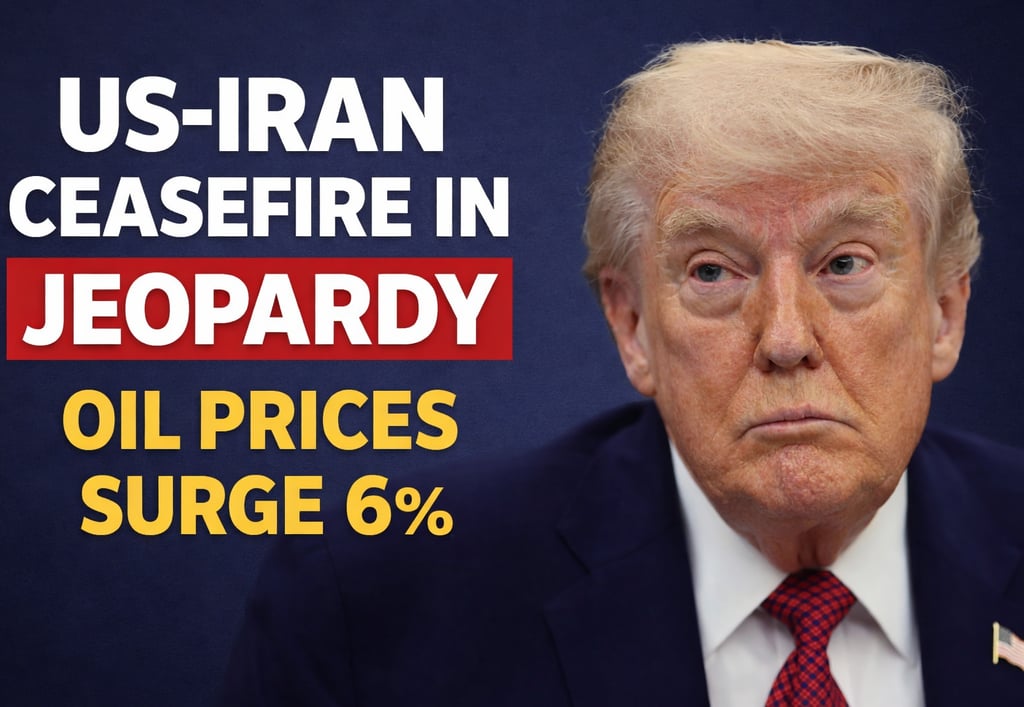
Oil Prices Rise 6% as US-Iran Ceasefire Nears Collapse — Global Energy Crisis Enters a Critical Phase (April 20, 2026)
On April 20, 2026, global energy markets witnessed intense volatility as crude oil prices surged by more than 6%. This increase is primarily driven by growing fears that the ongoing ceasefire between the United States and Iran may collapse. The situation poses a serious threat not only to the Middle East but also to the global economy.
The ceasefire, which was agreed upon for approximately two weeks (14 days), is now nearing its expiration around April 21, 2026. Uncertainty regarding its continuation has significantly heightened geopolitical tensions and market instability.
According to the latest developments, the United States’ seizure of an Iranian cargo ship, Iran’s strong warning of retaliation, and rising tensions in the Strait of Hormuz have placed global supply chains under severe pressure. In international markets, Brent crude rose by $5.51 to reach $95.89 per barrel, while U.S. West Texas Intermediate (WTI) increased by $5.46 to $89.31 per barrel.
This sharp rise follows a nearly 9% drop in oil prices just two days earlier on Friday, after Iran announced that commercial vessels would be allowed to pass freely through the Strait of Hormuz during the ceasefire. However, this relief proved temporary, as conditions quickly deteriorated, highlighting the fragile and highly reactive nature of the market.
Tensions escalated significantly after U.S. forces intercepted and seized an Iranian-flagged cargo ship attempting to breach a naval blockade. According to U.S. officials, the operation followed a six-hour standoff, during which the vessel’s engines were disabled before Marines boarded it via helicopters and took full control.
Iran condemned the action as “armed piracy” and warned of a strong response. Iranian military officials stated that the ship was traveling from China to Bandar Abbas and described the incident as a clear violation of international law. Tehran has made it clear that it will retaliate, increasing fears that the ceasefire could soon collapse.
At the same time, Iran has refused to participate in a second round of peace talks proposed by the United States, weakening hopes for a diplomatic resolution. Iranian officials argue that negotiations are meaningless while restrictions on Iran’s oil exports remain in place.
Iran’s First Vice President Mohammadreza Aref stated that either a free oil market must exist for all countries or everyone will have to bear the consequences. His statement reflects a hardened stance from Tehran and signals reduced willingness to compromise.
Meanwhile, U.S. President Donald Trump has taken a firm position, warning that if Iran does not accept U.S. conditions, critical infrastructure—including power plants and bridges—could be targeted. Such statements have further escalated tensions and increased global concern.
The Strait of Hormuz has emerged as the central flashpoint of the crisis. Approximately 20% of the world’s oil supply passes through this narrow waterway, meaning even minor disruptions can cause significant fluctuations in global prices. Although the strait is officially described as “open,” the reality on the ground remains highly unstable.
Several vessels are turning back, delaying transit, or facing security threats, including reports of gunfire. While more than 20 ships crossed the strait on Saturday—the highest number since March 1—this remains far below normal levels. These vessels were carrying oil, liquefied petroleum gas, metals, and fertilizers, but overall traffic is still heavily constrained.
Energy experts estimate that between 10 and 11 million barrels per day of oil production remain disrupted. Additionally, around 13 million barrels of crude oil and liquefied natural gas are currently stranded, with approximately 260 tankers stuck at various locations.
Shipping costs have risen sharply, and insurance premiums have multiplied several times. Some shipping companies are refusing to operate in the region altogether, further worsening the supply situation. Both the United States and Iran have effectively imposed competing maritime restrictions, complicating navigation even further.
Market analysts point out that financial markets are reacting to headlines about negotiations, while the physical oil market continues to deteriorate. This disconnect suggests that underlying supply issues remain unresolved and could worsen.
Asia has been the hardest-hit region. Jet fuel prices have surged from $93 to $204, while gasoil prices have increased by approximately 59%. These spikes are placing heavy pressure on aviation, transportation, and industrial sectors.
Global stock markets have also felt the impact. Markets in Dubai, Abu Dhabi, and Qatar declined, while European markets remained under pressure. Airline stocks have dropped significantly due to rising fuel costs.
The crisis is no longer limited to energy—it is now affecting global food systems. Disruptions in fertilizer shipments could impact agricultural production, potentially driving up the prices of wheat and other essential commodities. Experts warn that this could evolve into a broader global food security crisis.
At the regional level, the damage is already substantial. Iraq, Kuwait, Saudi Arabia, and the United Arab Emirates have collectively lost around 8 million barrels per day of oil production, creating a major supply shock.
The conflict began on February 28, 2026, and has now entered its seventh to eighth week. It is being described as the largest energy shock in modern history, severely disrupting global supply chains.
Since the beginning of the war, thousands of people have been killed, and widespread destruction has been reported across the region. U.S. and Israeli strikes on Iran, along with Israeli operations in Lebanon, have further complicated the situation. Iran has responded with missile and drone attacks targeting Israel and U.S. bases in the region.
Pakistan has taken on an important mediating role and is preparing for potential peace talks. Around 20,000 security personnel have been deployed in Islamabad, and strict security measures are in place. However, Iran’s refusal to participate has made the prospects of these talks uncertain.
European allies have also expressed concern, warning that any rushed agreement may fail to provide a lasting solution.
Experts believe that even if the Strait of Hormuz fully reopens, restoring normal supply chains could take months or even years. This means the economic impact of the crisis is likely to persist for a prolonged period.
Additional reports indicate that Indian tankers have also come under fire, demonstrating that the crisis has now taken on a truly global dimension.
In the United States, the effects are already visible, with gasoline prices reaching around $4 per gallon and expected to rise further. This is increasing pressure on consumers and adding to domestic political tensions, particularly around inflation and energy costs.
Overall, the situation remains highly fragile and uncertain. If the ceasefire collapses, oil prices could rise even further, with some estimates suggesting a potential surge to between $120 and $150 per barrel.
This crisis highlights the vulnerability of the global energy system. A regional conflict has the potential to disrupt the entire world, and without an immediate and sustainable diplomatic solution, the consequences could include a prolonged energy crisis, rising inflation, and a global economic slowdown.
The coming days will be decisive in determining whether tensions de-escalate or the world moves closer to a broader conflict.
Stay informed with the latest national and international news.
© 2026. All rights reserved.