
US-Iran Ceasefire Agreement 2026: Did Trump Win the War or Did Iran Turn the Tables Through Diplomacy?
A detailed analysis of the US-Iran ceasefire agreement, Trump's strategy, Iran's diplomatic gains, Israel's concerns, oil market impact, and the future of Middle East stability.
Raja Awais Ali
6/18/20267 min read
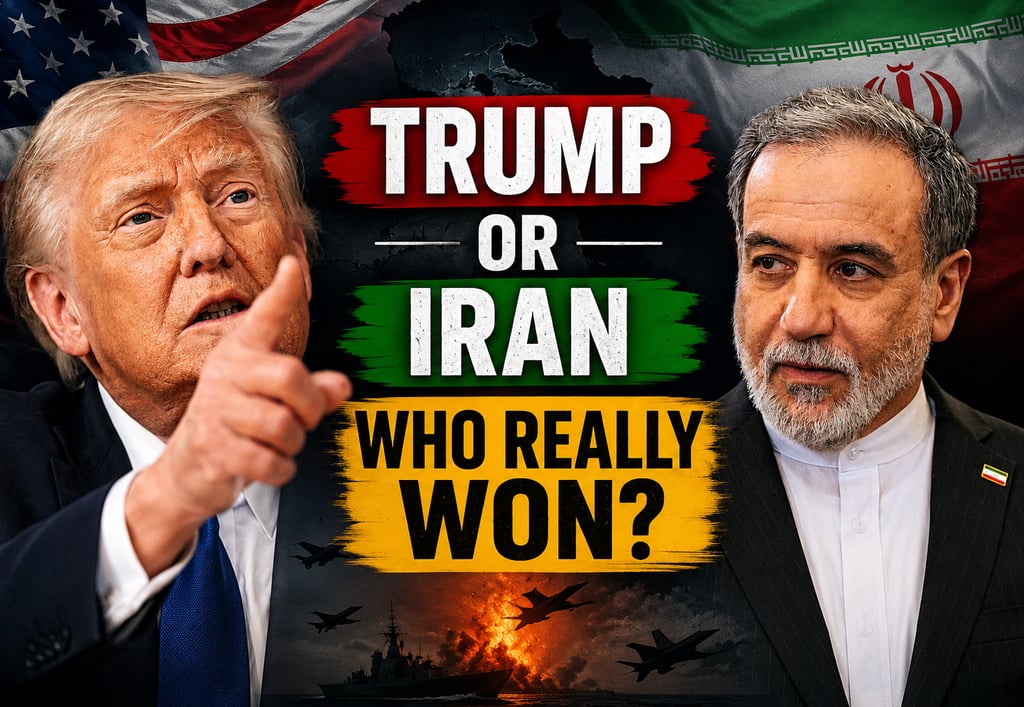
US-Iran Ceasefire Deal 2026: Trump’s Victory or Iran’s Diplomatic Success?
After months of bloody conflict, thousands of deaths, severe uncertainty in global markets, fluctuating oil prices, and widespread instability across the Middle East, a temporary ceasefire agreement has finally been reached between the United States and Iran. The agreement, reportedly signed by U.S. President Donald Trump and Iranian President Masoud Pezeshkian, is being described by some observers as a historic diplomatic breakthrough. Critics, however, argue that the deal leaves several fundamental questions unanswered and may create even more complicated challenges in the future. Their concerns gained further attention when President Trump, only hours after announcing the agreement, warned that the United States could resume military strikes against Iran if the deal was not respected. His remarks made it clear that although active fighting may have stopped for now, tensions between the two countries have not completely disappeared.
The roots of this conflict deepened when the United States and Israel launched a joint military campaign against Iran. According to reports, Iran’s senior leadership and military infrastructure were targeted from the very first day of the war. The conflict quickly expanded beyond Iran’s borders, and its consequences were felt across the region, particularly in Lebanon. The war continued for several months and left deep human, economic, and political scars that could influence the Middle East for years to come.
Reports suggest that more than 7,000 people lost their lives during the conflict, with the majority of casualties occurring in Iran and Lebanon. Millions faced economic hardship, while large numbers of civilians were forced to leave their homes. At the global level, rising energy prices and disruptions in supply chains increased concerns about inflation. Food supply systems also came under pressure, creating additional economic challenges for many developing countries.
According to the reported 14-point agreement, all direct military operations between the United States and Iran will cease immediately. The ceasefire on the Lebanese front has also been extended for an additional 60 days to allow negotiators time to work toward a permanent peace arrangement. The agreement reportedly includes the full restoration of maritime traffic through the Strait of Hormuz, reduced American pressure on Iranian ports, the release of frozen Iranian assets, sanctions relief measures, and the establishment of a $300 billion reconstruction and investment fund to support Iran’s post-war recovery. These provisions have attracted significant international attention because only a few months ago it seemed almost impossible that Iran would receive such substantial economic concessions.
Following the announcement of the agreement, President Trump told reporters that he expected Iran to comply with its commitments but warned that the United States would not hesitate to take military action if the agreement was violated. His comments suggested that Washington views the arrangement as an experimental phase rather than a final settlement. Trump stated that if Iran failed to demonstrate appropriate behavior, military operations could resume. At one point, he even suggested that if he became dissatisfied with the agreement, the United States could return to bombing campaigns.
However, during the same press conference, Trump made another statement that surprised many observers. At the beginning of the conflict, he had declared that Iran’s ballistic missile program would be completely destroyed. Now, he argued that if other countries possess missile capabilities, it may not be unreasonable for Iran to maintain a limited missile capability as well. This represented a noticeable shift from the position adopted during the early stages of the war.
Iranian leaders have presented the agreement as a major diplomatic victory. According to Iranian officials, objectives that hostile powers failed to achieve through military force were ultimately secured by Iran through negotiations while protecting its national interests. Mohammad Bagher Ghalibaf, who reportedly led Iran’s negotiating efforts, stated in an interview with state television that diplomacy delivered far greater benefits than continued warfare. Tehran argues that sanctions relief, the release of frozen assets, and opportunities for reconstruction investment demonstrate that Iran was not completely isolated and successfully defended its key interests despite immense external pressure.
One of the most significant aspects of the agreement concerns Iran’s nuclear program. For years, the United States insisted that Iran transfer its stockpile of enriched uranium outside the country. Iran repeatedly rejected that demand. Under the new arrangement, enriched uranium would reportedly be reduced to lower levels under the supervision of the International Atomic Energy Agency. Iran has once again pledged that it does not intend to develop nuclear weapons. Critics, however, point out that Iran has made similar assurances in the past, meaning that implementation and verification will be the true test of the agreement.
A review of Washington’s original war objectives raises important questions about the outcome of the conflict. At the beginning of the campaign, U.S. officials stated that they intended to inflict irreversible damage on Iran’s nuclear program, destroy its missile capabilities, limit its regional influence, and weaken the activities of its allied groups across the Middle East. Yet the current situation appears far more complex. Iran’s government remains in power, its missile program has not been completely eliminated, a significant portion of its nuclear materials reportedly remains inside the country, and its regional networks have not been entirely dismantled.
For this reason, many observers are asking whether the United States truly achieved its objectives. Looking at the results, Iran’s government remains intact, its nuclear program has not been completely dismantled, its missile capabilities still exist, and it appears likely to receive important economic benefits under the agreement. These realities have led some analysts to describe the ceasefire as a diplomatic success for Tehran.
The question becomes even more significant when examining the financial costs of the war. Although the U.S. government has not released a complete estimate of the conflict’s expenses, defense experts believe that the deployment of naval fleets in the Gulf, air operations, advanced missile usage, intelligence missions, logistical support, and maintaining military forces throughout the region likely cost tens of billions of dollars. A single modern long-range missile can cost millions of dollars, and hundreds of such weapons were reportedly used during the conflict.
Does this mean that the United States lost the war? The answer is not straightforward. Washington can argue that it compelled Iran to accept international monitoring, brought Tehran back to the negotiating table, and demonstrated its military influence across the region. Iran, on the other hand, can argue that despite intense military pressure, its government survived, its state institutions remained functional, its missile program was not completely destroyed, and it secured economic concessions. As a result, many experts believe that the conflict ended without a clear winner and instead became a costly and complicated geopolitical struggle.
Israel’s role throughout the crisis has also been highly significant. For decades, Israel has considered Iran its greatest national security threat. Israeli leaders have consistently argued that granting economic or military relief to Tehran could create additional security risks in the future. This is one reason why Israel appears far less satisfied with the agreement than many other international actors. Differences between Israel and the United States have become increasingly visible, particularly regarding operations against Hezbollah in Lebanon.
President Trump publicly criticized Israeli Prime Minister Benjamin Netanyahu, suggesting that Israel sometimes responds too aggressively. He also indicated that a softer approach toward Lebanon may be necessary. These comments attracted attention because reports of disagreements between Washington and Tel Aviv regarding Lebanon have circulated for months.
Lebanon emerged as perhaps the most severely affected secondary front of the conflict. Israeli military operations and Hezbollah activities impacted thousands of civilians and forced more than one million people to leave their homes. Although violence has decreased since the ceasefire took effect, complete calm has not yet been achieved. Reports of Israeli airstrikes and drone operations in southern Lebanon continue to emerge, while Israeli forces have also reported attacks against their personnel.
At the G7 summit held in France, world leaders welcomed the agreement between the United States and Iran. Leaders from France, the United Kingdom, Germany, Japan, Italy, Canada, and the United States jointly expressed hope that the ceasefire could pave the way for broader peace across the Middle East. Nevertheless, European governments remain concerned that Iran has managed to preserve a significant degree of regional influence despite the war and that the issue could resurface in the future.
From an economic perspective, the most immediate and significant impact of the agreement has been on global oil markets. The Strait of Hormuz is one of the world’s most important maritime routes, handling approximately 20 percent of globally traded seaborne oil. During the conflict, fears that this vital waterway could be disrupted pushed oil prices higher and raised concerns about a potential global energy crisis.
Following the ceasefire announcement on June 18, 2026, global markets reacted quickly. Brent crude futures reportedly fell below $80 per barrel and traded near $78 per barrel, while U.S. West Texas Intermediate crude declined to around $75 per barrel. The decline reflected expectations that the Strait of Hormuz would remain fully open and that regional oil supplies would return to normal.
According to energy market experts, approximately 93 million barrels of non-Iranian crude oil and around 72 million barrels of Iranian crude oil were unable to reach global markets on time during the conflict. Following the ceasefire, investors estimated that more than 165 million barrels of oil could eventually return to the market, creating a significant increase in supply.
Another major economic component of the agreement is the proposed $300 billion reconstruction and investment fund for Iran. If fully implemented, the initiative could trigger substantial investment in Iran’s energy sector, infrastructure projects, and industrial development. In addition, the release of billions of dollars in frozen Iranian assets could provide significant relief to the Iranian economy.
Despite these developments, market confidence has not been fully restored. One major reason is President Trump’s repeated warning that military action could resume if Iran violates the agreement. These concerns contributed to a partial recovery in oil prices after the initial decline, as investors remain cautious about the possibility of renewed tensions in the region.
The next 60 days may prove decisive. This period will determine whether the United States and Iran can transform the temporary ceasefire into a permanent peace arrangement. If negotiations succeed, the Middle East could enter a new political era characterized by greater stability and cooperation. However, if either side violates the agreement or if fighting escalates again between Israel and Lebanon, the region could quickly return to a period of severe instability.
The reality today is that neither side achieved all of its objectives. The United States did not secure every condition it originally sought, while Iran remains under pressure despite gaining important concessions. Israel continues to voice serious concerns, Lebanon remains fragile, and global powers are carefully monitoring developments.
For that reason, many analysts view this agreement not as a complete victory or complete defeat for any single party, but rather as a political compromise in which every side gained something, lost something, and postponed certain decisions for the future. The coming weeks and months will ultimately determine whether this ceasefire becomes the foundation for lasting peace in the Middle East or merely a temporary pause before another period of confrontation.
Stay informed with the latest national and international news.
© 2026. All rights reserved.