
US House Elections 2026: How Redistricting and Supreme Court Decisions Are Weakening Voter Power
A detailed analysis of how redistricting, gerrymandering, and recent U.S. Supreme Court rulings are reducing competition in the 2026 House elections, leaving most voters with limited electoral impact.
Raja Awais Ali
5/3/20264 min read
How Redistricting and the Supreme Court Are Shrinking Voter Power in U.S. House Elections
The United States has long presented itself as the world’s leading democracy, but the dynamics shaping the 2026 midterm elections suggest a growing disconnect between that image and political reality. Recent data and expert analysis indicate that a significant portion of American voters are effectively being sidelined from meaningful participation in elections — largely due to redistricting practices and recent rulings by the U.S. Supreme Court.
What was once a technical and legal process has now evolved into a central political battleground. The key question emerging today is whether voters truly determine electoral outcomes — or whether district maps are increasingly deciding results before a single vote is cast.
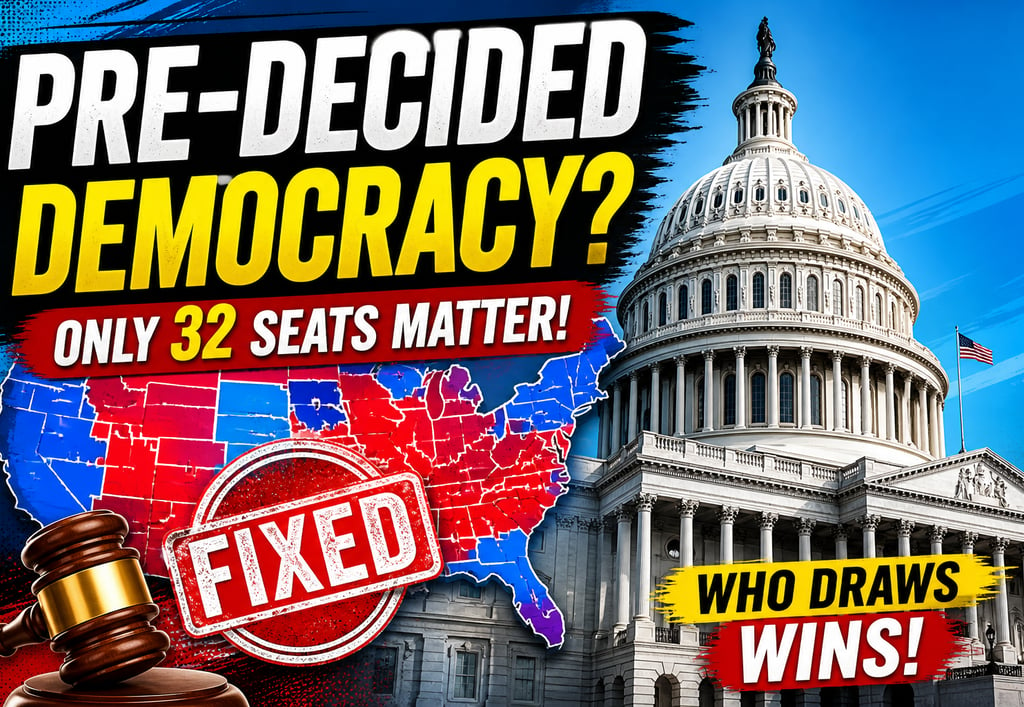
One of the most striking findings is the sharp decline in competitive races within the U.S. House of Representatives. Out of all 435 seats, only 32 districts are currently considered genuinely competitive. This means that nearly 90% of districts are effectively non-competitive, with outcomes largely predictable in advance.
As a result, control of the House in the November 2026 elections could be determined by less than 10% of American voters. This reality challenges a core democratic principle — that every vote carries equal weight.
Further analysis reinforces this trend. According to leading election forecasters, approximately 375 seats fall into the “Solid Republican” or “Solid Democrat” categories, where serious competition is not expected. An additional 28 districts are labeled “Likely”, meaning they are not currently competitive but could shift under changing conditions. Even so, the true electoral battlefield remains confined to a very small number of districts.
Historically, this represents a significant shift. The current level of competitiveness is the lowest recorded at this stage of an election cycle since at least 2008, highlighting how rapidly the American political landscape is becoming more polarized and structurally uncompetitive.
At the heart of this transformation is gerrymandering — the strategic manipulation of electoral district boundaries for political advantage. While not a new phenomenon, its use has intensified in recent years, evolving into a highly sophisticated political tool. The situation escalated further when Donald Trump encouraged Republican-led states to redraw district maps in their favor, effectively triggering what experts now describe as a nationwide “gerrymandering war.”
A notable example comes from Texas, where redistricting efforts targeted five Democratic-held seats, setting off a chain reaction across multiple states. This marked a departure from the traditional norm of redistricting only once per decade following the national census, signaling a more aggressive and continuous approach to map-drawing.
The role of the U.S. Supreme Court has been particularly consequential. Its recent decision weakened a key provision of the Voting Rights Act that had previously protected districts with significant racial minority populations, especially Black and Latino communities. With these protections reduced, political observers expect that a dozen or more such districts could be redrawn, potentially diluting minority representation.
These developments underscore a deeper structural shift. District boundaries are no longer just administrative lines — they have become instruments of political power. By redrawing these lines, lawmakers can reshape electoral outcomes and influence the balance of power in Congress.
Technological advancements have further amplified this trend. Modern data analytics allow mapmakers to identify voter preferences with remarkable precision, down to the census block level. This enables highly targeted strategies such as concentrating opposition voters into a few districts (“packing”) or spreading them thinly across many districts (“cracking”). The result is a system where electoral outcomes can often be anticipated well before Election Day — a troubling sign for any democratic framework.
The consequences extend beyond elections themselves. When candidates operate in districts where victory is virtually guaranteed, they have little incentive to appeal to moderate or opposing voters. Instead, they focus primarily on their core base. This dynamic encourages more ideologically extreme positions and reduces the likelihood of bipartisan cooperation.
A comparison with past decades illustrates the shift. Twenty to thirty years ago, Congress frequently passed major legislation with broad, cross-party support. Today, it is increasingly characterized by polarization, legislative gridlock, and heightened political tension.
It is also important to note that gerrymandering is not the sole factor contributing to this trend. Geographic sorting has played a significant role as well. Voters are increasingly clustering in like-minded communities — with rural areas leaning conservative and urban and suburban regions trending Democratic. This natural sorting further reduces the number of competitive districts.
Additionally, the decline of split-ticket voting has reinforced partisan alignment. In 2000, there were 86 House members elected from districts that voted for the opposite party’s presidential candidate. By 2024, that number had dropped to just 16, reflecting a more rigid and polarized electorate.
Taken together, these factors are reshaping the nature of American elections. While the formal process of voting remains intact, the range of meaningful electoral competition has narrowed significantly.
For Democrats, gaining control of the House requires just three additional seats. However, because most districts are considered safe, this outcome will likely be decided in a limited number of battleground areas. In effect, the political direction of the entire country may hinge on voters in just a handful of districts.
This raises a broader and more profound question: is the United States transitioning from a fully competitive democracy to a more managed electoral system?
Experts warn that if current trends continue, elections will become even less competitive, voter engagement may decline, and public trust in democratic institutions could erode further.
Ultimately, the issue is not that Americans are unable to vote. The deeper concern is that for many voters, their vote no longer meaningfully influences the outcome.
And when impact disappears from democracy, what remains is not its essence — only its form.
Stay informed with the latest national and international news.
© 2026. All rights reserved.