
US Aircraft Carrier USS Abraham Lincoln Enters Middle East Amid Rising Iran Tensions — 26 Jan 2026 Latest News
US aircraft carrier USS Abraham Lincoln arrives in the Middle East amid rising Iran tensions and ongoing protests. Gulf airspace stance and potential conflict consequences.
Raja Awais Ali
1/26/20262 min read
US Aircraft Carrier USS Abraham Lincoln Enters Middle East Amid Rising Iran Tensions — 26 Jan 2026
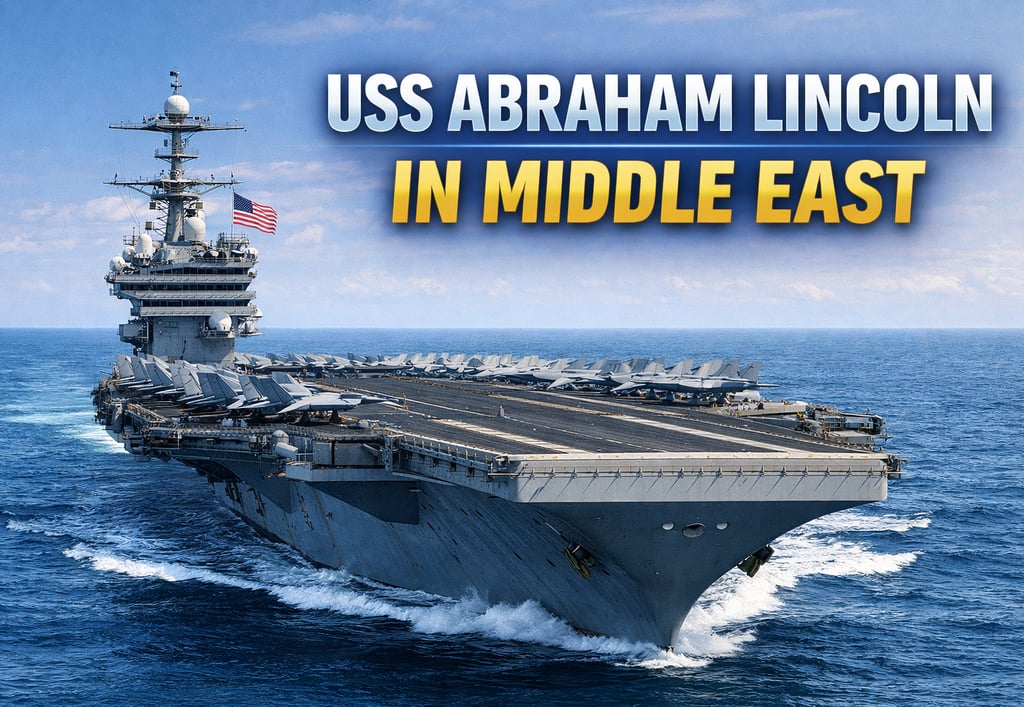
On January 26, 2026, the United States Navy deployed the nuclear-powered aircraft carrier USS Abraham Lincoln (CVN‑72) and its accompanying carrier strike group to the Middle East, reinforcing U.S. military presence amid rising tensions with Iran and ongoing domestic unrest. The naval group includes three guided missile destroyers: USS Frank E. Petersen Jr., USS Spruance, and USS Michael Murphy. The carrier also carries F‑35C jets, F/A‑18 Super Hornets, and supporting helicopters.
The USS Abraham Lincoln is temporarily stationed in international waters of the Persian Gulf and Gulf of Oman. It is not permanently based in any Gulf country; its mission is to monitor the situation, deter threats, and maintain regional security.
U.S. officials have stated that the deployment aims to protect American personnel, maintain regional stability, and keep options open for potential military actions if necessary. The U.S. Department of Defense has also deployed additional fighter jets, PATRIOT and THAAD air defense systems, and surveillance aircraft to respond swiftly to any threats.
Iran’s Response and Warnings
Iran reacted strongly, warning that any U.S. aggression would be considered an all-out war. Iran-backed militias have also declared that they would respond forcefully to any military action against Iran or its allies.
Gulf States’ Position
Regional Gulf countries have taken precautionary measures. The United Arab Emirates (UAE) stated that it will not allow its airspace to be used for attacks on Iran. Qatar, Saudi Arabia, and other Gulf states have emphasized restraint and neutrality regarding airspace usage, aiming to avoid escalation.
Potential Consequences of a U.S. Military Strike
If the U.S. were to strike Iran or its allies directly, the consequences could be severe:
Iranian Retaliation: Iran could target U.S. naval vessels, bases, and allied positions in the Gulf using missiles, drones, and other capabilities.
Militia Escalation: Iran-backed groups in Yemen (Houthis), Iraq, Syria, and Lebanon (Hezbollah) could simultaneously attack U.S. and Western interests, potentially igniting a broader regional war.
Global Economic Impact: The Persian Gulf is a critical energy supply route. Any disruption could spike oil and gas prices, triggering global economic instability.
Diplomatic Pressure: The U.S. and its allies could face international backlash, with European and other countries opposing military action, complicating diplomatic efforts.
Current Status of Protests in Iran (26 Jan 2026)
Protests inside Iran remain ongoing but are heavily controlled. The government has ordered security forces to crack down on demonstrators without exceptions. Internet and communications are tightly restricted, making independent coverage challenging. Reports indicate continued arrests and casualties, with thousands potentially affected, though precise numbers remain unverified.
Although street demonstrations have decreased in scale, public dissent and unrest persist, with human rights groups monitoring the situation closely.
Regional Security Context
The Middle East remains highly sensitive and volatile. Iran’s internal unrest, combined with the U.S. military buildup and regional militia threats, increases the risk of broader instability. Global leaders have urged restraint and negotiation, while Gulf states are taking measures to protect their citizens and maintain internal stability.
Key Takeaways
USS Abraham Lincoln and its strike group are in the Middle East to monitor escalating U.S.–Iran tensions.
The carrier is stationed temporarily in international waters of the Persian Gulf and Gulf of Oman.
Iran has issued warnings, labeling any attack as a potential all-out war.
Gulf countries, especially the UAE, emphasize restraint and neutrality in airspace usage.
Iran-backed militias have threatened potential attacks, increasing regional risks.
Protests in Iran continue under strict government control with ongoing human rights concerns.
A U.S. attack could trigger regional war, energy market disruption, and diplomatic complications.
Stay informed with the latest national and international news.
© 2026. All rights reserved.