
US Adds BYD, Alibaba, Baidu and NIO to Military-Linked List as China Tech Tensions Grow
The US has added BYD, Alibaba, Baidu, NIO, YMTC, CXMT and other Chinese firms to its military-linked companies list. Discover what the decision means for global technology, trade, AI and US-China relations.
Raja Awais Ali
6/9/20265 min read
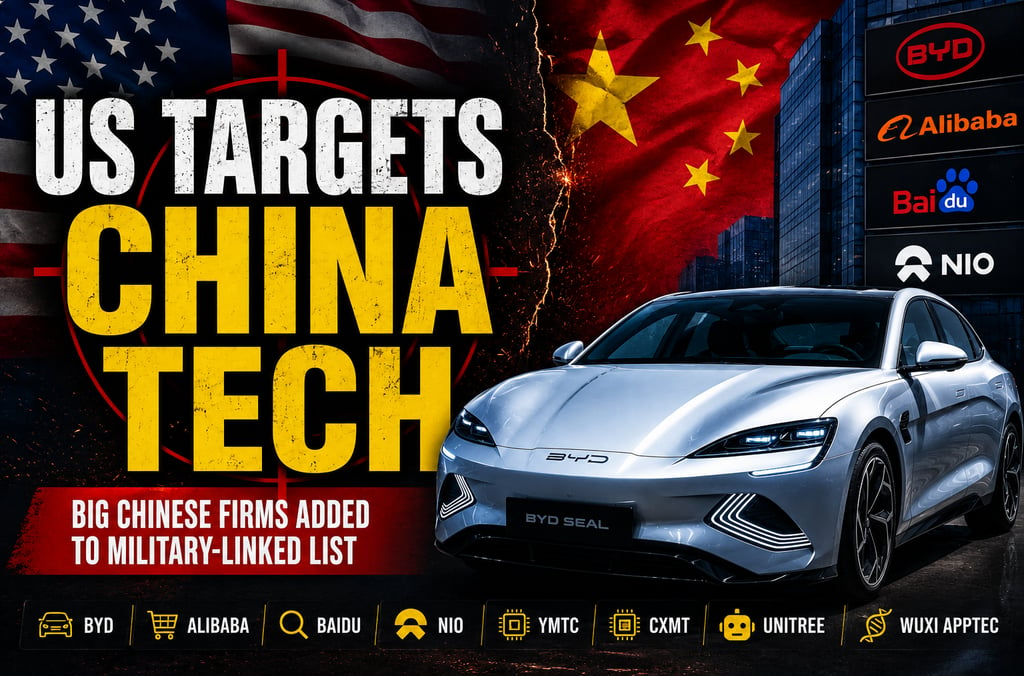
US Adds BYD, Alibaba, Baidu and NIO to Military-Linked List as China Tech Tensions Grow
The United States has taken another major step in its long-running technology and security competition with China by adding some of the country's most influential companies to a Pentagon list of firms believed to be linked to China's military. The updated list now includes electric vehicle giant BYD, technology leaders Alibaba and Baidu, EV manufacturer NIO, memory chip makers CXMT and YMTC, robotics company Unitree, sensor technology specialist RoboSense and biotechnology firm WuXi AppTec among several other Chinese businesses.
The move comes at a sensitive moment in US-China relations. Less than a month ago, US President Donald Trump met Chinese President Xi Jinping in Beijing, where both leaders attempted to preserve a fragile trade truce after years of economic tensions. However, the Pentagon's latest decision shows that while trade discussions may continue, Washington remains deeply concerned about China's growing technological capabilities and their potential military applications.
The updated designation is part of what is commonly known as the Chinese Military Companies List or the 1260H list, which is required under US law and reviewed regularly by the Department of Defense. The list identifies companies that Washington believes are connected to China's military modernization efforts either directly or indirectly. Although being added to the list does not immediately trigger sanctions, it can have important consequences for future business opportunities and relationships with the US government.
One of the most significant aspects of the announcement is the variety of industries represented. Unlike traditional military contractors, many of the newly listed companies operate in sectors that are considered central to the future global economy. These include artificial intelligence, cloud computing, semiconductors, electric vehicles, robotics, biotechnology, telecommunications equipment, sensors and renewable energy technologies. This reflects a growing belief within Washington that future geopolitical competition will be determined not only by military strength but also by control of critical technologies.
Among the companies attracting the most attention is BYD, which has become the world's largest seller of electric vehicles and a major competitor to Tesla in several international markets. BYD strongly rejected the Pentagon's designation and stated that it would use all available legal and administrative channels to defend its interests. The company argued that labeling it as a military-linked organization was unjustified and harmful to its business achievements, particularly in the United States.
Alibaba also responded forcefully to the announcement. The company said there was no basis for its inclusion and insisted that it is neither a military organization nor part of any military-civil fusion strategy. Alibaba stated that it would pursue all available legal options to challenge what it described as a misrepresentation of its business activities. Baidu issued a similar response, calling the designation completely baseless and vowing to seek removal from the list through legal channels.
WuXi AppTec, one of China's most important biotechnology companies, also challenged the Pentagon's decision and described its inclusion as incorrect. The company announced plans to take immediate action to contest the designation. Several other companies named in the update, including CXMT, YMTC, Unitree, RoboSense, BOE Technology Group, TP-Link Technologies, Tianma Microelectronics, CALB Group, EVE Energy, Zhongji Innolight, JA Solar Technology and Trina Solar, did not immediately provide extensive public responses.
China's government reacted quickly and sharply. Foreign Ministry spokesperson Lin Jian accused the United States of unfairly targeting Chinese businesses and called the list discriminatory. Beijing urged Washington to reverse what it described as mistaken policies and warned that China would take necessary measures to protect the legitimate rights and interests of Chinese companies. The response highlights the increasing tension between the world's two largest economies as technology becomes a central area of strategic competition.
The inclusion of memory chip manufacturers CXMT and YMTC is particularly notable. Both companies are important players in China's effort to build a self-sufficient semiconductor industry. Semiconductors have become one of the most strategically important technologies in the world because they power everything from smartphones and data centers to advanced military systems and artificial intelligence platforms. Their addition to the list suggests that Washington views China's progress in semiconductor development as a major national security concern.
The robotics sector also received significant attention in the Pentagon update. Unitree has become internationally recognized for its advanced humanoid and quadruped robots, while RoboSense develops sophisticated sensing technologies used in autonomous vehicles and automation systems. The timing is especially interesting because Nvidia recently announced plans to work with Unitree on robotics projects designed for researchers and developers. The Pentagon's action may increase scrutiny of future collaborations involving advanced robotics and artificial intelligence technologies.
The broader message behind the updated list extends beyond individual companies. For many years, US-China tensions were largely focused on trade deficits, tariffs and market access. Today, the rivalry has evolved into a struggle over technological leadership. Artificial intelligence, advanced chips, robotics, electric vehicles, telecommunications infrastructure and biotechnology are increasingly viewed as assets that can shape both economic growth and military power. As a result, governments are paying much closer attention to companies operating in these fields.
Although the Pentagon list does not function as a direct sanctions mechanism, it does carry practical consequences. Under recently enacted US laws, the Department of Defense will soon be prohibited from entering into direct contracts with companies included on the list. Starting in 2027, those restrictions will expand further, preventing the Pentagon from purchasing products or services from these firms through third-party suppliers. Such measures could create challenges for companies seeking to maintain relationships with American government agencies and defense-related supply chains.
At the same time, the companies involved are attempting to reassure investors and customers. NIO stated in regulatory filings that it does not expect the procurement restrictions to have a material impact on its operations. Alibaba similarly said that the designation would not affect its ability to conduct business normally in the United States or other international markets. Even so, being publicly identified as a military-linked company by the Pentagon can influence investor confidence, regulatory scrutiny and commercial partnerships.
The latest Pentagon update also serves as a reminder that Washington's approach toward China increasingly focuses on entire technology ecosystems rather than individual firms. Many policymakers now believe that the line between civilian and military technology is becoming less clear. Innovations developed for commercial purposes can often be adapted for defense applications, making technology companies an important part of national security discussions.
For global markets, the implications are significant. Investors, multinational corporations and governments will be watching closely to see whether further restrictions follow. Additional measures could affect supply chains, investment decisions and international technology partnerships across multiple industries. Businesses operating between the United States and China may face increasing pressure to navigate a more complex regulatory environment as geopolitical competition intensifies.
Ultimately, the addition of BYD, Alibaba, Baidu, NIO, CXMT, YMTC, Unitree, RoboSense and other Chinese companies to the Pentagon's military-linked list represents more than a regulatory update. It reflects a deeper transformation in the relationship between the United States and China. The contest is no longer centered only on trade. It is increasingly about who will lead the future of artificial intelligence, semiconductors, robotics, electric vehicles and other technologies that are expected to define global economic and strategic power for decades to come. As both countries continue to compete for influence in these critical sectors, decisions like this one are likely to play an increasingly important role in shaping the future of the global technology landscape.
Stay informed with the latest national and international news.
© 2026. All rights reserved.