
Ukraine Sanctions Foreign Suppliers Fueling Russian Missile Program
Latest 8 Feb 2026: Ukraine targets Chinese, UAE and other foreign suppliers providing components for Russian missiles and drones with new sanctions.
Raja Awais Ali
2/8/20262 min read
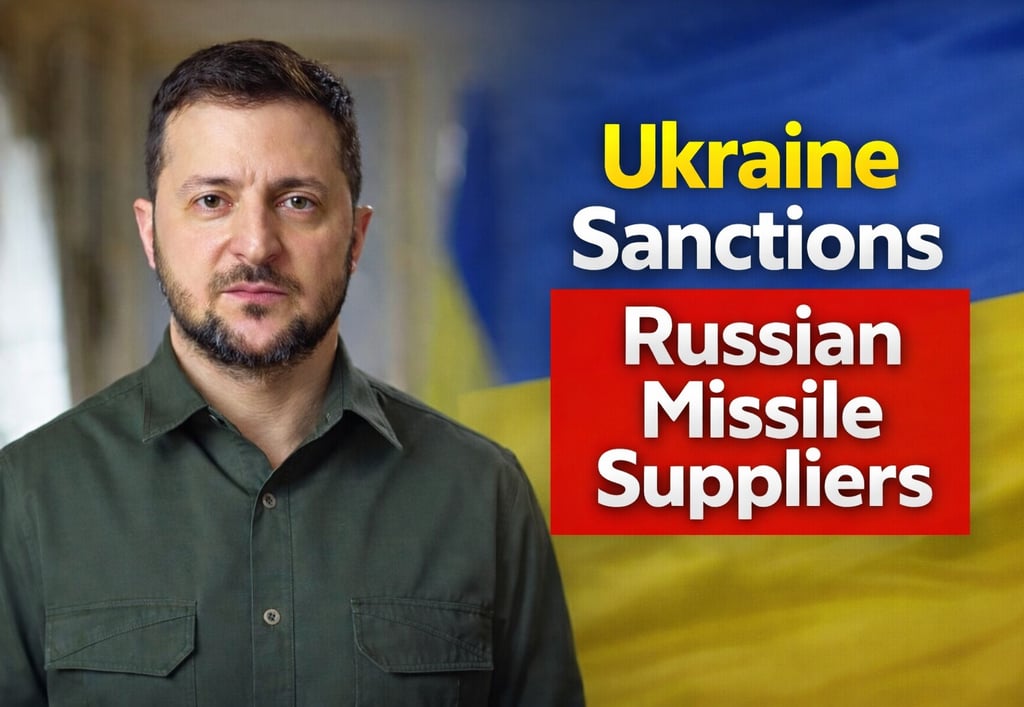
Ukraine Imposes Sanctions on Foreign Suppliers of Components for Russian Missiles — 8 February 2026
Ukraine has introduced a new and far-reaching package of sanctions on 8 February 2026, targeting foreign companies and individuals involved in supplying critical components used in Russian missiles and combat drones. The decision, approved by President Volodymyr Zelensky, is designed to disrupt Russia’s military supply chain and close the international loopholes that have allowed Moscow to continue its attacks despite years of global restrictions.
Ukrainian officials state that Russia’s modern weapons cannot be produced using domestic resources alone. Advanced systems require microchips, navigation modules, optical sensors, and electronic circuits that are imported through complex networks. These parts are often delivered under the label of civilian or dual-use technology and later redirected to military factories. Kyiv believes that without these external supplies, Russia’s ability to launch large-scale missile strikes would decline sharply.
The sanctions focus on companies operating in China, the United Arab Emirates, Panama, and several post-Soviet states. Investigations by Ukrainian security services identified firms that allegedly provided logistics services, re-export channels, and financial mediation for Russian defense manufacturers. The new measures include asset freezes, trade prohibitions, restrictions on banking operations, and bans on access to international payment systems. Authorities have also targeted cryptocurrency platforms suspected of enabling hidden transactions for military procurement.
President Zelensky explained that the intensity of Russian attacks remains extremely high. During the past week alone, Ukrainian cities were hit by more than 2,000 attack drones, around 1,200 guided bombs, and over 100 missiles. These strikes damaged power stations, heating networks, residential buildings, and transport infrastructure, leaving thousands of families without electricity in the middle of winter. According to Kyiv, many of the weapons used in these attacks were built with foreign-made components.
The Ukrainian government has outlined three main goals behind the sanctions. First, to weaken Russia’s capacity to manufacture precision missiles and long-range drones by cutting access to key technologies. Second, to increase coordinated pressure from international partners, particularly the European Union and the United States. Kyiv expects several of its proposals to be included in the upcoming EU 20th sanctions package. Third, to shut down alternative financial routes that Moscow has used to bypass earlier restrictions through shell companies and digital currencies.
Military analysts say the strategy could be highly effective. Modern weapon production depends on a stable flow of semiconductors and specialized electronics. If these supplies are blocked, Russia will struggle to maintain the current tempo of strikes. Ukraine argues that economic and technological isolation of the Russian defense sector is just as important as military aid on the battlefield. The government has called on global partners to tighten export controls and monitor suspicious trade activities more closely.
The decision of 8 February 2026 represents one of the strongest economic moves taken by Ukraine since the beginning of the full-scale war. Instead of responding only with air defenses and diplomacy, Kyiv is expanding the confrontation into the financial and industrial sphere. The coming months will determine how strictly these sanctions are enforced, but the message is clear: any foreign business that helps fuel Russian aggression will face serious consequences.
Stay informed with the latest national and international news.
© 2026. All rights reserved.