
UK Delays Hillsborough Transparency Law After Spy Exemption Backlash | 19 Jan 2026
UK government pauses Hillsborough Transparency Law vote after backlash over intelligence exemptions, amid demands for accountability without loopholes.
Raja Awais Ali
1/19/20263 min read
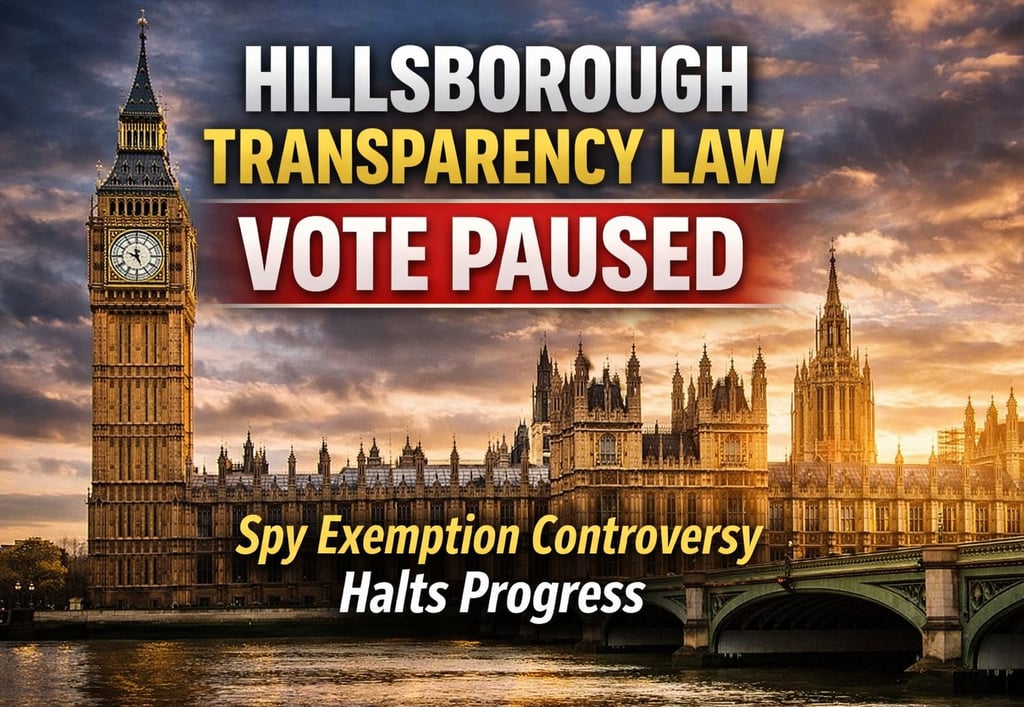
UK Government Pauses Hillsborough Transparency Law After Backlash Over Spy Exemptions
The UK government has postponed a key parliamentary vote on the proposed Hillsborough Transparency Law, formally known as the Public Office (Accountability) Bill, following mounting criticism that controversial provisions could allow intelligence agencies to evade meaningful scrutiny.
The bill was due to receive its third reading in the House of Commons on 19 January, but ministers withdrew it from the agenda at the last moment. The government has instead announced a pause in the legislative process to allow for wider consultations with bereaved families, campaigners, and Members of Parliament. Revised legislation is now expected to return later in the year, potentially via the House of Lords.
What Is the Hillsborough Transparency Law?
The proposed law takes its name from the Hillsborough disaster, one of the darkest chapters in British sporting history. In 1989, 97 Liverpool football supporters died after severe overcrowding and catastrophic failures in crowd management at Hillsborough Stadium.
For decades, official narratives wrongly blamed supporters, while evidence later revealed systemic failures and a prolonged institutional cover-up by authorities. The injustice faced by victims’ families became the driving force behind calls for a legal “duty of candour” — a binding obligation requiring public officials and institutions to tell the truth during investigations, inquests, and public inquiries.
Under the bill, public bodies, civil servants, contractors, and officials would be legally required to act openly and honestly. Knowingly misleading an inquiry could carry serious sanctions, including criminal penalties.
Spy Exemptions Spark Political Backlash
The controversy centres on a government amendment relating to the intelligence services. Under the proposed wording, the duty of candour would apply to agencies such as MI5 and MI6 only with the approval of their respective service chiefs.
Campaigners and opposition figures warned this would create a dangerous loophole, allowing senior intelligence officials to decide what information could be withheld under broad claims of national security — potentially undermining the very purpose of the law.
Senior political figures added to the criticism. Steve Rotheram and Andy Burnham argued the exemption risked turning the legislation into a “selective transparency law”, rather than a universal standard of accountability.
Government Response
Prime Minister Keir Starmer defended the decision to pause the bill, saying the government must “get the balance right” between ensuring accountability and protecting national security. He insisted the delay does not signal a retreat from reform, but a commitment to ensuring the law is both effective and workable.
Culture Secretary Lisa Nandy also stressed that the intelligence services would not be exempt from accountability. However, she acknowledged that the current wording requires refinement to prevent unintended consequences for legitimate intelligence operations, while still avoiding secrecy-driven cover-ups that have caused further harm to victims’ families in past inquiries.
Campaigners Welcome the Pause
Families of victims and transparency campaigners cautiously welcomed the government’s decision, describing it as a “necessary reset”. Many argued that passing a weakened version of the law would have betrayed decades of campaigning and risked repeating historic injustices.
Advocacy groups said meaningful reform must ensure no public institution — including the security services — can self-police its obligation to tell the truth.
What Happens Next?
Ministers have now begun a period of detailed consultation with bereaved families, campaigners, MPs, and peers. The aim is to remove loopholes while preserving legitimate national security safeguards.
The revised bill is expected to return to Parliament later in 2026, potentially with broader political backing and clearer, more robust wording.
Why This Law Matters
If enacted in its strengthened form, the Hillsborough Transparency Law would represent one of the strongest accountability frameworks in UK legal history. It would establish truthfulness as a legal duty — not a discretionary choice — for all public officials following major public tragedies.
For families still seeking justice decades on, the law carries not only legal weight but deep symbolic importance: a guarantee that future victims will not face the same institutional silence and deception.
Stay informed with the latest national and international news.
© 2026. All rights reserved.