
Uber and Lyft Partner With Baidu for UK Robotaxi Trials in 2026
Uber and Lyft team up with Baidu to launch driverless robotaxi trials in the UK in 2026, marking a major shift in autonomous transport.
Raja Awais Ali
12/22/20252 min read
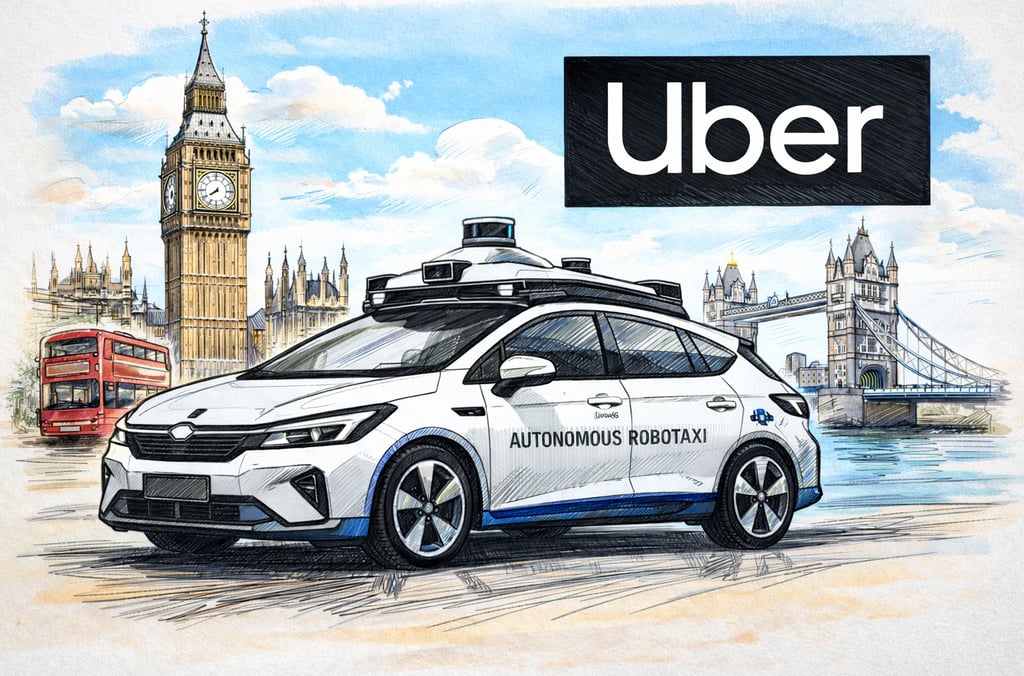
Uber and Lyft Partner With Baidu to Launch Robotaxi Trials in the UK in 2026
London | December 22, 2025 — Global ride-hailing giants Uber and Lyft have announced a strategic partnership with Chinese technology powerhouse Baidu to begin driverless robotaxi trials in the United Kingdom in 2026, marking a major step forward in the evolution of autonomous transportation.
Under the agreement, Uber and Lyft will integrate Baidu’s advanced self-driving technology into their platforms, allowing passengers to book fully autonomous robotaxis through familiar mobile apps once regulatory approvals are completed. The collaboration signals a significant shift in how ride-hailing companies are approaching the future of mobility by relying on artificial intelligence rather than human drivers.
Baidu’s autonomous driving unit, Apollo Go, has already logged millions of successful robotaxi rides across multiple cities in China. The system uses a combination of artificial intelligence, high-precision mapping, lidar sensors, cameras, and real-time data processing to navigate complex urban environments. The UK trials will mark Baidu’s most ambitious expansion into a Western market to date.
The United Kingdom was selected due to its rapidly evolving regulatory framework for autonomous vehicles. Recent legislation has provided clear legal guidelines for testing and deploying self-driving cars, placing responsibility on operators rather than passengers. British officials have emphasized that autonomous technology could reduce road accidents, improve traffic efficiency, and lower emissions, making the country an attractive destination for global tech firms.
Initial robotaxi trials are expected to begin in London and selected major cities during the first half of 2026. The pilot phase will involve a limited number of vehicles and users, allowing companies to closely monitor safety, system reliability, and public response. If successful, the service could expand gradually to larger fleets and broader commercial use.
Industry analysts note that autonomous vehicles have the potential to significantly reduce operational costs for ride-hailing companies, which have long struggled with profitability. Removing the need for human drivers could lower expenses while enabling 24-hour service availability. Additionally, most robotaxis are electric, aligning with the UK’s climate goals by reducing carbon emissions and urban pollution.
Despite the promise, challenges remain. Public trust, cybersecurity risks, and performance in unpredictable real-world scenarios continue to be major concerns. Regulators will closely scrutinize trial results before approving large-scale deployment. Uber, Lyft, and Baidu have stated that safety remains their top priority throughout the testing phase.
Overall, this partnership represents a defining moment for the global autonomous vehicle industry. If the UK trials succeed, robotaxis could soon become a common feature of European cities, reshaping urban transportation and redefining how people move within cities in the AI-driven era.
Stay informed with the latest national and international news.
© 2026. All rights reserved.