
Trump’s White House Ballroom Plan Sparks Political Backlash as Americans Face Economic Pressure
President Donald Trump’s repeated focus on the White House ballroom project during rising gas prices, inflation, and the Iran war has triggered criticism from both Democrats and Republicans ahead of the 2026 midterm elections. Full political and economic analysis.
Raja Awais Ali
5/24/20264 min read
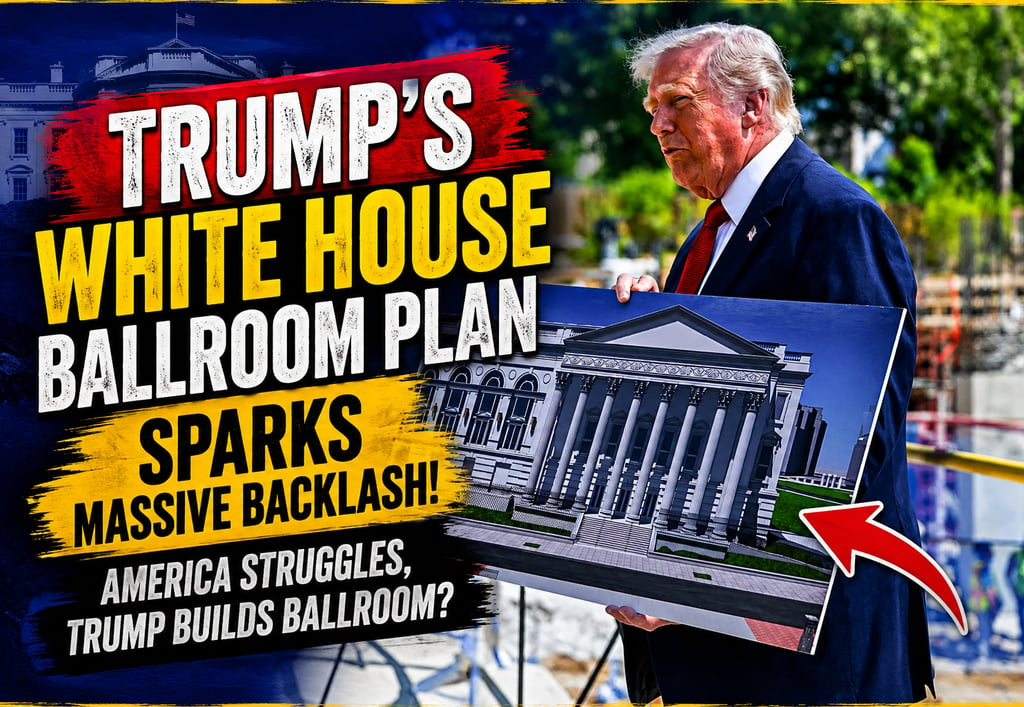
Trump’s White House Ballroom Plan Becomes a Political Flashpoint During America’s Economic Struggles
As the United States moves closer to the 2026 midterm elections, President Donald Trump is facing growing criticism over what many political observers describe as a disconnect between his priorities and the daily struggles of ordinary Americans. While millions of citizens continue dealing with rising fuel prices, inflation, and economic uncertainty linked to the Iran war, Trump has increasingly focused public attention on an ambitious White House ballroom project that has now become one of the most controversial political stories in Washington.
The large-scale ballroom project, which Trump describes as part of his presidential legacy, has become a regular subject in his speeches, media appearances, social media posts, and conversations with reporters. Political analysts say the issue is no longer just about construction or architecture — it has evolved into a debate over leadership priorities during a difficult economic period for American families.
According to multiple reviews of Trump’s public remarks throughout 2026, the president has mentioned the White House ballroom at least 40 times this year alone. In May itself, he reportedly discussed the project nine different times, showing how central the initiative has become to his second-term agenda. Observers note that even during major international crises and sensitive diplomatic meetings, Trump repeatedly returns to the ballroom topic.
The controversy intensified after Trump visited the construction site outside the White House and defended the project while discussing the economic impact of the Iran conflict. During the visit, he urged Americans to remain patient despite rising gas prices and economic pressure, describing the financial damage caused by the conflict as “peanuts.” His comments immediately sparked backlash online and among political opponents who argued that many Americans are struggling to afford basic necessities.
The criticism grew even stronger after another off-the-cuff comment earlier this month in which Trump said he does not think about Americans’ financial situation when discussing Iran because preventing Tehran from obtaining nuclear weapons is his primary concern. The statement quickly went viral and became a major talking point for Democratic lawmakers, who accused the administration of ignoring the economic pain felt across the country.
The ballroom itself is only one part of a much broader legacy-focused agenda. Trump has also promoted plans to redesign Washington’s Reflecting Pool and build a massive 250-foot “Independence Arch” in the nation’s capital. Supporters argue these projects are intended to symbolize American strength, prestige, and national pride. Critics, however, believe the projects are overly expensive, politically disconnected, and poorly timed given the economic climate.
Even after high-profile meetings with Chinese President Xi Jinping, Trump continued promoting the ballroom idea publicly. Following one diplomatic trip, he posted that China has a grand ballroom and the United States should have one too. Moments like these have reinforced the perception that the project holds personal importance for Trump beyond simple infrastructure development.
Inside the Republican Party, concerns are quietly growing. Several Republican strategists and lawmakers reportedly fear that Trump’s continued focus on construction projects and legacy politics could damage the party ahead of the midterm elections. Party insiders believe voters are more concerned about grocery prices, fuel costs, healthcare expenses, and economic stability than ceremonial government buildings.
Republican Senator Cynthia Lummis publicly acknowledged that the ballroom issue may be receiving too much attention. She attempted to reassure voters by emphasizing that the ballroom itself is expected to be funded through private donations rather than taxpayer money.
Trump claims he has secured approximately $400 million from wealthy donors and personal contributions to finance the project. However, the situation became politically complicated after the Secret Service requested nearly $1 billion in federal funding for additional security upgrades connected to the ballroom and surrounding White House complex. The proposal immediately triggered resistance in Congress, including from some Republicans who questioned the timing and necessity of such spending during a period of economic anxiety.
The backlash became serious enough that lawmakers recently removed the proposed security funding from a Senate spending bill, representing a major setback for the administration. Political analysts view the decision as an early sign that even some Republican allies are uncomfortable defending the project publicly.
Democrats now see the ballroom controversy as a powerful campaign issue ahead of November’s elections. Senator Raphael Warnock criticized Republicans for focusing on luxury-style projects while many families struggle with rising living costs linked to tariffs, inflation, and international instability. Democratic strategists believe the issue helps reinforce their broader argument that the administration is out of touch with working-class Americans.
At the same time, Trump continues to insist that the economy is performing strongly. He frequently points to stock market growth, investment announcements, and long-term economic projections while dismissing concerns about inflation. However, public polling suggests many Americans remain worried about their personal finances despite official economic messaging from the White House.
Another factor increasing political pressure is Trump’s reduced domestic travel schedule since the Iran war escalated earlier this year. After initially planning frequent campaign-style trips to promote Republican candidates and economic achievements, the president has spent much of his recent time at the White House or his Florida residence. Critics argue this has created an image of political isolation during a period when voters want direct engagement from national leaders.
The broader political risk for Republicans is perception. In American politics, public image often matters as much as policy itself. Voters facing financial hardship generally expect leaders to demonstrate empathy, urgency, and practical economic solutions. When a president repeatedly discusses ballrooms, monuments, and architectural projects during a cost-of-living crisis, opponents can easily frame the administration as disconnected from everyday reality.
Still, Trump’s supporters strongly defend the initiative. Many believe a grand White House ballroom would modernize America’s presidential complex and better represent the country’s global status. Others see the project as part of Trump’s long-standing branding style, where large symbolic structures are designed to project strength and prestige.
Whether the ballroom controversy ultimately affects the 2026 elections remains uncertain. But politically, the issue has already become far larger than a construction project. It now represents a wider national debate over leadership priorities, economic frustration, government spending, and the image Trump wants to leave behind during his second presidency.
As economic pressures continue and election season intensifies, the White House ballroom may become one of the defining political symbols of America’s current moment — admired by supporters as a vision of national grandeur, but criticized by opponents as evidence of misplaced priorities during a time of public hardship.
Stay informed with the latest national and international news.
© 2026. All rights reserved.