
Trump Voting Machine Controversy 2026: Secret Push Against Dominion Machines Raises U.S. Election Fears
New reports reveal Trump officials explored efforts to block Dominion voting machines before the 2026 midterms. Full analysis of election security, paper ballots, federal control concerns, and the growing U.S. political controversy.
Raja Awais Ali
5/22/20264 min read
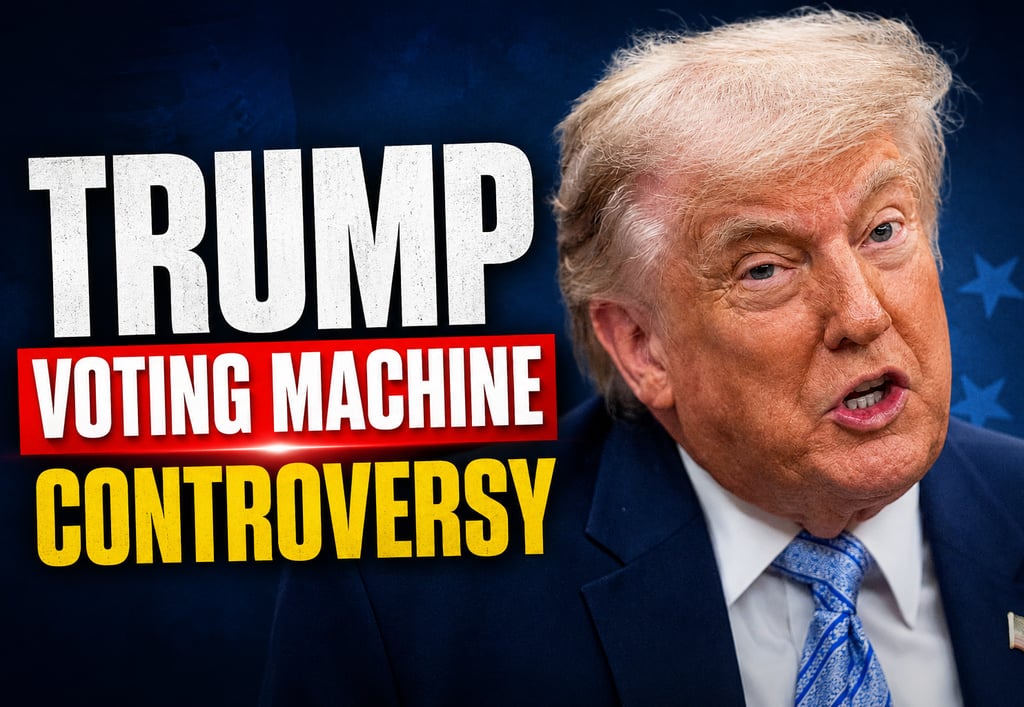
Trump Voting Machine Controversy 2026: Secret Push Against Dominion Machines Raises U.S. Election Fears
America’s election system is once again at the center of a major political storm after reports revealed that officials connected to President Donald Trump explored plans to target voting machines used across more than half of the United States. The controversy has triggered fresh debate over election security, federal authority, conspiracy theories, and the future of democracy ahead of the 2026 midterm elections.
According to multiple officials familiar with internal discussions, senior figures connected to the Trump administration examined whether voting machines manufactured by Dominion Voting Systems could be treated as potential national security risks. The idea reportedly focused on restricting or removing the machines from use before the upcoming congressional elections.
The effort eventually collapsed after officials failed to produce evidence supporting claims that the machines had been used to manipulate election results. However, the revelations have intensified political tensions in Washington and renewed concerns among election experts who fear growing attempts to challenge confidence in the U.S. voting system.
At the center of the controversy is White House adviser Kurt Olsen, a lawyer who has spent years supporting claims that the 2020 presidential election was affected by widespread fraud. American courts, state investigations, federal agencies, and bipartisan reviews repeatedly concluded that there was no evidence of large-scale election manipulation in 2020. Despite this, Trump and many of his allies have continued to question the legitimacy of electronic voting systems.
Sources familiar with the discussions said Olsen explored whether the U.S. Commerce Department could classify components inside Dominion voting machines as national security concerns. Officials reportedly discussed whether supply chain laws designed to block foreign technology threats from countries like China or Russia could be used against election equipment.
The discussions were linked to long-running conspiracy theories claiming that Dominion machines contained hidden foreign software connected to Venezuela. Those allegations became widely circulated after the 2020 election, but no investigation, cybersecurity review, or court proceeding has ever produced evidence proving the claims.
Several other administration officials were reportedly involved in the discussions. Among them was Paul McNamara, a senior aide connected to the Office of the Director of National Intelligence led by Tulsi Gabbard. Sources said McNamara spoke with Commerce Department officials regarding possible security concerns related to voting machine technology.
Brian Sikma, another White House official involved in domestic policy discussions, was also reportedly connected to early conversations surrounding election system reviews and voting machine investigations.
The controversy goes far beyond voting technology. According to officials familiar with internal meetings, discussions also took place about whether the federal government could gain greater authority over how elections are managed across individual states. Under the U.S. Constitution, elections are primarily administered by state governments in order to prevent centralized political control over the democratic process.
Legal experts warn that any attempt by a federal administration to directly control state election systems would trigger a major constitutional battle. Critics argue that such actions could undermine public trust and weaken the balance of power that protects American elections from political interference.
Another major issue involved proposals supporting hand-counted paper ballots instead of electronic voting systems. Trump has repeatedly argued that paper ballots are safer and more reliable than machines. Some of his advisers reportedly supported replacing electronic systems with manually counted paper votes nationwide.
Election security experts strongly disagree with that approach. While paper records are considered important for audits and verification, experts say fully hand-counted elections could create serious logistical problems. Counting millions of ballots manually would likely slow election results, increase human error, and create opportunities for disputes and accusations of fraud.
Most American election systems already combine electronic voting technology with paper verification systems. According to federal election data, more than 98 percent of U.S. voting jurisdictions already produce paper records for every vote cast. These systems allow election officials to conduct audits and recounts if necessary.
Cybersecurity researchers say the current system, which combines machine tabulation with paper verification, provides stronger protection than purely manual vote counting. Experts warn that abandoning modern election systems entirely could increase confusion and reduce efficiency during national elections.
The debate intensified further after Trump recently reshared old claims accusing Dominion machines of deleting votes. Similar allegations previously resulted in major legal consequences for media organizations and political commentators that promoted false election fraud narratives.
In 2023, Fox News agreed to pay Dominion Voting Systems $787 million in one of the largest defamation settlements in U.S. media history after broadcasting false claims related to the 2020 presidential election. Court filings and legal proceedings found that unsupported allegations about Dominion’s voting machines had been repeatedly promoted despite the lack of evidence.
The new controversy also includes investigations involving voting machines used in Puerto Rico during the 2024 gubernatorial election. Officials reportedly conducted technical examinations of the machines searching for signs of foreign interference or suspicious code linked to overseas actors.
Cybersecurity analysts later identified some known technical vulnerabilities, but investigators reportedly found no evidence of Venezuelan software, election manipulation, or foreign-controlled hacking systems inside the machines.
Sources familiar with the investigation said officials dismantled several voting machines to inspect internal hardware and supply chain components. Some chips were reportedly packaged in China, while others came from countries including Japan, South Korea, and Malaysia.
Technology experts say global electronics supply chains commonly involve components assembled or packaged across multiple countries. Analysts argue that the presence of internationally manufactured parts alone does not prove any national security threat or foreign election interference.
The controversy surrounding these investigations has raised fears that election conspiracy theories could once again dominate American politics ahead of the 2026 midterms. Democratic lawmakers and voting rights organizations worry that repeated claims about election fraud may be used to challenge future results or reduce public trust in democratic institutions.
Supporters of Trump argue that election transparency and security reviews are necessary to protect public confidence. They believe electronic systems should face stronger oversight and stricter federal investigations. Critics, however, argue that repeated attacks on voting systems without evidence risk damaging faith in elections themselves.
The issue highlights a deeper divide inside American politics. One side believes the current election system remains vulnerable to manipulation and foreign influence. The other argues that years of investigations have repeatedly confirmed the integrity of modern U.S. elections.
As the 2026 midterm elections approach, the battle over voting machines, federal authority, and election legitimacy is becoming one of the most politically explosive issues in Washington. The growing conflict could shape not only the upcoming elections but also the long-term future of public trust in American democracy.
Stay informed with the latest national and international news.
© 2026. All rights reserved.