
Trump Says U.S. Should Be Involved in Choosing Iran’s Next Supreme Leader Amid Power Struggle
U.S. President Donald Trump says Washington should be involved in selecting Iran’s next Supreme Leader after Ali Khamenei’s death. Analysis of the political stakes, possible successors, and regional impact – March 5, 2026.
Raja Awais Ali
3/5/20263 min read
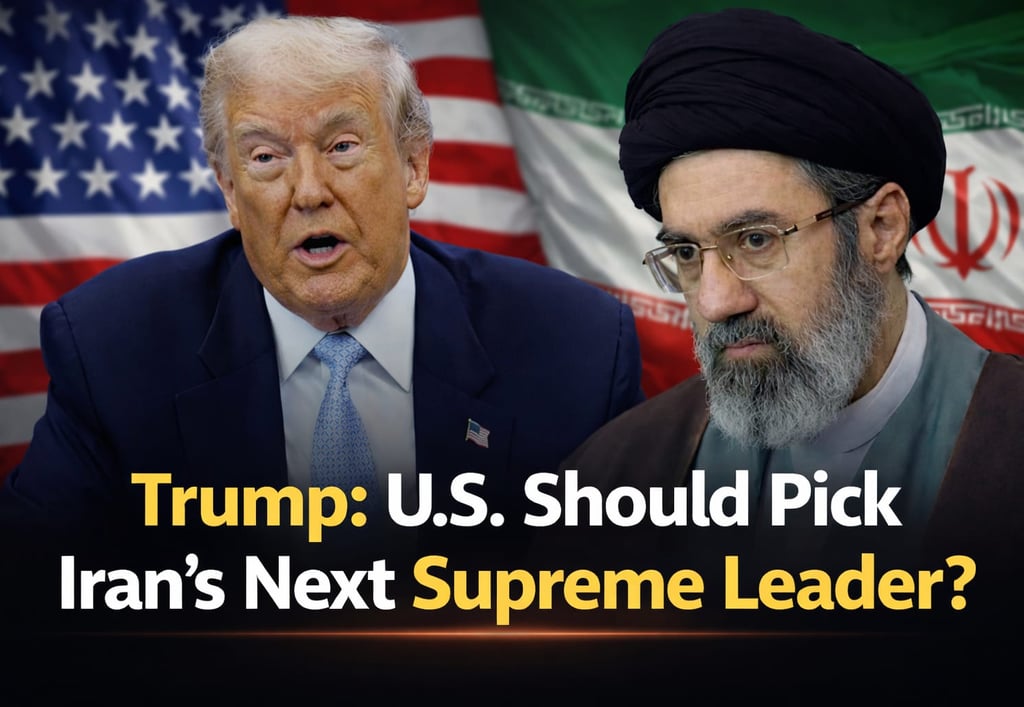
Trump Says U.S. Should Be Involved in Choosing Iran’s Next Supreme Leader
On March 5, 2026, U.S. President Donald Trump said the United States should play a role in the process of selecting Iran’s next Supreme Leader, a statement that has drawn significant international attention amid ongoing uncertainty about Iran’s political future.
According to a report by Axios, Trump argued that the leadership transition in Iran could have far-reaching consequences not only for the country itself but also for the stability of the Middle East. His comments come at a time when Iran is facing a leadership vacuum following the death of its long-time Supreme Leader Ali Khamenei, an event that has triggered intense political discussions inside the Islamic Republic.
Speaking about the situation, Trump suggested that Washington could not ignore such a major geopolitical development. He said the United States had a strong interest in ensuring that Iran’s next leader would pursue policies that reduce regional tensions and avoid future military confrontations.
Iran’s Supreme Leader is the most powerful authority in the country’s political system. The position holds ultimate control over the armed forces, judiciary, intelligence services and key foreign policy decisions. Because of this immense authority, the selection of a new Supreme Leader is considered one of the most critical political processes in Iran.
Under Iran’s constitution, the responsibility for choosing the Supreme Leader belongs to the Assembly of Experts, an influential body made up of senior Islamic scholars. The council consists of 88 clerics who meet and vote to appoint the country’s highest authority. The process typically involves internal consultations and political negotiations among various factions within Iran’s establishment.
However, the current political environment has made the selection process far more complicated. Iran has been facing heightened tensions in the region and increased international scrutiny, making the leadership transition a matter of global concern.
During the interview referenced in the Axios report, Trump specifically rejected the possibility of Mojtaba Khamenei — the son of the late Supreme Leader — becoming Iran’s next top authority. Mojtaba Khamenei has long been viewed by some analysts as a potential successor because of his influence within Iran’s political and security circles.
Trump argued that a hereditary transfer of power would not be acceptable and warned that such a development could deepen tensions between Iran and Western countries. He emphasized that the United States would closely monitor the leadership transition and would prefer to see a figure emerge who is willing to engage in diplomacy and reduce confrontation with the international community.
Political analysts say the question of Iran’s next leader carries major implications for the broader Middle East. Iran remains one of the region’s most influential powers, with strategic alliances and political networks extending across several countries including Iraq, Syria and Lebanon.
Because of these connections, any shift in Iran’s leadership could reshape regional dynamics. A hardline leader might maintain a confrontational approach toward the United States and its allies, potentially escalating tensions. On the other hand, a more pragmatic leader could open the door for renewed diplomatic engagement.
Trump’s remarks have also sparked debate among international policy experts. Some argue that direct involvement by a foreign power in another country’s leadership process could raise serious concerns about sovereignty and international norms. Others believe Washington’s interest reflects the broader strategic stakes involved in Iran’s future leadership.
So far, Iranian officials have not issued a formal response to Trump’s comments. However, Iranian media outlets have widely reported the statement, with some commentators portraying it as an attempt to exert political pressure during a sensitive transition period.
Experts caution that while global powers may try to influence political outcomes, Iran’s leadership structure ultimately relies on internal institutions and elite consensus. The Assembly of Experts, along with influential religious and military figures, will likely play the decisive role in determining who becomes the country’s next Supreme Leader.
As the situation develops, the leadership transition in Iran is expected to remain one of the most closely watched political events in the region. The outcome will not only shape Iran’s domestic political direction but could also influence diplomatic relations, regional security dynamics and the broader balance of power in the Middle East.
For now, Trump’s statement highlights how deeply the question of Iran’s leadership resonates beyond its borders. With tensions already high across the region, the identity and policies of Iran’s next Supreme Leader could play a decisive role in determining whether the coming years bring renewed confrontation or cautious diplomatic engagement.
Stay informed with the latest national and international news.
© 2026. All rights reserved.