
Can Donald Trump Become U.S. President for a Third Term? Constitution, Global Politics and the Iran–Israel War Explained
Can Donald Trump legally serve a third term as U.S. president? A detailed analysis of the U.S. Constitution, the 22nd Amendment, and how the Iran–Israel conflict is fueling debate in American politics.
Raja Awais Ali
3/7/20263 min read
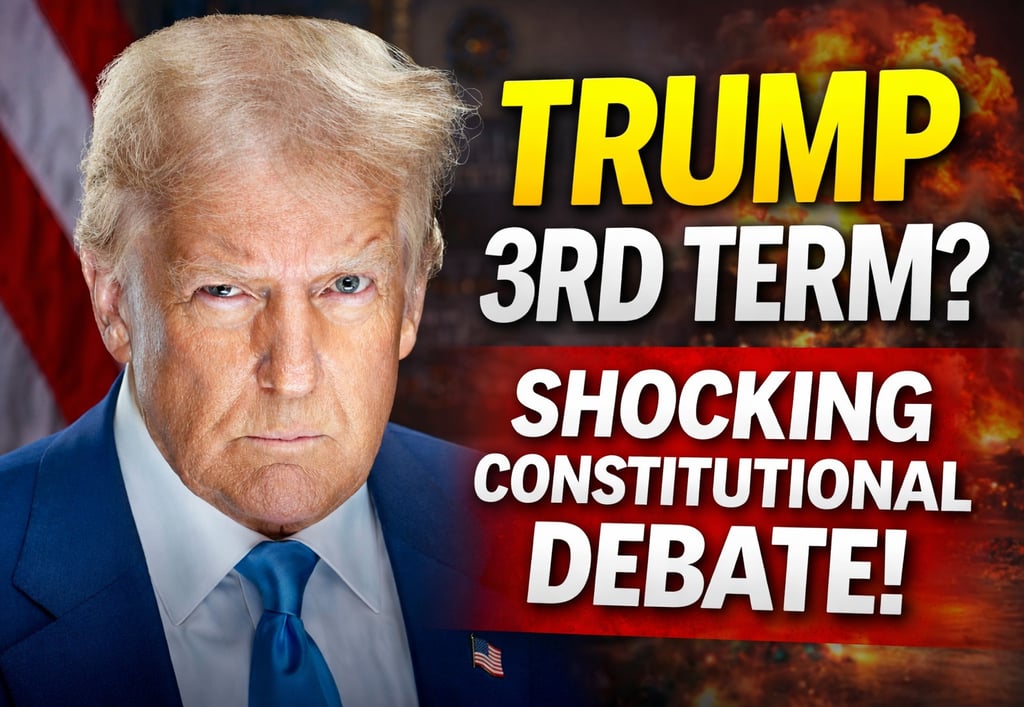

Can Donald Trump Become U.S. President for a Third Term? Constitution, Global Politics and the Iran–Israel War Explained
In American politics, one question has resurfaced in debates and media discussions: can U.S. President Donald Trump legally serve a third term in office? At first glance, the answer seems simple. Most Americans know that a president can serve only two terms. However, when viewed through the lens of the U.S. Constitution, legal interpretations, and the current global political climate, the issue becomes more complex and controversial.
The U.S. Constitution limits presidential terms through the Twenty-second Amendment. Ratified in 1951, it states that no individual may be elected president more than twice. The amendment was introduced to prevent excessive concentration of power and to ensure leadership rotation in the United States.
The term limit followed Franklin D. Roosevelt’s unprecedented presidency. Roosevelt served from 1933 until his death in 1945, winning four elections. Before him, a two-term presidency was a long-standing tradition established by George Washington, though it was not a formal rule. Roosevelt’s four terms sparked debate, leading to the adoption of the 22nd Amendment. Since then, every president has served a maximum of two terms. Barack Obama and George W. Bush, for example, were constitutionally barred from running for a third term.
Some constitutional scholars note a subtle legal nuance. The amendment bars election to the presidency more than twice but does not explicitly forbid assuming the office through other mechanisms. This has led to theoretical debates. One hypothetical scenario involves a former two-term president running for vice president. If the sitting president resigns or becomes unable to serve, the vice president could theoretically assume the presidency. However, most scholars argue this is not viable due to the Twelfth Amendment, which states that anyone constitutionally ineligible to serve as president cannot serve as vice president. Thus, such a workaround would likely fail legal scrutiny.
The only definitive way for a U.S. president to serve a third term would be through another constitutional amendment modifying or repealing the 22nd Amendment. Achieving this is extremely difficult, requiring two-thirds approval in both houses of Congress and ratification by three-fourths of U.S. states—a political threshold rarely reached.
The debate over presidential leadership has gained attention amid escalating geopolitical tensions, particularly the Iran–Israel conflict. On February 28, 2026, joint U.S. and Israeli strikes reportedly killed Iran’s Supreme Leader Ayatollah Ali Khamenei. Several senior Iranian military and political figures were also targeted. Iran confirmed Khamenei’s death and declared a 40-day national mourning period. In response, Iran launched retaliatory missile and drone attacks against Israeli territory and U.S. military installations across the Middle East.
The confrontation quickly spread. Iranian strikes reportedly targeted U.S. military facilities in Gulf states, including Bahrain, Kuwait, Qatar, the United Arab Emirates, Saudi Arabia and Oman. The crisis raised fears of broader regional instability. Military activity in the Persian Gulf intensified, maritime routes faced increased risks, and global energy markets reacted nervously. Tensions around the Strait of Hormuz—a vital route for global oil shipments—pushed oil prices higher.
The crisis was further complicated by President Trump’s comments, expressing hope that Iran’s next leader would be acceptable to the United States and capable of contributing to regional stability. The remarks drew criticism because, under Iran’s constitution, the Supreme Leader is selected by the Assembly of Experts, with no formal role for foreign governments.
The conflict has also fueled domestic debate. Some voters, analysts, and former military officials argue that the confrontation is primarily between Iran and Israel, questioning U.S. involvement. Critics note the immense military spending incurred over a short period and warn of the financial burden of prolonged engagement.
The U.S. Constitution is designed to prevent the concentration of power and ensure regular leadership transitions. While legal theories occasionally spark debate, the practical reality is clear: serving more than two presidential terms is virtually impossible under current rules. Only a major constitutional amendment could change that—an outcome that remains politically and institutionally difficult.
Stay informed with the latest national and international news.
© 2026. All rights reserved.