
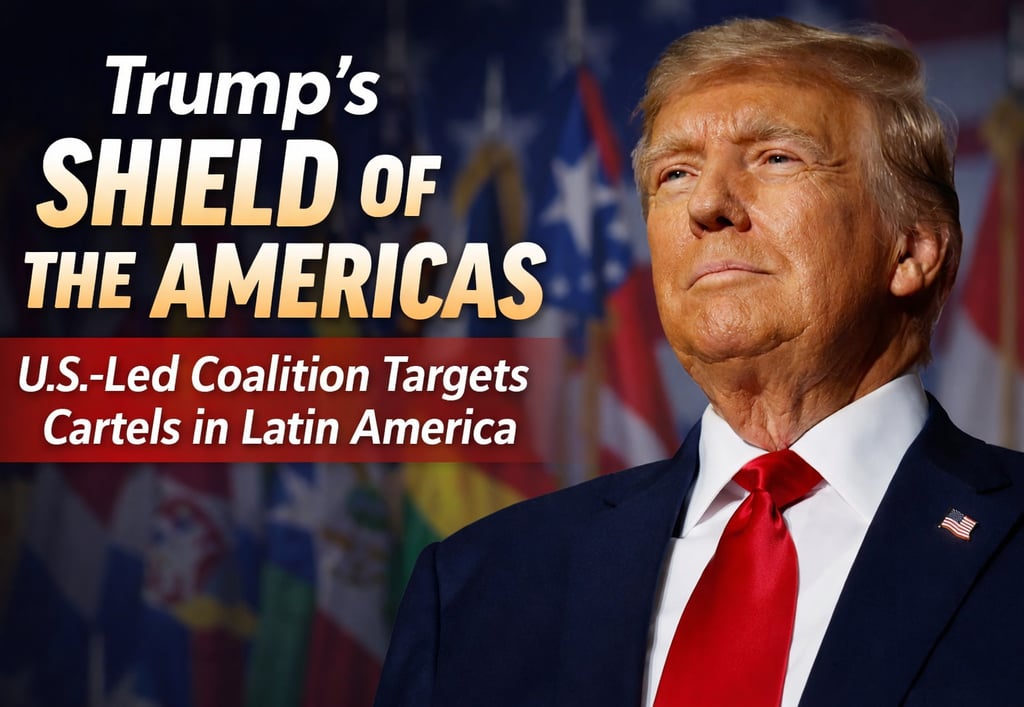
Trump’s “Shield of the Americas”: U.S.-Led Coalition Targets Cartels in Latin America
On March 7, 2026, President Trump hosted the historic Shield of the Americas Summit, forming a U.S.–Latin America coalition to combat drug cartels and counter China’s influence in the Western Hemisphere.
Raja Awais Ali
3/7/20262 min read
Trump’s Historic Summit with Latin American Leaders: The ‘Shield of the Americas’ Coalition
The global political landscape has witnessed a renewed wave of American influence as U.S. President Donald J. Trump hosted a pivotal summit on March 7, 2026, in Florida, named the “Shield of the Americas,” establishing a military coalition designed to coordinate joint operations against drug cartels, organized crime networks, and transnational criminal groups across the Western Hemisphere. The summit occurred just days after U.S. strikes in Iran, signaling that Washington’s strategic focus extends beyond the Middle East and aims to strengthen its influence within its own hemispheric region. President Trump emphasized that the rising power of organized crime in Latin America poses a serious threat to U.S. security and trade interests, asserting that effective countermeasures require combined military and coordinated multinational action.
Approximately a dozen leaders from Latin America and the Caribbean attended, including Argentina’s President Javier Milei, Chile’s President-elect Jose Antonio Kast, El Salvador’s President Nayib Bukele, Ecuador’s President Daniel Noboa, Honduras’ President Nasry Asfura, Dominican Republic’s Luis Abinader, Bolivia’s Rodrigo Paz, Panama’s Jose Raul Molino, Guyana’s Irfan Ali, Costa Rica’s Rodrigo Chavez, Paraguay’s Santiago Pena, and Trinidad and Tobago’s Kamla Persad-Bissessar. These leaders largely align with Trump’s hardline policies, emphasizing security measures, crime suppression, and economic models favoring private enterprise over state intervention. Many have implemented stringent anti-crime policies, such as El Salvador’s “mega-prison” initiative, where last year the U.S. deported over 200 Venezuelans without trial.
Trump reiterated during the summit that the only way to dismantle cartels is through military force, although human rights observers criticized this approach, cautioning that it prioritizes force over public protection and may have unintended impacts on civilians. Analysts argue that long-term solutions require social reforms, education, and economic opportunities to address the root causes of criminal networks. Another key aim of the summit was to counter China’s expanding influence in the region, as in 2024, Chinese trade with Latin America reached $518 billion, and Beijing extended more than $120 billion in loans to regional governments. China’s investments include satellite tracking stations in Argentina, ports in Peru, and oil facilities in Venezuela, developments viewed as strategic threats by the U.S. The Trump administration has sought to reinforce American influence and limit Chinese initiatives, exemplified by Panama’s recent action against a Hong Kong-based company operating in the Panama Canal and U.S. moves to seize control of Venezuelan oil exports under President Nicolás Maduro.
The coalition is significant not only for regional security but also for its potential economic impact, as it could expand U.S. investment and trade ties, reduce Chinese leverage, and foster regional stability, creating new opportunities for commerce. However, key nations such as Mexico, Brazil, and Colombia did not participate, highlighting persistent diplomatic divisions in the region. These countries are central hubs for cartel activity, and their absence raises questions about the coalition’s practical effectiveness. In the coming months, the world will observe whether this coalition can genuinely weaken the cartels or if it serves mainly as a symbolic diplomatic initiative, while U.S. global strategy, China’s reduced influence, and domestic reforms in Latin America will play a critical role in its ultimate success.
Stay informed with the latest national and international news.
© 2026. All rights reserved.