
Trump Shares Leaked Texts and AI Images, Vows “No Going Back” on Greenland | January 20, 2026
Trump escalates Greenland controversy by sharing leaked texts and AI mock-ups, declaring “no going back.” Full analysis of the January 20, 2026 crisis.
Raja Awais Ali
1/20/20263 min read
Trump, Leaked Texts and AI Mock-Ups: “No Going Back” on Greenland — A Full Analysis
On January 20, 2026, global politics entered a new phase of tension after U.S. President Donald Trump adopted an uncompromising and highly controversial stance on Greenland, declaring that there would be “no going back” on America’s ambitions regarding the strategically vital Arctic territory. What began as a political statement quickly escalated into a full-scale diplomatic crisis, fueled by leaked private messages, artificial intelligence–generated images, and rhetoric that alarmed U.S. allies across Europe. The episode has raised serious questions about diplomacy, security, and the future balance of power in the Arctic region.
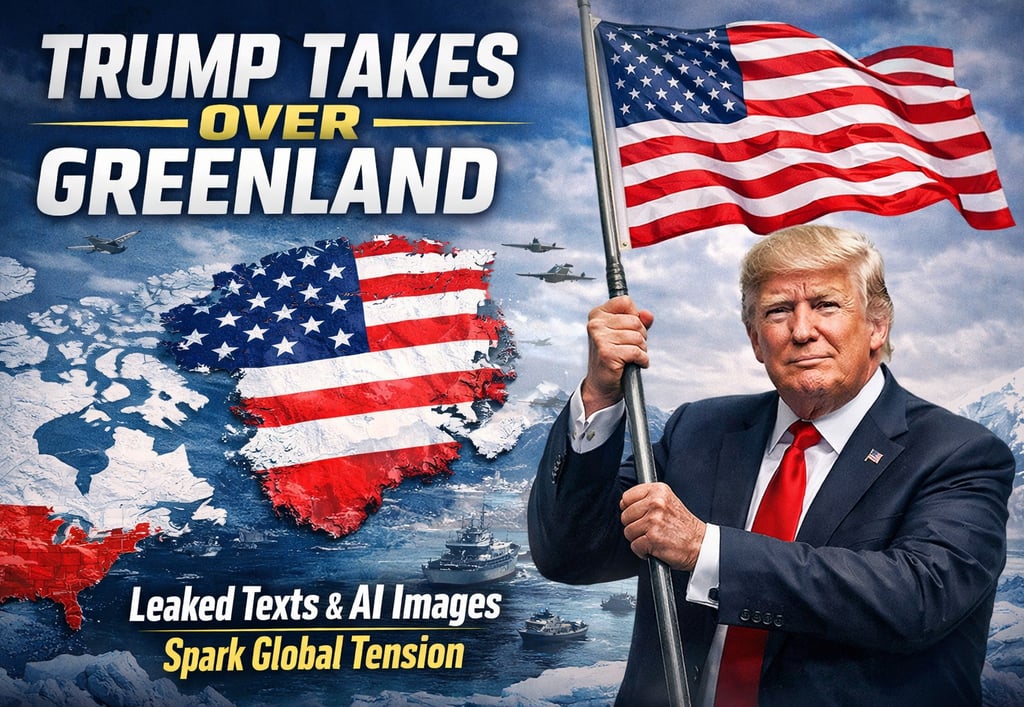
President Trump did not limit his position to speeches alone. Using his social media platform, Truth Social, he shared AI-generated mock-up images depicting himself raising the American flag over Greenland. In several visuals, Greenland — and in some cases even Canada — appeared integrated into a U.S. map. Critics described these images as provocative and irresponsible, arguing that they blurred the line between political messaging and psychological pressure. Supporters, however, viewed them as symbolic assertions of U.S. strategic intent in a rapidly changing geopolitical landscape.
Adding to the controversy, Trump publicly released excerpts of private text messages exchanged with key global figures, including French President Emmanuel Macron and NATO Secretary General Mark Rutte. The disclosure of these communications shocked diplomatic circles, where confidentiality is considered fundamental to trust between allies. One message from Macron reportedly questioned the rationale behind the Greenland push, while other messages appeared cautiously supportive. European officials privately expressed concern that the publication of such correspondence could undermine future diplomatic engagement with Washington.
At the core of Trump’s argument lies national and global security. According to the U.S. president, Greenland’s location makes it indispensable for missile defense systems, Arctic surveillance, and countering the expanding presence of Russia and China in the region. Trump has repeatedly stated that the issue is “not just about America,” but about maintaining global security in an increasingly unstable world. His refusal to rule out the use of pressure has intensified fears that the dispute could move beyond diplomacy.
Denmark, which maintains sovereignty over Greenland while granting it extensive self-rule, reacted swiftly. Danish leaders reaffirmed that Greenland is not for sale and that its future can only be decided by its people. Greenland’s local government echoed this stance, emphasizing self-determination and rejecting any unilateral claims. France and other European nations went further, warning that Trump’s rhetoric resembled outdated colonial thinking and posed a direct challenge to international norms.
The European Union also signaled potential economic consequences. Senior EU officials indicated that retaliatory trade measures, possibly affecting tens of billions of euros in U.S. imports, were under consideration should Washington continue its aggressive posture. Financial markets responded with caution, and analysts warned that a prolonged U.S.–Europe confrontation could harm global economic stability at a fragile time.
Beyond immediate diplomatic fallout, the Greenland controversy has broader implications. NATO unity has been tested, and experts suggest that Russia and China could exploit divisions among Western allies to strengthen their own influence in the Arctic. The episode has also highlighted a new trend in modern politics: the use of artificial intelligence and visual propaganda to shape public perception and apply international pressure.
In conclusion, Trump’s declaration of “no going back” on Greenland marks a critical moment in 2026’s global political landscape. The combination of leaked messages, AI-generated imagery, and uncompromising rhetoric has transformed a strategic debate into a full-blown international crisis. Whether this standoff leads to negotiations or deeper confrontation will shape not only U.S.–European relations but also the future of Arctic geopolitics. One thing is clear: the Greenland issue is no longer a theoretical discussion — it is now a defining test of power, diplomacy, and global order.
Stay informed with the latest national and international news.
© 2026. All rights reserved.