
Does Trump Have a Case Against JPMorgan Over Closed Accounts?
President Trump sues JPMorgan over alleged political debanking. A detailed legal, financial, and political analysis of the case as of Jan 25, 2026.
Raja Awais Ali
1/25/20262 min read
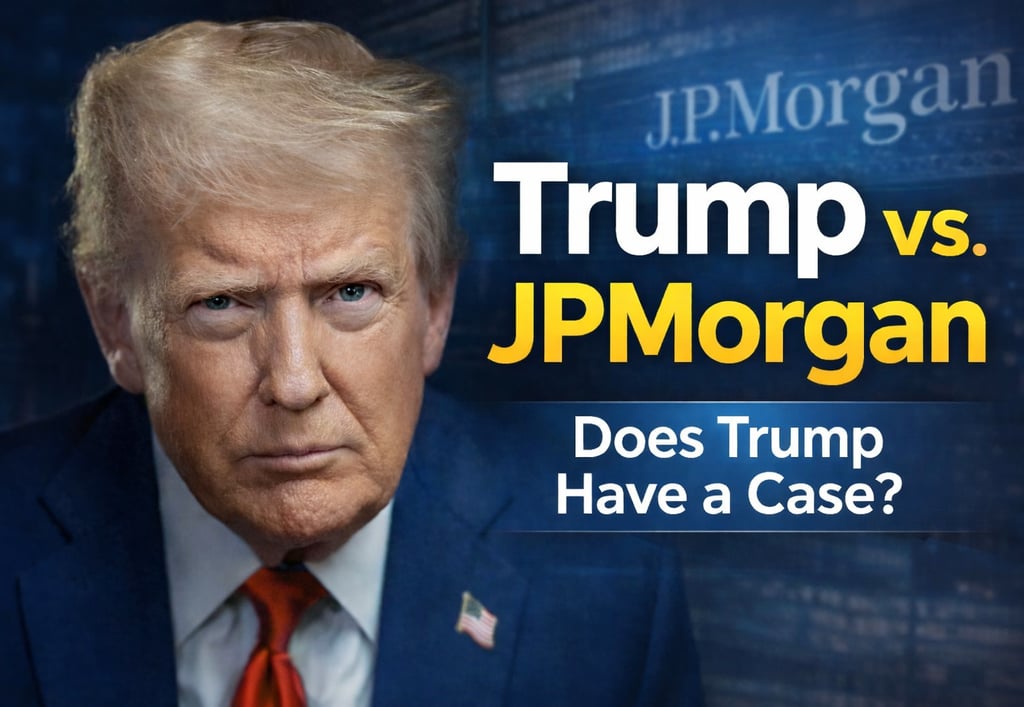
Does President Trump Have a Legal Case Against JPMorgan for Closing His Accounts? A Detailed Analysis
The United States is witnessing a high-profile legal confrontation that goes far beyond an ordinary dispute between a customer and a bank. President Donald Trump has filed a major lawsuit against JPMorgan Chase, America’s largest bank, and its CEO Jamie Dimon, alleging that the bank closed his and his companies’ accounts for political reasons. Filed in January 2026 in a Florida court, the case has triggered intense debate across legal, political, and financial circles.
According to President Trump, JPMorgan abruptly shut down several of his accounts in 2021 without providing a clear or transparent explanation. He claims the bank gave only limited notice and failed to justify its decision with any concrete legal or regulatory reasoning. Trump argues that the move was not a routine business decision but a politically motivated act driven by ideological bias and external pressure.
The president has described this practice as “debanking”—a term used to describe the exclusion of individuals or organizations from the financial system due to their political views or public positions. Trump maintains that JPMorgan’s actions went beyond standard risk management and were instead aimed at marginalizing him financially because of his political identity and influence.
Trump’s legal team argues that the account closures caused significant financial and reputational damage. They claim the decision disrupted business operations, strained relationships with other financial institutions, and negatively affected investment and financing opportunities. The lawsuit also alleges commercial defamation, asserting that JPMorgan’s actions indirectly portrayed Trump and his businesses as financial or legal risks, discouraging other banks from engaging with them.
On this basis, President Trump is seeking $5 billion in damages, arguing that the bank violated principles of good faith and fair dealing. His lawyers contend that even private financial institutions must not abuse their power by making decisions rooted in political discrimination rather than objective financial criteria.
JPMorgan Chase has firmly rejected all allegations. The bank maintains that it does not make decisions based on political beliefs, party affiliation, or public statements. According to the bank, account closures are standard practice when legal, regulatory, or reputational risks are identified, and such decisions are made in accordance with internal policies and compliance obligations.
The bank has emphasized that large financial institutions operate under strict regulatory scrutiny and must regularly assess risk exposure. From JPMorgan’s perspective, the decision to end certain banking relationships was lawful, routine, and unrelated to politics.
Legal experts say the outcome of the case will largely depend on evidence. Under U.S. law, banks generally have broad discretion to choose their clients, particularly when risk management or compliance concerns are involved. However, if President Trump can prove that JPMorgan acted solely on political grounds, the case could set a significant legal precedent.
Analysts note that this lawsuit is not only legal but deeply political. Trump has long argued that major corporations and financial institutions are biased against conservative leaders. By pursuing this case while in office, he is reinforcing a broader narrative that powerful corporate entities should be held accountable when they overstep their influence.
The case may also have long-term implications for the banking sector. A ruling in Trump’s favor could force banks to adopt greater transparency when terminating accounts, while a victory for JPMorgan would reaffirm the broad autonomy financial institutions currently enjoy.
Ultimately, the Trump-JPMorgan lawsuit represents more than a dispute over closed accounts. It is a test of how political power, corporate authority, and financial access intersect in modern America. The court’s decision could reshape the boundaries between politics and banking for years to come.
Stay informed with the latest national and international news.
© 2026. All rights reserved.