
Trump Iran War 2026: Is Donald Trump Losing the Iran Conflict After Three Months?
Three months after the U.S.-Iran war began, questions are growing over whether Donald Trump is winning or losing the conflict. Full analysis of war costs, Strait of Hormuz tensions, oil prices, Iran’s nuclear program, U.S. strategy, and global geopolitical risks.
Raja Awais Ali
5/23/20266 min read
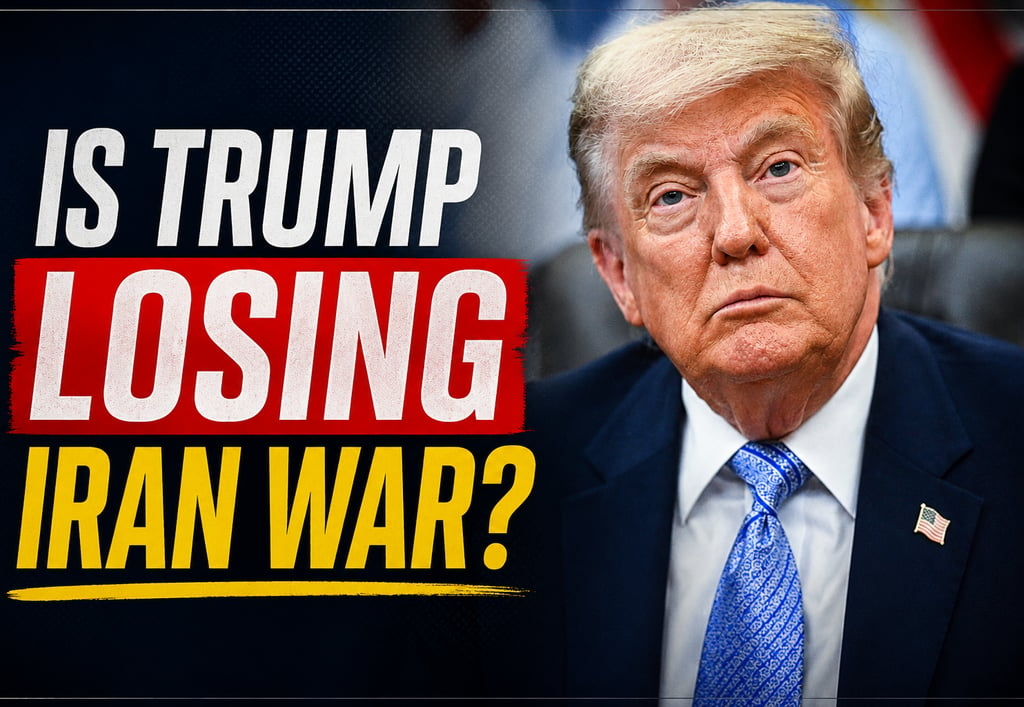
Trump Iran War 2026: Is Donald Trump Losing the Iran Conflict After Three Months?
Three months into the 2026 U.S.-Iran war, the biggest question in global politics is no longer who won the first strikes or which side destroyed more military targets. The real question now is whether U.S. President Donald Trump is slowly losing the wider strategic war against Iran despite America’s overwhelming military power.
When the conflict began in February 28 2026, the White House believed the operation would be fast, decisive, and politically beneficial for Trump ahead of the U.S. midterm elections. American and Israeli airstrikes hit Iranian missile facilities, naval infrastructure, military bases, and senior commanders within days. Washington presented the campaign as a major military success and repeatedly claimed that “Operation Epic Fury” had achieved its objectives.
But three months later, the situation looks very different.
Iran’s government is still standing. Its regional influence has not disappeared. Its nuclear program has not been fully eliminated. Most importantly, Tehran has continued to use the Strait of Hormuz as a powerful geopolitical pressure point capable of shaking the global economy.
The Strait of Hormuz remains one of the world’s most critical energy routes, carrying nearly one-fifth of global oil and gas supplies. Iran demonstrated that even under heavy military pressure, it still has the ability to disrupt international shipping routes and create fear in global energy markets. Oil prices surged multiple times during the conflict while global investors reacted nervously to every escalation in the Gulf.
This growing uncertainty is one of the main reasons analysts are beginning to question whether Trump can truly present the war as a geopolitical victory rather than just a short-term military success.
Former U.S. Middle East negotiator Aaron David Miller described the war as a conflict that was originally designed to be a quick demonstration of American strength but is now turning into a possible long-term strategic failure. According to him, Washington succeeded tactically on the battlefield but failed to reshape the political realities of the region.
For Trump, the stakes are personal as well as political.
Throughout his political career, Trump built his image around strength, dominance, and winning. He has often mocked opponents as “losers” and presented himself as a leader who always comes out on top. But the Iran conflict is becoming increasingly difficult to frame as a clear victory because Iran has refused to surrender politically despite severe military and economic damage.
At the same time, domestic pressure inside the United States is increasing.
Trump had campaigned for a second term promising to avoid unnecessary wars and foreign entanglements. Instead, he now finds himself managing one of the most dangerous Middle East conflicts in recent years. Rising fuel prices, economic uncertainty, and declining approval ratings are creating additional political pressure ahead of the November midterm elections, where Republicans are already facing a difficult battle to maintain control of Congress.
The economic cost of the war is also becoming impossible to ignore.
Defense and economic analysts estimate that within just three months, the United States may already have spent between $180 billion and $250 billion directly and indirectly on military operations linked to Iran. These costs include naval deployments in the Gulf, continuous air operations, missile defense systems, military logistics, intelligence support, protection of global shipping routes, and expanded military coordination with regional allies.
Maintaining large-scale U.S. naval forces around the Strait of Hormuz alone reportedly costs millions of dollars every single day. Advanced missile defense systems, warship deployments, combat aircraft operations, fuel supply chains, and regional troop movements are placing enormous pressure on American military resources and budgets.
Meanwhile, global economic effects are spreading far beyond the Middle East.
Oil market instability has pushed energy prices higher across several regions, increasing fears of inflation and slowing economic growth. American consumers are already feeling the impact through rising gasoline prices while businesses continue facing uncertainty in global trade and transportation costs.
Some economists warn that if the conflict continues for several more months, the financial burden could begin to resemble the early economic pressure created by the Iraq and Afghanistan wars, although this conflict is unfolding at a much faster and more economically sensitive pace due to its connection with global energy markets.
Iran, however, is fighting a very different kind of war.
Instead of trying to match American military power directly, Tehran has focused on asymmetric warfare tactics. With comparatively limited financial and military resources, Iran has managed to create pressure through regional instability, maritime threats, drone operations, and strategic control over energy routes.
This has led many international analysts to describe the conflict as a “low-cost resistance versus high-cost superpower war,” where the United States is spending hundreds of billions of dollars while Iran uses limited resources to create global disruption.
Iranian leaders have also presented the conflict as proof that the Islamic Republic can survive direct confrontation with the United States. Although Iran suffered major military losses, Tehran argues that simply remaining politically intact after months of attacks is itself a victory.
Another major problem for Trump is that his main war objective remains incomplete.
At the beginning of the conflict, Trump repeatedly stated that the purpose of the war was to stop Iran from obtaining a nuclear weapon. However, three months later, that objective still appears uncertain.
Reports suggest that part of Iran’s highly enriched uranium stockpile may still remain hidden underground despite U.S. and Israeli strikes. Intelligence experts believe Tehran could potentially recover and continue processing nuclear material if negotiations collapse or tensions rise again.
Some analysts now fear the war may actually push Iran closer toward developing a nuclear weapon rather than stopping it. According to this argument, Iranian leaders may conclude that nuclear capability is the only reliable way to prevent future American military attacks, similar to the deterrence model used by North Korea.
Trump also promised to weaken Iran’s regional proxy networks and reduce Tehran’s influence across the Middle East. But despite military pressure, Iran-backed groups remain active in several parts of the region, and security concerns continue for Gulf countries and Israel.
The conflict has also exposed growing divisions between the United States and some of its traditional European allies.
Several European governments reportedly refused to provide deeper military involvement because they believed Washington moved too quickly toward war without broader international consultation. This has created additional diplomatic tension between America and Europe at a time when global cooperation is already fragile.
Meanwhile, both China and Russia are closely studying the conflict. Defense experts believe both countries are analyzing American military limitations, weapons usage rates, and Iran’s ability to use asymmetric tactics against a much stronger opponent.
Some analysts argue that Beijing could apply lessons from the Iran conflict to future tensions around Taiwan, while Moscow may also use similar observations in its long-term military planning.
Despite all the criticism, Trump still has defenders who argue that the war damaged Iran significantly and strengthened America’s regional partnerships.
Former Trump adviser Alexander Gray stated that weakening Iran’s military infrastructure itself should be considered a strategic success. Supporters of the administration also argue that Gulf Arab states have moved closer to Washington during the crisis while concerns over Chinese influence in the Middle East have increased.
However, the broader reality remains complicated.
The war has already lasted twice as long as Trump originally suggested. Negotiations remain unstable, regional tensions continue, and fears of another military escalation have not disappeared. Trump continues threatening additional strikes if Iran refuses new conditions, but every new threat also increases the risk of a wider regional conflict involving multiple countries.
Some American analysts believe Trump now faces two difficult choices.
He can either accept a limited diplomatic agreement that may appear politically weak but provides an exit from the crisis, or he can expand military pressure and risk dragging the United States deeper into a prolonged confrontation with unpredictable consequences.
Brookings Institution analyst Robert Kagan warned that the long-term geopolitical consequences of the Iran conflict could become even more damaging to America’s global image than the withdrawals from Vietnam or Afghanistan. According to him, the difference is that Iran sits in the center of one of the world’s most strategically important regions linked directly to energy markets, trade routes, and great power competition.
Three months after the war began, one reality is becoming increasingly clear: despite unmatched military strength, the United States has not forced Iran into complete submission. At the same time, Iran, despite economic sanctions, military destruction, and international pressure, has not collapsed politically.
That is why the Iran war is no longer being judged only by destroyed targets or military statistics. It is now being judged by economic pressure, political endurance, global energy disruption, diplomatic fallout, and the changing balance of power in the Middle East.
The coming months may ultimately decide whether Trump can still reshape the conflict into a political victory or whether the war becomes remembered as a costly confrontation that exposed the limits of American power against a determined regional rival.
If Washington continues spending enormous financial and military resources without achieving its core objectives, the conflict could become a serious challenge not only for Trump’s presidency but also for America’s long-term credibility and deterrence strategy around the world.
And if Iran continues surviving under pressure while maintaining influence over one of the world’s most important energy chokepoints, the Middle East could be entering a new geopolitical era where economic leverage, energy disruption, and asymmetric warfare become more powerful than traditional military dominance alone.
Stay informed with the latest national and international news.
© 2026. All rights reserved.