
Trump Considers Iran Strikes as Gulf States Warn and EU Imposes New Sanctions | Jan 29, 2026
Trump weighs limited Iran strikes to fuel protests as Gulf states warn of escalation, Israel stays cautious, and the EU announces new sanctions.
Raja Awais Ali
1/29/20263 min read
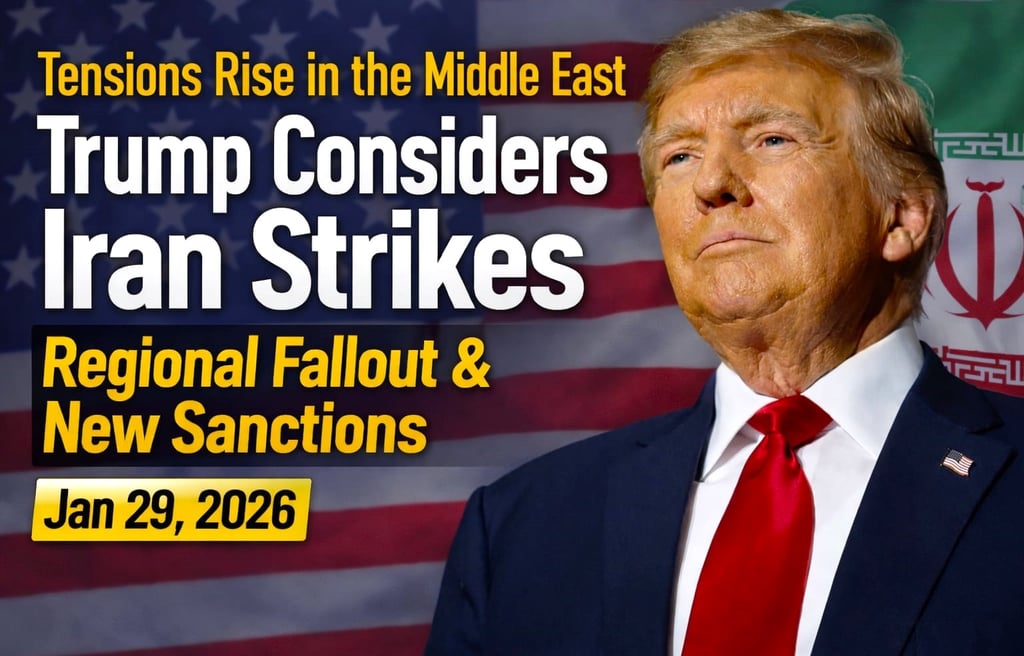
Trump Weighs Iran Military Strikes as Gulf States Warn of Regional Fallout and EU Imposes New Sanctions
U.S. President Donald Trump is weighing the option of limited military strikes against Iran in a move that senior officials say could reignite anti-government protests inside the country, according to multiple diplomatic and security sources. The deliberations come amid renewed unrest in Iran, mounting economic pressure, growing regional concern among Gulf states, Israel’s cautious security posture, and fresh sanctions announced by the European Union.
Sources familiar with internal discussions say the White House has reviewed scenarios involving targeted airstrikes against Iranian security infrastructure, including facilities linked to the Islamic Revolutionary Guard Corps (IRGC), missile networks, and command centers. The objective, officials stress, is not a full-scale war but calculated pressure intended to exploit Iran’s internal vulnerabilities and encourage renewed public dissent.
Iran has been facing its most severe domestic challenges in years. Protests that began in late December 2025 were driven by soaring inflation, unemployment, currency collapse, and long-standing political grievances. Official figures place inflation above 40%, while the Iranian rial has fallen to near-record lows against the U.S. dollar. Human rights groups report thousands of arrests, widespread internet restrictions, and dozens of deaths during the government’s crackdown on demonstrations.
President Trump has publicly stated that Iran must agree to a new and more restrictive agreement covering its nuclear ambitions and ballistic missile program or face “serious consequences.” In recent weeks, the United States has increased its naval and air presence in and around the Gulf, moves widely interpreted by analysts as part of Washington’s pressure campaign rather than preparation for immediate conflict.
Gulf States Urge Restraint
Gulf countries have reacted with growing alarm to the possibility of U.S. military action. Saudi Arabia, Qatar, the United Arab Emirates, and Oman have all conveyed concerns to Washington, warning that any strike on Iran could trigger retaliation across the region. Officials fear that shipping lanes, energy infrastructure, and civilian populations could be exposed to Iranian countermeasures or actions by allied militias.
Saudi officials have privately indicated that the kingdom would not permit its airspace to be used for attacks on Iran, reflecting broader regional anxiety over escalation. Gulf leaders argue that while Iran’s behavior is destabilizing, a military confrontation could spiral into a conflict that disrupts global energy markets and regional security.
Israel Maintains a Cautious Stance
Israel has taken a measured but alert position. Israeli security officials believe that limited airstrikes alone would be insufficient to dismantle Iran’s political system or long-term military capabilities. While Israel continues to view Iran as a strategic threat, officials have avoided endorsing immediate U.S. military action, emphasizing intelligence coordination and deterrence.
At the same time, Israel has warned that any Iranian or proxy attack on Israeli territory would be met with a decisive response, underscoring the fragile balance currently holding the region together.
European Union Announces New Sanctions
On 29 January 2026, the European Union announced a new round of sanctions targeting Iranian entities and individuals linked to human rights violations. The measures include asset freezes, travel bans, and expanded financial restrictions, particularly against figures associated with the IRGC and internal security forces.
EU officials said the sanctions were imposed in response to Iran’s violent suppression of protests and continued refusal to meet international human rights standards. While Europe continues to support diplomatic engagement, officials stressed that accountability and pressure are necessary to address Tehran’s actions.
A High-Risk Moment for the Region
Analysts warn that the convergence of military pressure, domestic unrest, regional fear, and economic strain has created one of the most dangerous moments for Middle East stability in recent years. While Washington views targeted force as a means of leverage, critics argue that external military pressure often strengthens hardliners rather than weakening them.
For now, no final decision has been made by the White House. Diplomacy, sanctions, and military signaling continue simultaneously, leaving Iran, its neighbors, and global markets on edge. The coming weeks will determine whether tensions ease through negotiation or escalate into a confrontation with far-reaching consequences.
Stay informed with the latest national and international news.
© 2026. All rights reserved.