
Trump Warns Iran Over Strait of Hormuz Tolls as Oil Prices Surge 50% | Global Energy Crisis April 2026
US President Donald Trump warns Iran against charging tolls in the Strait of Hormuz as oil prices surge 50%. Japan releases emergency oil reserves amid a deepening global energy crisis.
Raja Awais Ali
4/10/20263 min read
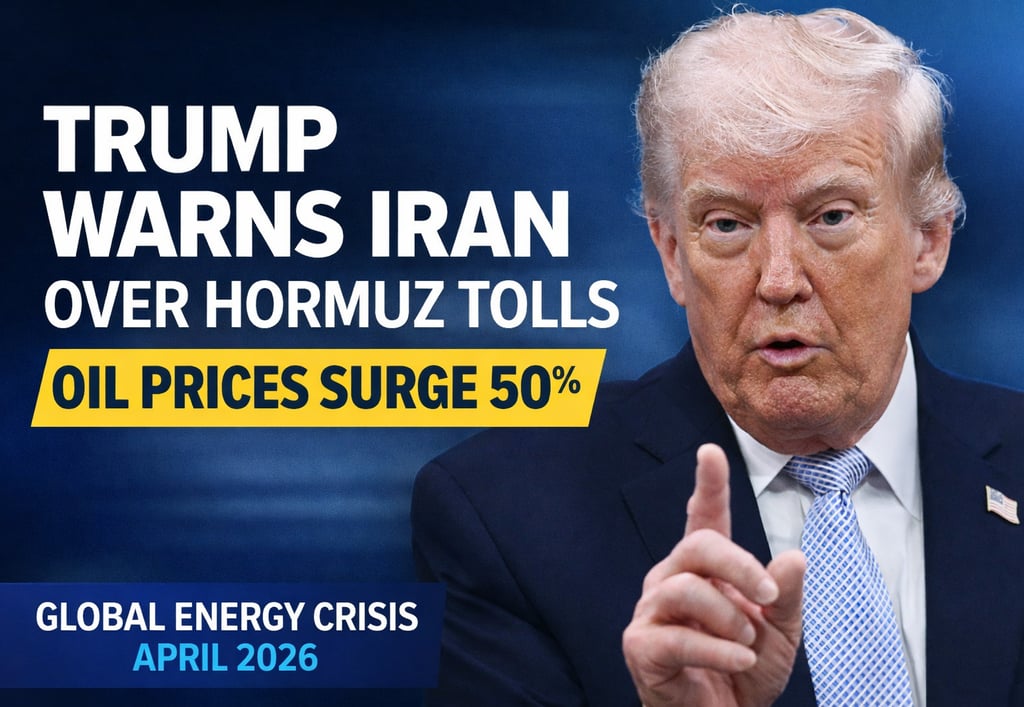
Trump Warns Iran Over Strait of Hormuz Tolls as Oil Prices Surge 50% | Global Energy Crisis Deepens
The global energy market is entering a critical phase in April 2026, as escalating tensions in the Gulf region continue to disrupt oil supplies and intensify economic uncertainty worldwide. In a strong warning, Donald Trump said Iran must not impose tolls on ships passing through the Strait of Hormuz, as fears grow over a worsening energy crisis that has already pushed oil prices up by nearly 50%.
The warning comes amid reports that Tehran is considering charging fees for tanker transit through the strategic waterway, a move that could further strain global trade. Trump, writing on social media, said such actions would violate the terms of a recently agreed ceasefire and disrupt already fragile energy flows.
“There are reports that Iran is charging fees to tankers passing through the Strait of Hormuz. They should not be doing that, and if they are, they must stop immediately,” Trump said, adding, “That is not part of the agreement we have.”
The remarks follow a two-week ceasefire agreement reached on April 7, 2026, between the United States and Iran after weeks of conflict that damaged energy infrastructure across the Gulf. A central condition of the ceasefire was the reopening of the Strait of Hormuz to allow hundreds of stranded tankers and commercial vessels to resume operations.
However, despite the agreement, the situation on the ground remains fragile. Hundreds of oil tankers are still stranded in the region, creating a major bottleneck in global supply chains. The disruption has significantly slowed crude shipments, while insurance premiums and freight costs for shipping companies have surged, adding further pressure on global energy markets.
The Strait of Hormuz remains one of the most critical oil chokepoints in the world, with nearly 20% of global oil supply passing through it daily. Any disruption in this narrow waterway has immediate consequences for international markets. Asian economies—including Japan, China, and India—are among the hardest hit due to their heavy reliance on Gulf oil imports.
In a controversial move, Iran has proposed an alternative maritime route for vessels, advising them to sail through Iranian waters near Larak Island to avoid potential naval mines in traditional shipping lanes. The guidance was issued by Iran’s Islamic Revolutionary Guard Corps (IRGC), according to regional reports. However, this alternative route has raised serious concerns among shipping firms and insurers due to heightened legal and security risks.
Adding to the uncertainty, Hamid Hosseini said that Tehran may consider charging tolls in cryptocurrency during the ceasefire period. Analysts believe this move could help Iran bypass US sanctions and reduce reliance on the dollar-based financial system, potentially signaling a major shift in global trade mechanisms.
The impact of the crisis is now spreading far beyond oil markets. Several key industries are facing disruptions, including liquefied natural gas (LNG) supply chains, aluminium production, and global aviation due to rising jet fuel costs. India is experiencing shortages of cooking gas (LPG), while Asian semiconductor manufacturers are dealing with helium supply constraints. Diesel prices are also rising, affecting agricultural sectors worldwide.
Japan remains one of the most affected countries, relying on the Gulf for approximately 95% of its oil imports. In response, Prime Minister Sanae Takaichi announced that Japan will release an additional 20 days’ worth of oil reserves starting in May to stabilize supply.
Japan is also working to diversify its energy imports. Officials suggest that more than half of the country’s oil imports could soon be rerouted through alternative channels bypassing the Strait of Hormuz. Additionally, Japan is increasing imports of US crude oil, with projections showing a fourfold increase compared to the previous year.
Saudi Arabia has also been significantly impacted by the conflict. Iranian attacks have reduced the kingdom’s oil production capacity by approximately 600,000 barrels per day, while flows through the key East-West Pipeline have dropped by around 700,000 barrels per day. This pipeline plays a critical role in bypassing the Strait of Hormuz.
To maintain exports, Saudi Arabia is relying on the Red Sea route, particularly through the port of Yanbu. However, full recovery remains dependent on the complete reopening and stabilization of the Strait of Hormuz.
In a notable market shift, Iranian crude oil is now trading at a premium rather than a discount. Chinese independent refiners, known as “teapot refiners,” are paying between $1.50 and $2 per barrel above Brent crude. This marks a significant reversal from pre-conflict levels, when Iranian oil was sold at discounts of around $10 per barrel.
Brent crude is currently trading near $97 per barrel, while US West Texas Intermediate (WTI) is approaching $98.50 per barrel. Analysts warn that prices could surpass $100 if tensions escalate further or if the Strait of Hormuz faces additional disruption.
Overall, the Strait of Hormuz crisis has evolved into a major global economic threat. A complete shutdown could disrupt nearly 20% of the world’s oil supply, potentially triggering a global recession. Experts stress that immediate diplomatic efforts, strict adherence to the ceasefire, and investment in alternative energy sources are essential to stabilize the situation.
Stay informed with the latest national and international news.
© 2026. All rights reserved.