
Trump Hosts UFC Freedom 250 at the White House as War, Politics and Public Debate Collide
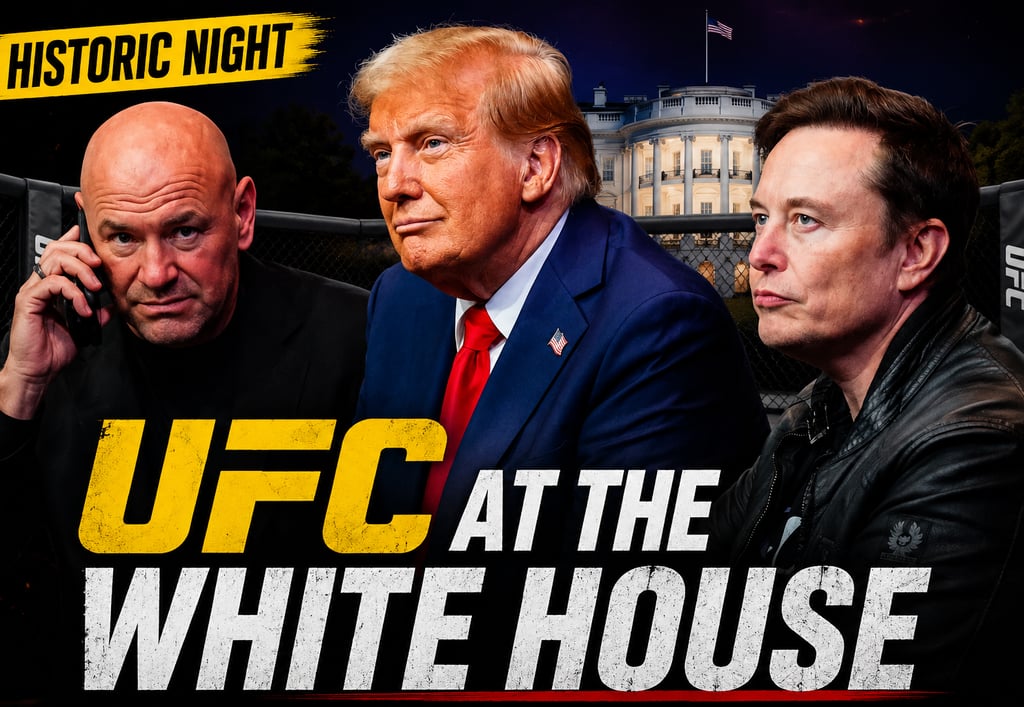
Donald Trump celebrated his 80th birthday by hosting UFC Freedom 250 at the White House. The historic event featured a championship fight card, drew political scrutiny, raised ethical questions, and sparked nationwide debate.
Raja Awais Ali
6/14/20264 min read
Trump Hosts UFC Freedom 250 at the White House as War, Politics and Public Debate Collide
President Donald Trump celebrated his 80th birthday by hosting UFC Freedom 250 on the South Lawn of the White House, creating one of the most unusual and controversial events ever staged at the presidential residence. The event combined sports, politics, entertainment, and national symbolism while drawing attention from across the United States and around the world.
UFC Freedom 250 was organized as part of celebrations marking the upcoming 250th anniversary of the founding of the United States. To accommodate the event, a massive temporary arena known as "The Claw" was constructed on White House grounds. Standing 92 feet (28 meters) tall, the structure housed the UFC Octagon just steps away from the White House itself, creating a setting unlike anything previously seen in American presidential history.
The fight card featured seven mixed martial arts bouts involving 14 fighters representing five countries. The headline event was a lightweight championship contest between UFC lightweight champion Ilia Topuria and former interim titleholder Justin Gaethje. The championship fight was scheduled for up to five rounds and served as the centerpiece of the evening.
The event came at a politically sensitive time for Trump. Seventeen months into his second term, the president has been facing growing pressure related to the ongoing conflict involving Iran. The four-month war has contributed to rising consumer prices, which have reached their highest level in three years. Public opinion surveys have also shown growing concern among voters regarding the administration's handling of national and international challenges. Against that backdrop, many observers viewed UFC Freedom 250 as an opportunity for Trump to project strength, command public attention, and counter growing speculation about his political influence.
Approximately 4,000 invited guests were expected to attend the event inside the temporary arena. Tickets were not sold to the general public. Reports indicated that UFC offered some access opportunities to guests contributing more than $1 million. About one-quarter of the audience consisted of active-duty military personnel and service members invited by the administration. In addition, tens of thousands of people were expected to gather in a nearby public park where giant screens were set up to broadcast the fights live.
The decision to host a private sporting event on federal property generated immediate controversy. Critics argued that using White House grounds for a private company's event represented an unusual expansion of presidential authority and raised questions about ethics, transparency, and government oversight. A legal challenge sought to block the event, claiming that the administration lacked proper authorization and should have obtained congressional approval before proceeding.
However, a federal judge declined to stop the event, allowing it to move forward as scheduled. The ruling cleared the way for one of the most unique sporting spectacles ever held at a government property in the United States.
Trump's relationship with UFC President Dana White became another major focus of discussion. White has publicly supported Trump since his first presidential campaign in 2016 and remains one of his most prominent allies in the sports world. UFC's popularity among younger male audiences has also made the organization politically significant, as many analysts consider that demographic an important voting bloc.
Financial and ethical concerns also became central to the debate surrounding UFC Freedom 250. TKO Group Holdings, the parent company of UFC, is a publicly traded company. Reports indicated that Trump's trust purchased shares in TKO Group Holdings ahead of the event. Meanwhile, a company licensed to market the president's likeness sold commemorative coins priced at up to $12,000. Additionally, Crypto.com, one of the official sponsors of UFC Freedom 250, had previously partnered with Trump Media & Technology Group.
These business relationships prompted critics to question whether conflicts of interest existed. The White House strongly rejected those concerns, stating that the president's business affairs are managed separately by family members and that no conflict of interest was involved.
UFC stated that it invested more than $60 million in the event and did not expect to generate a profit. Despite that claim, critics continued to argue that UFC Freedom 250 resembled a private corporate gathering more than a traditional national celebration.
Public reaction to the event appeared sharply divided. A survey of 4,531 American adults found that only 16 percent believed it was appropriate to host a UFC event at the White House. Among mixed martial arts fans, Trump's approval rating stood at 45 percent, while 55 percent expressed disapproval. Although that figure exceeded his overall national approval rating of 35 percent, it remained significantly lower than his 79 percent approval rating among Republican voters.
The survey also revealed unique political characteristics among MMA fans. Nearly half identified as politically independent, while approximately one-third identified as Republicans and one in five identified as Democrats. Political observers noted that this audience represents a politically valuable group because it is less tied to traditional party loyalties than many other voter blocs.
The event itself was designed to create a memorable and highly visual experience. Some fighters were expected to begin their walkouts from areas near the Oval Office before making their way through the Rose Garden and West Wing colonnade toward the Octagon. The arena featured only 20 rows of seating on each side, creating an unusually intimate atmosphere for a major championship event.
Reports described powerful music and crowd noise echoing throughout the White House grounds during preparations. Sound from the venue reportedly reverberated off the Truman Balcony and surrounding structures, adding to the dramatic atmosphere of the evening.
The international significance of the event was highlighted by reports that scheduling around the upcoming Group of Seven (G7) Summit was adjusted to accommodate Trump's attendance at UFC Freedom 250 before traveling to the diplomatic gathering.
Weather also presented challenges for organizers. Daytime temperatures climbed above 90 degrees Fahrenheit (32 degrees Celsius), while forecasters warned of possible rain and thunderstorms later in the evening. Despite those concerns, the open-air arena was constructed without a permanent roof.
Supporters described UFC Freedom 250 as a bold celebration of America's upcoming 250th anniversary and praised it as an innovative way to connect sports with national pride. Critics, however, viewed the event as a controversial blending of politics, entertainment, business interests, and presidential power.
Regardless of where opinions fall, UFC Freedom 250 has already secured a place in history as one of the most unconventional events ever held at the White House. As fighters entered the Octagon beneath the lights of "The Claw," the event became more than a championship fight card. It evolved into a powerful symbol of how politics, media, celebrity culture, and sports increasingly intersect in modern America, creating moments that capture public attention far beyond the arena itself.
Stay informed with the latest national and international news.
© 2026. All rights reserved.