
Trump Raises Global Tariff Rate to 15% in February 2026 – Full Economic Impact Report
President Trump announces plan to raise the global tariff rate from 10% to 15% on February 21, 2026. Full analysis of economic, legal, and global trade impact.
Raja Awais Ali
2/21/20263 min read
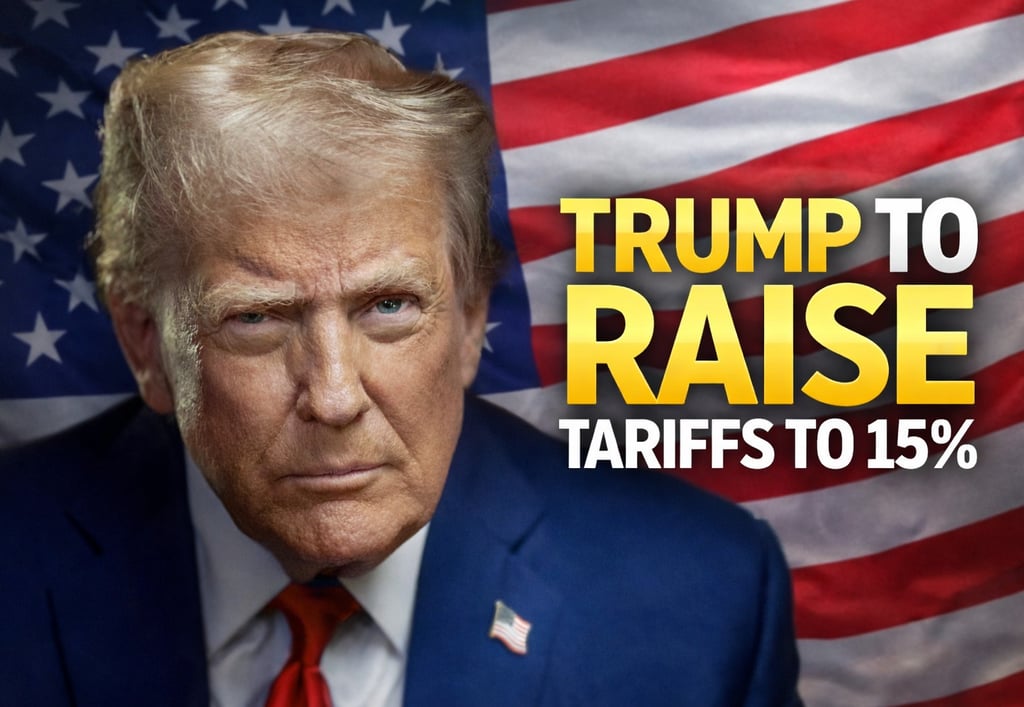
Trump Announces Plan to Raise Global Tariff Rate from 10% to 15%: Global Economic and Trade Implications
On February 21, 2026, U.S. President Donald Trump announced a major shift in American trade policy, revealing plans to raise the baseline global tariff rate on imported goods from 10% to 15%. The statement was delivered from the White House and immediately captured global attention, sending ripples through financial markets and prompting responses from key trading partners. The proposed increase represents a significant development in the administration’s economic strategy and signals a renewed emphasis on protecting domestic industries while addressing long-standing trade imbalances.
According to President Trump, the United States has faced persistent trade deficits for years, with recent annual figures exceeding $800 billion. He argued that many foreign governments impose higher tariffs and non-tariff barriers on American goods while benefiting from comparatively open access to U.S. markets. The administration believes that increasing the tariff rate to 15% will help correct what it describes as unfair trade practices, encourage domestic production, and strengthen the country’s negotiating leverage in future trade discussions. Officials estimate that a 5% rise in the baseline tariff could generate tens of billions of dollars in additional annual customs revenue, depending on import levels and market adjustments.
The announcement follows recent legal scrutiny from the Supreme Court of the United States, which reviewed elements of earlier trade measures introduced by the administration. The Court indicated that certain broad tariff actions required clearer congressional authorization. In response, the White House signaled that it would rely on provisions within the Trade Act of 1974, which grants the president limited authority to adjust tariffs under specific economic circumstances, including significant trade deficits or balance-of-payments concerns. This legal pathway is seen as a more structured approach to implementing the proposed tariff increase while remaining within constitutional boundaries.
Economists suggest that the immediate impact of raising tariffs from 10% to 15% would likely be felt across sectors heavily dependent on imported goods. Industries such as electronics, automotive parts, machinery, steel, textiles, and consumer household products could experience higher input costs. While a 5% tariff increase does not automatically translate into a full 5% rise in retail prices, analysts estimate that consumers may see price increases ranging from 2% to 4% in certain product categories, depending on supply chain dynamics and competitive market conditions. Supporters argue that these short-term adjustments could be offset by long-term benefits, including job growth in domestic manufacturing and increased investment in American production facilities.
Financial markets reacted cautiously to the news. The U.S. dollar showed moderate volatility, and bond markets reflected concerns about potential inflationary pressures. Investors are closely monitoring congressional discussions and awaiting clearer guidance on implementation timelines. Business groups remain divided: some manufacturing associations have welcomed the move as a necessary corrective measure, while retailers and import-reliant companies warn that higher costs could reduce profit margins and consumer purchasing power.
On the international stage, major trading partners including the European Union, China, Japan, and South Korea are assessing potential responses. Trade experts caution that retaliatory tariffs could escalate tensions and disrupt global supply chains. Historical trade disputes have demonstrated that prolonged tariff escalations may slow global growth, with some preliminary projections suggesting that extended trade friction could reduce global GDP growth by approximately 0.3% to 0.6%. However, administration officials maintain that decisive action is required to reset trade relationships and ensure reciprocal treatment for American exporters.
The broader strategic objective behind the proposed tariff increase aligns with President Trump’s “America First” economic framework, which prioritizes domestic industry resilience and reduced dependence on foreign manufacturing hubs. By raising the global tariff baseline to 15%, the administration aims to create incentives for companies to relocate production to the United States or diversify supply chains in ways that favor American workers. Critics, however, argue that protectionist policies can sometimes produce unintended consequences, including reduced trade efficiency and higher overall costs for businesses and consumers.
As of February 21, 2026, the proposal remains a developing policy initiative, with further legislative clarification and international negotiations expected in the coming weeks. Whether the tariff increase ultimately strengthens the U.S. economy or intensifies global trade tensions will depend on implementation details, diplomatic engagement, and market adaptability. What is clear is that the decision marks a pivotal moment in contemporary U.S. trade policy, with implications extending far beyond American borders and into the broader architecture of global commerce.
Stay informed with the latest national and international news.
© 2026. All rights reserved.