
Trump Meets Global CEOs at Davos 2026 as U.S. Policy Dominates World Economic Forum
U.S. President Donald Trump meets global CEOs at Davos 2026, placing American trade, tariffs, and geopolitical policy at the center of global economic discussions on January 19, 2026.
Raja Awais Ali
1/19/20263 min read
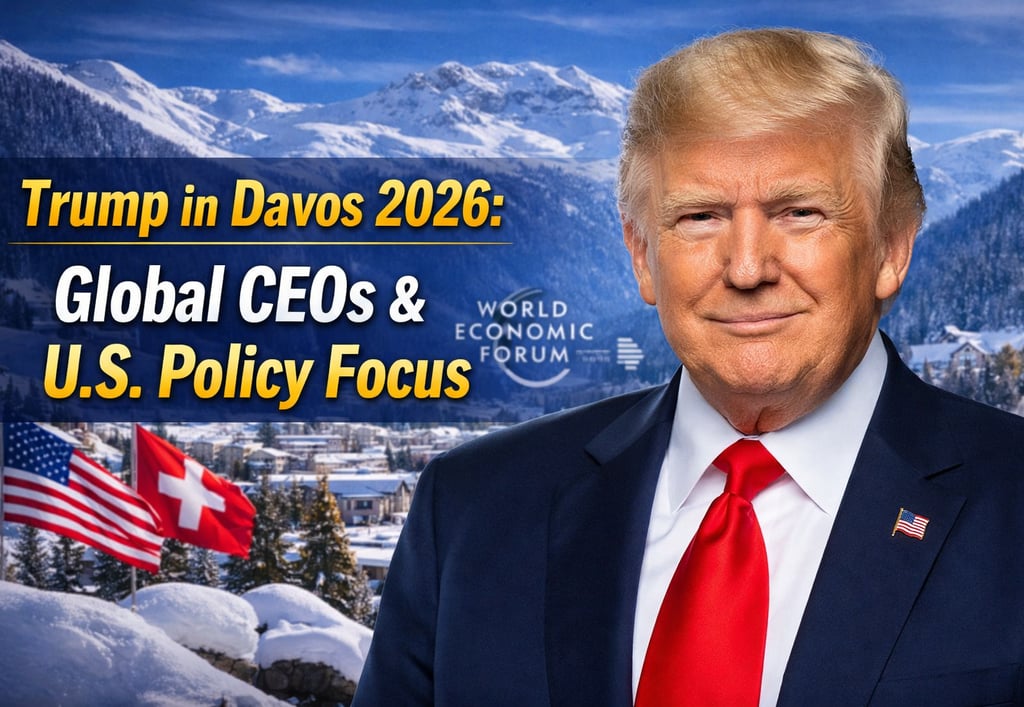
Trump Meets Global CEOs at Davos 2026 as U.S. Policy Dominates World Economic Forum
The World Economic Forum (WEF) in Davos, Switzerland, has once again become the focal point of global political and economic debate. As of January 19, 2026, one figure has clearly shaped the tone and direction of discussions more than any other: U.S. President Donald J. Trump. His engagement with global corporate leaders and senior policymakers has placed American economic and geopolitical policy firmly at the center of this year’s forum.
The 56th Annual World Economic Forum has drawn nearly 3,000 participants from more than 130 countries, including over 800 chief executives from leading multinational corporations and more than 60 heads of state and government. While Davos traditionally focuses on long-term global challenges such as climate change, inequality, and development, the 2026 edition has taken on a more politically charged character, driven largely by renewed U.S. assertiveness on trade and national interest.
President Trump is scheduled to host a closed-door reception with global CEOs, an event organized with direct involvement from the White House. Invitations were extended to leaders from the finance, technology, energy, manufacturing, and consulting sectors—industries that play a decisive role in shaping global growth and investment flows. Unlike conventional Davos speeches, this gathering is designed for direct engagement, allowing corporate leaders to hear U.S. policy priorities firsthand and raise concerns directly with the American administration.
The significance of the meeting lies not only in its exclusivity but also in its timing. Global markets are navigating uncertainty caused by geopolitical tensions, trade disputes, and uneven post-pandemic recovery. By meeting executives face to face, the U.S. administration is signaling that it intends to actively shape global economic outcomes rather than react to them.
The American presence at Davos this year is notably strong. Trump is leading what officials describe as the largest U.S. delegation ever sent to the forum, including multiple cabinet members, senior economic advisers, and foreign policy officials. This reflects a clear strategy: to align U.S. diplomacy, economic policy, and business interests on the global stage.
Several key policy issues have dominated discussions surrounding the U.S. delegation. Trade policy remains at the top of the agenda. Trump’s renewed emphasis on tariffs and reciprocal trade measures—particularly involving European economies—has generated both support and concern among global business leaders. While some executives welcome clearer trade rules and a focus on domestic production, others warn that escalating trade tensions could disrupt supply chains and slow global growth.
Geopolitics has also loomed large over the forum. U.S. positions on strategic territories, security alliances, and relations with major powers have sparked intense debate in private meetings and public panels alike. Diplomatic sources confirm that informal discussions between U.S. officials and representatives from rival geopolitical blocs are taking place on the sidelines, underlining Davos’s role as a venue for quiet but consequential diplomacy.
Reaction from the corporate world has been mixed. Supporters argue that the Trump administration’s approach offers predictability and prioritizes economic sovereignty. Critics, however, fear that economic nationalism may undermine multilateral cooperation and long-term stability. International financial institutions have cautioned that prolonged trade disputes and geopolitical uncertainty could increase market volatility in 2026.
What sets Davos 2026 apart is how clearly U.S. policy has reshaped the forum’s narrative. Topics such as sustainability and climate finance remain on the agenda, but they now share space with discussions on power, security, and national economic strategy. This shift reflects a broader change in the global order, where economic decision-making is increasingly influenced by geopolitical considerations.
As the forum continues, investors, governments, and markets worldwide are closely watching the outcomes of Trump’s meetings with global CEOs. The signals sent from Davos are expected to influence investment decisions, trade negotiations, and diplomatic relationships throughout the year.
In many ways, Davos 2026 has become a testing ground for the future of global economic leadership. With U.S. policy at the forefront, the conversations taking place in the Swiss Alps this week may shape the direction of the global economy well beyond 2026.
Stay informed with the latest national and international news.
© 2026. All rights reserved.