
Trump Ends EV Fuel Economy Incentive Rule on February 18, 2026 – Major Shift in U.S. Auto Policy
President Donald Trump rescinds EV fuel economy incentive rule on Feb 18, 2026, reshaping U.S. auto regulations, pricing, and climate policy.
Raja Awais Ali
2/18/20263 min read
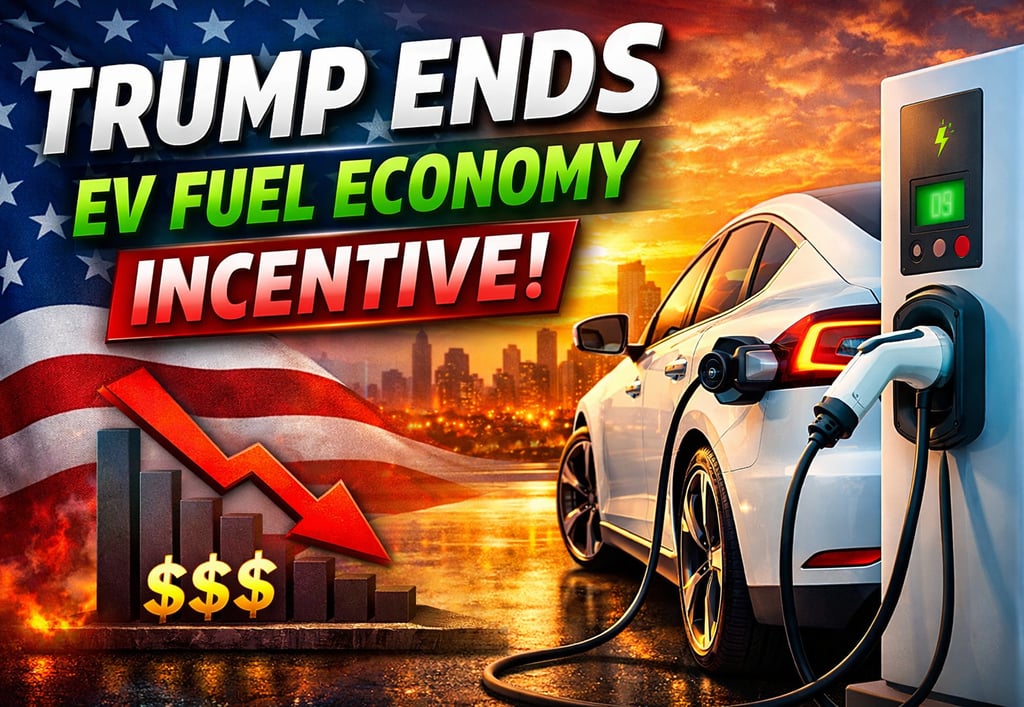
Trump Ends EV Fuel Economy Incentive Rule, Signaling Major Change in U.S. Auto Policy
On February 18, 2026, U.S. President Donald Trump announced a significant regulatory change by rescinding a rule that provided automakers with special fuel economy credits for producing electric vehicles (EVs). The decision marks a major shift in federal automotive and environmental policy and is expected to influence the future direction of the American auto industry.
The rule that has been eliminated was commonly referred to as the “fuel content factor.” Under this system, electric vehicles were awarded additional fuel economy credits compared to traditional gasoline or diesel vehicles. These credits helped automakers meet Corporate Average Fuel Economy (CAFE) standards more easily by boosting the overall efficiency rating of their vehicle fleets.
Critics of the previous rule argued that it overstated the real-world energy efficiency benefits of EVs by assigning them disproportionately high fuel economy values. Supporters, however, maintained that the credits were essential to accelerate EV adoption and reduce greenhouse gas emissions.
The Trump administration stated that the rollback is aimed at restoring transparency and establishing more realistic compliance standards. According to officials, the prior framework created regulatory imbalances by allowing manufacturers to offset lower efficiency in conventional vehicles through enhanced EV credits. By removing the incentive multiplier, automakers will now be required to meet fuel economy targets based on more direct and comparable measurements.
Electric vehicle sales in the United States have grown steadily in recent years. By the end of 2025, EVs accounted for approximately 9% to 10% of total new vehicle sales nationwide. Under the previous credit system, each EV sold contributed significantly toward an automaker’s fleet-wide efficiency calculation. Industry analysts estimate that this structure provided manufacturers with compliance flexibility equivalent to millions of vehicles across large production portfolios.
The administration argues that eliminating the rule may reduce regulatory burdens and potentially lower vehicle costs for consumers. Some government estimates suggest that complex environmental compliance requirements had increased average vehicle prices by between $2,000 and $3,000 per unit. Officials believe that simplifying the credit system could ease manufacturing costs, although independent experts caution that final pricing will continue to depend on global supply chains, battery material costs, and technological advancements.
Environmental organizations have expressed concern that scaling back EV-related incentives could slow progress toward national emissions reduction targets. According to data from the Environmental Protection Agency, the transportation sector accounts for roughly 27% to 29% of total U.S. greenhouse gas emissions, making it one of the largest contributors to carbon output. Climate policy advocates warn that reducing regulatory incentives for electric vehicles may affect long-term decarbonization efforts.
On the other hand, some industry analysts argue that the EV market has matured significantly and may no longer require strong regulatory multipliers to remain competitive. As of early 2026, the United States has more than 180,000 public charging stations, nearly double the number recorded five years ago. Additionally, battery production costs have declined by approximately 70% over the past decade, improving EV affordability and market viability.
The policy change may also lead to political and legal challenges. Environmental advocacy groups could pursue judicial review, while certain states may attempt to maintain stricter emission or fuel economy standards at the state level. Historically, disagreements between federal and state authorities over environmental regulations have resulted in prolonged legal disputes, and similar developments may unfold in the coming months.
Overall, the decision to rescind the EV fuel economy incentive rule represents a clear shift in federal automotive and energy strategy. While the administration presents the move as a step toward regulatory balance and economic efficiency, critics view it as a potential setback for climate-focused transportation policies. The long-term impact will depend on market responses, consumer demand, legal outcomes, and the broader direction of U.S. environmental governance.
As of February 18, 2026, this policy reversal stands as one of the most consequential automotive regulatory developments of the year, shaping debate across industry, environmental, and political spheres nationwide.
Stay informed with the latest national and international news.
© 2026. All rights reserved.