
Trump Demands Iran’s Unconditional Surrender as Middle East War Escalates — Global Implications
U.S. President Donald Trump demands Iran’s “unconditional surrender” as Middle East conflict enters its seventh day, intensifying regional tensions and global energy instability. Full report on casualties, geopolitical impact, and ongoing military operations.
Raja Awais Ali
3/6/20262 min read
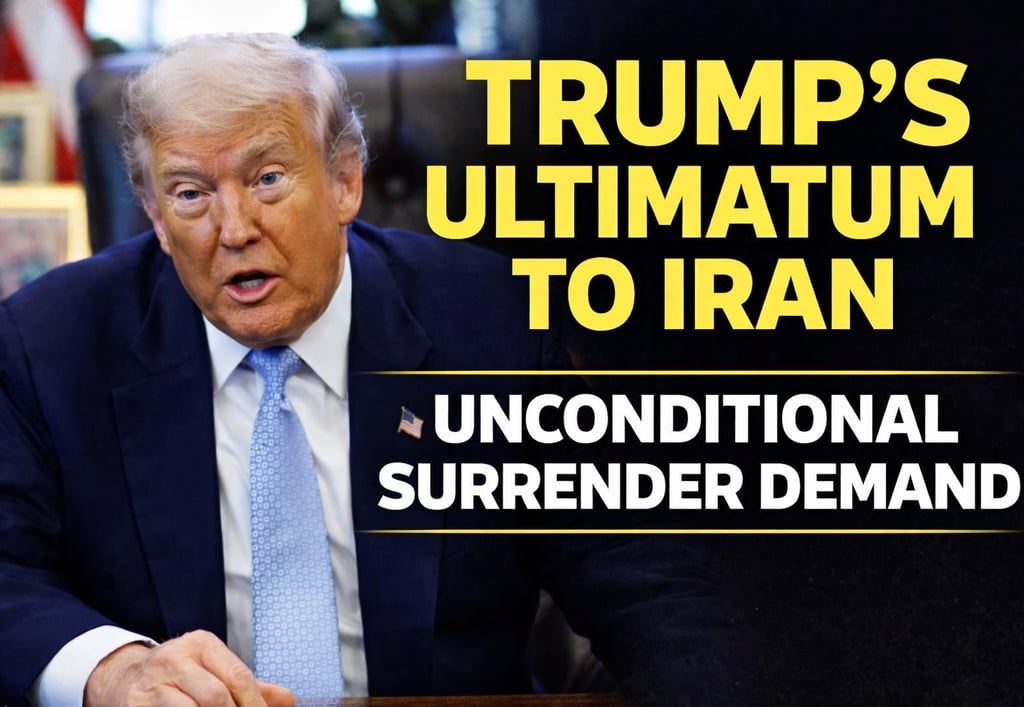
Trump Demands Iran’s Unconditional Surrender Amid Intensifying Middle East War
The Middle East conflict entered its seventh consecutive day on March 6, 2026, with U.S. President Donald Trump declaring that there will be no agreement with Iran except an unconditional surrender. This marks a significant escalation just days after the U.S. and Israel launched coordinated strikes against Tehran, including the assassination of Supreme Leader Ayatollah Ali Khamenei.
Trump’s statement, posted on social media, said: There will be no deal with Iran except unconditional surrender. After that, and the selection of a great and acceptable leader, we and our allies will work to bring Iran back from the brink of destruction, making its economy stronger and more prosperous than ever."
The announcement came hours after Iranian President Masoud Pezeshkian stated that mediation efforts by unspecified countries had begun, signaling early attempts to resolve the conflict diplomatically. Pezeshkian emphasized that Iran is committed to lasting regional peace but will defend its sovereignty and national dignity without compromise.
Origins of the Conflict
The war began when U.S. and Israeli forces targeted Iran’s top leadership and military installations, killing Supreme Leader Khamenei. Iran responded with missile and drone attacks targeting Israel and U.S. allies in the Gulf, escalating civilian casualties and infrastructure damage.
Casualty figures reported so far:
Iran: Over 1,230 dead.
Lebanon: 123 dead, 683 wounded from Israeli airstrikes.
Israel: At least 10 killed in Iranian attacks.
These numbers highlight the human cost of the war, particularly among civilians in Lebanon, Iran, and Israel.
Trump’s Strategic Objectives
President Trump has indicated that he intends to play a role not only in ending the war but also in selecting Iran’s next supreme leader. This unprecedented intervention in Iran’s internal governance reflects a broader U.S. goal to restructure Tehran’s political system while eliminating its ability to project power beyond its borders.
Israel’s strategy, meanwhile, focuses on weakening Iran’s regional proxies, particularly Hezbollah in Lebanon. Following mass evacuation orders in southern Beirut, approximately 300,000 civilians have been displaced, many forced to sleep in cars, streets, or on beaches.
Regional and Global Implications
The conflict has already disrupted global energy markets, with oil and gas prices spiking due to supply uncertainties. Israeli forces have reportedly destroyed 80% of Iran’s air defense systems and 60% of missile launchers, limiting Iran’s capacity for retaliatory strikes.
Reports indicate that Russia is providing Iran with intelligence on U.S. military positions in the Middle East, further complicating regional dynamics.
Iran’s Response
Iran has rejected Trump’s demands, asserting that it will defend its territory and sovereignty. A transitional panel has been tasked with selecting a new supreme leader, but Tehran insists that no external influence will be accepted in the process. The Iranian government maintains that peaceful resolution remains a priority, but national defense will not be compromised.
Broader Global Consequences
The war is driving inflation and energy instability worldwide.
Gulf countries are mobilizing defenses amid missile and drone attacks.
Global financial markets have reacted negatively to escalating tensions.
Experts warn that prolonged conflict could have long-term effects on international security, trade, and diplomatic relations.
Conclusion
President Trump’s demand for Iran’s unconditional surrender, combined with ongoing Israeli airstrikes and Iran’s retaliatory measures, marks a highly volatile stage in Middle East geopolitics. With thousands dead, hundreds of thousands displaced, and global markets destabilized, the conflict’s consequences are already significant and could worsen if no diplomatic intervention occurs.
The international community faces urgent pressure to mediate and prevent a broader regional and global crisis, as failure to do so may result in unprecedented humanitarian, economic, and political fallout.
Stay informed with the latest national and international news.
© 2026. All rights reserved.