
Trump Chides Mark Carney at Davos, Says Canada Should Be Grateful | Davos 2026 News
Trump criticizes Canadian PM Mark Carney at Davos 2026, saying Canada should be grateful to the US. Full analysis of the global political impact.
Raja Awais Ali
1/21/20262 min read
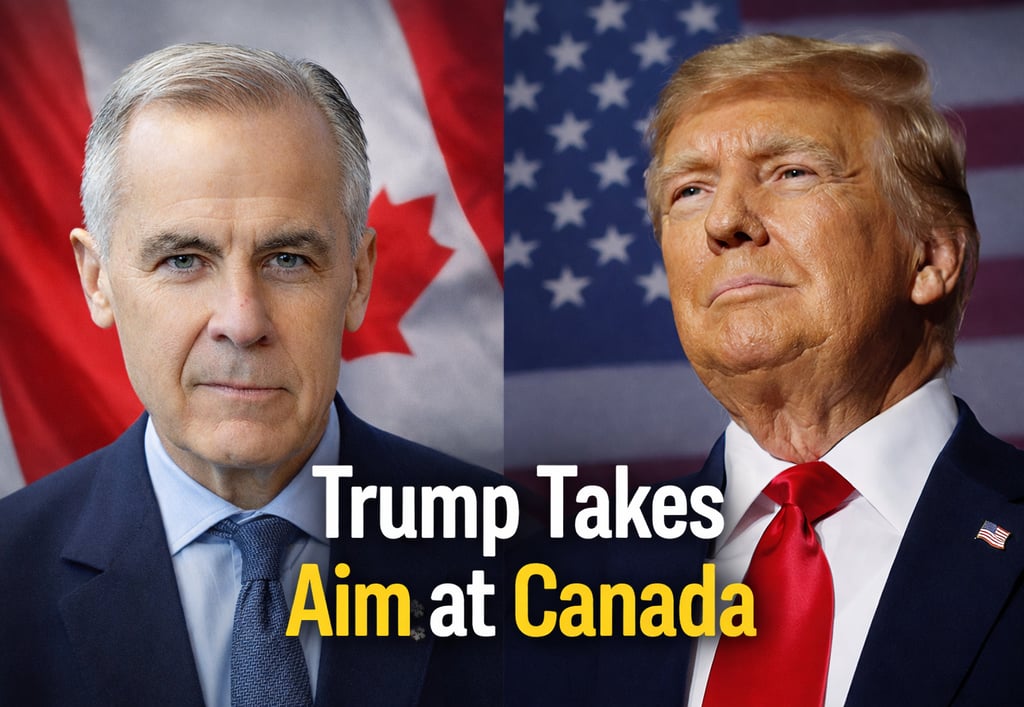
Trump Chides Mark Carney at Davos, Says Canada Should Be “Grateful” to the United States
At the World Economic Forum 2026 in Davos, Switzerland, a sharp exchange of rhetoric between U.S. President Donald Trump and Canadian Prime Minister Mark Carney drew global attention, highlighting growing tensions over alliances, global order, and national interests. On January 21, 2026, President Trump used his Davos address to openly criticize Carney, asserting that Canada should be “grateful” to the United States for its security and economic stability—a remark that sparked widespread diplomatic and political debate.
The controversy followed Prime Minister Mark Carney’s speech a day earlier, on January 20, during which he addressed the future of the global political and economic system. Carney warned that the world was no longer merely experiencing change but witnessing the erosion of a rules-based international order. He argued that powerful nations are increasingly relying on economic pressure, trade barriers, and strategic coercion, threatening global cooperation and long-term stability. Carney urged middle powers and allies to work collectively to shape a fairer and more resilient international system.
While Carney did not name any country or leader, his remarks were widely interpreted as a critique of unilateral policies pursued by major powers. Many attendees at Davos praised his speech as measured, realistic, and timely, particularly amid rising geopolitical uncertainty and economic fragmentation.
President Trump, however, responded forcefully the following day. Speaking before world leaders, business executives, and policymakers, Trump dismissed Carney’s position and emphasized what he described as Canada’s dependence on the United States. He stated that Canada benefits significantly from U.S. military protection, trade access, and geographic security, adding that such advantages should be openly acknowledged.
“I saw your prime minister yesterday,” Trump said. “He didn’t seem very grateful. Canada receives a lot from the United States, and it should remember that its security and prosperity are closely tied to America.”
The comments marked an unusually blunt public rebuke of a close ally, particularly at a global forum traditionally characterized by diplomatic restraint. Political analysts noted that such language toward a NATO partner could strain U.S.–Canada relations, which have long been grounded in cooperation across defense, trade, and border security.
Notably, Carney’s original address avoided direct confrontation. He focused instead on broader systemic challenges, stating that relying on past frameworks was no longer viable. “We cannot expect old rules to simply return,” he said, emphasizing the need for updated international norms that reflect current realities. Observers believe these remarks were perceived by Trump as an indirect criticism of his “America First” agenda.
During his Davos appearance, Trump also reaffirmed his broader foreign policy stance, stressing that the United States would prioritize its national interests even if that approach unsettled allies. He indicated that while Washington prefers negotiation over confrontation, it would not hesitate to act decisively to protect American strategic and economic goals.
The exchange prompted mixed reactions across Europe and other regions. Some diplomats cautioned that demanding gratitude from allies could undermine mutual trust, while others viewed the remarks as consistent with Trump’s long-standing approach to international relations. Analysts warned that continued public disputes among allied nations could weaken global cooperation at a time of heightened economic and geopolitical risk.
Ultimately, the Davos 2026 episode reflects a deeper global debate about power, partnership, and leadership. On one side stands a vision centered on national sovereignty and transactional alliances; on the other, a call for multilateral cooperation and shared responsibility. Whether Trump’s assertive posture or Carney’s collaborative approach will shape the next phase of global governance remains to be seen, but the confrontation has clearly signaled that divisions over the future of the world order are becoming more pronounced.
Stay informed with the latest national and international news.
© 2026. All rights reserved.