
Supreme Court Expands Trump's Presidential Power in Historic FTC Ruling and Overturns 91-Year-Old Precedent
The U.S. Supreme Court has granted Donald Trump broad authority to remove federal regulatory officials, overturning the landmark 1935 Humphrey's Executor decision. Learn what the ruling means for presidential power, the FTC, independent agencies, the Federal Reserve, and the future of the American administrative state.
Raja Awais Ali
6/30/20265 min read
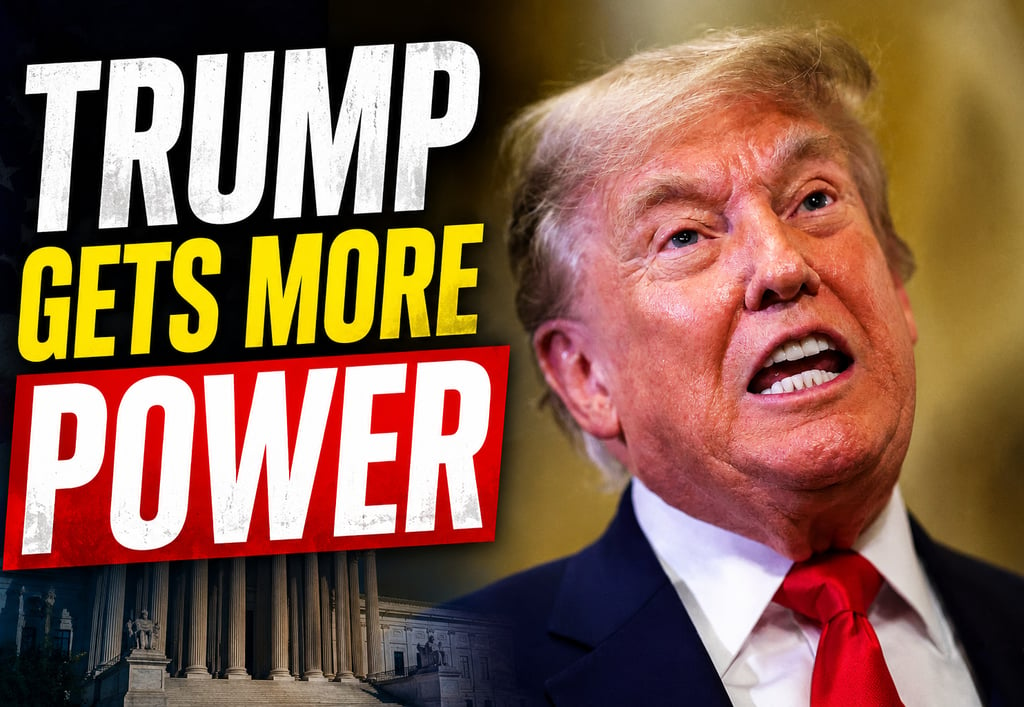
Supreme Court Expands Trump's Presidential Power in Historic Decision That Could Reshape the U.S. Government
June 30, 2026, may be remembered as one of the most significant dates in modern American constitutional history. In a landmark 6-3 decision, the U.S. Supreme Court granted President Donald Trump broad authority to remove leaders of federal regulatory agencies. Legal scholars view this ruling as one of the largest expansions of presidential power in decades. The decision strengthens presidential authority and overturns a nearly 91-year-old legal precedent that helped define the framework of the American administrative system.
This case is significant beyond Donald Trump. At its heart, the dispute addresses a fundamental question in American government: Who should have ultimate control of the executive branch—an elected president or independent regulatory agencies that operate somewhat free from political pressure?
The roots of this controversy trace back to the famous 1935 Supreme Court case, Humphrey's Executor v. United States. This case remains one of the most influential constitutional rulings in American history. At the time, President Franklin D. Roosevelt was pushing his New Deal agenda to lift the U.S. out of the Great Depression. During this period, Roosevelt sought to remove Federal Trade Commission Commissioner William E. Humphrey.
Roosevelt and Humphrey had significant policy disagreements. The president believed Humphrey was hindering parts of his economic reform program and wanted him gone. However, the law concerning the Federal Trade Commission allowed the president to dismiss commissioners only for specific reasons like inefficiency, neglect of duty, or misconduct. Political or policy disagreements alone were not valid grounds for removal.
Humphrey challenged his removal in court. He passed away while the legal battle was ongoing, but his estate continued the case, leading to the well-known title, Humphrey's Executor v. United States.
In 1935, the Supreme Court unanimously ruled against Roosevelt. The Court concluded that the Federal Trade Commission was not strictly an executive agency. Instead, it carried out quasi-legislative and quasi-judicial functions, which allowed Congress to provide commissioners with protection from removal purely based on political disagreements. This decision became a cornerstone of the American administrative state and formed the legal basis for the independence of various federal agencies for nearly a century.
The ruling established protections for agencies such as the Federal Trade Commission, the National Labor Relations Board, the Merit Systems Protection Board, and many other independent regulatory bodies. For decades, Humphrey's Executor represented a major limitation on presidential authority regarding certain federal officials.
Now, that precedent has been overturned.
The current dispute started when President Donald Trump attempted to remove Democratic Federal Trade Commission Commissioner Rebecca Slaughter from office in March 2025. Slaughter's term was supposed to continue until 2029, and she argued that federal law protected her from dismissal without cause. The main question before the courts was whether the protections established under Humphrey's Executor were still relevant today.
The Trump administration argued that the federal government of 2026 is not the same as it was in 1935. They contended that modern regulatory agencies wield considerable executive power. They investigate companies, enforce regulations, impose penalties, influence national policy, and directly impact major sectors of the economy. Because of these roles, the administration argued that agency officials should ultimately be accountable to the president.
The Supreme Court's conservative majority agreed. In its 6-3 ruling, the Court formally overturned Humphrey's Executor, stating that officials exercising executive power can generally be removed by the president. The majority held that Article II of the U.S. Constitution gives executive authority to the president and that restrictions on removing executive officers contradict that constitutional framework.
The decision is seen as a significant victory for the Unitary Executive Theory, a constitutional doctrine that has gained traction among conservative legal scholars in recent decades. This theory asserts that the entire executive branch should remain under presidential control, and independent agencies should not function beyond the president's authority.
Although this idea gained ground during President Ronald Reagan's administration in the 1980s, supporters have spent years promoting it through academic study, legal advocacy, and judicial appointments. The Supreme Court's recent ruling marks a significant win for this legal philosophy.
Legal experts quickly recognized the historic implications of the decision. Michael Gerhardt, a law professor at the University of North Carolina, called it the most significant expansion of presidential power in decades and a culmination of years of work by conservative legal movements. Gerhardt said the ruling has drastically weakened the administrative state.
John Yoo, a law professor at the University of California, Berkeley, and a longtime supporter of strong presidential authority, noted that the decision provides presidents with more control over a federal bureaucracy that expanded heavily during Franklin Roosevelt's, Lyndon Johnson's, and Barack Obama's administrations. Yoo suggested that the era of a truly independent administrative state may effectively be over.
Christine Chabot from Marquette University Law School referred to the ruling as the biggest victory for the Unitary Executive Theory. Meanwhile, constitutional scholar Erwin Chemerinsky warned that agency independence might largely disappear, making regulatory agencies more responsive to presidential priorities and potentially less insulated from politics.
Critics worry that the ruling will heighten political influence over federal agencies, which Congress originally intended to be guided by expertise instead of partisan interests. However, supporters argue that democratic accountability requires executive officials to remain answerable to the president elected by the American people.
The practical consequences could be significant. Future presidents may now have much greater authority to reshape regulatory agencies immediately when they take office. As administrations change between political parties, regulatory policy might shift more dramatically than in the past.
A Republican administration focused on reducing regulationand favoring business interests could appoint leaders who share those priorities. A Democratic administration prioritizing environmental protection, labor rights, consumer safeguards, or stricter corporate oversight could similarly appoint officials who align with its goals. As a result, federal regulatory policy may become more closely tied to election outcomes.
One notable exception arose on the same day. In a separate case, the Supreme Court ruled against allowing President Trump to remove Federal Reserve Governor Lisa Cook. The Court highlighted the Federal Reserve's unique historical and institutional status, indicating that the central bank's independence is different from that of other regulatory agencies.
That distinction could be important. Financial markets generally value stability and independence in institutions, especially central banks responsible for monetary policy. By not fully extending the ruling to the Federal Reserve, the Court seemed to acknowledge the unique role the institution plays in maintaining economic stability.
Still, the wider constitutional impact is enormous. The ruling fundamentally changes the power balance between the presidency and independent federal agencies. For nearly 91 years, Humphrey's Executor helped distribute authority among various government entities. The Supreme Court has now shifted that balance significantly toward the White House.
Ultimately, this decision is about much more than Rebecca Slaughter, the Federal Trade Commission, or even Donald Trump. It signifies a major redefinition of how the executive branch functions and how power is shared within the federal government.
For supporters, the ruling restores democratic accountability by ensuring that executive officials answer to an elected president. For critics, it undermines crucial institutional protections designed to keep expert decision-making free from political influence.
No matter where one stands on the issue, the Supreme Court's 2026 ruling will likely be seen as a pivotal moment in American constitutional law. Its effects could influence the relationship between presidents, Congress, federal agencies, financial regulators, businesses, workers, and consumers for decades to come. Future generations may look back on this decision as a defining moment that transformed the structure of American government, much like legal scholars have viewed Humphrey's Executor v. United States.
Stay informed with the latest national and international news.
© 2026. All rights reserved.