
How the Supreme Court Could Reshape the 2026 U.S. Midterm Elections: Redistricting, Mail Voting, and Campaign Finance Explained
The U.S. Supreme Court is set to rule on major election cases that could impact redistricting, mail-in voting, campaign finance, and control of Congress in the 2026 midterm elections. Here's what voters need to know.
Raja Awais Ali
5/31/20266 min read
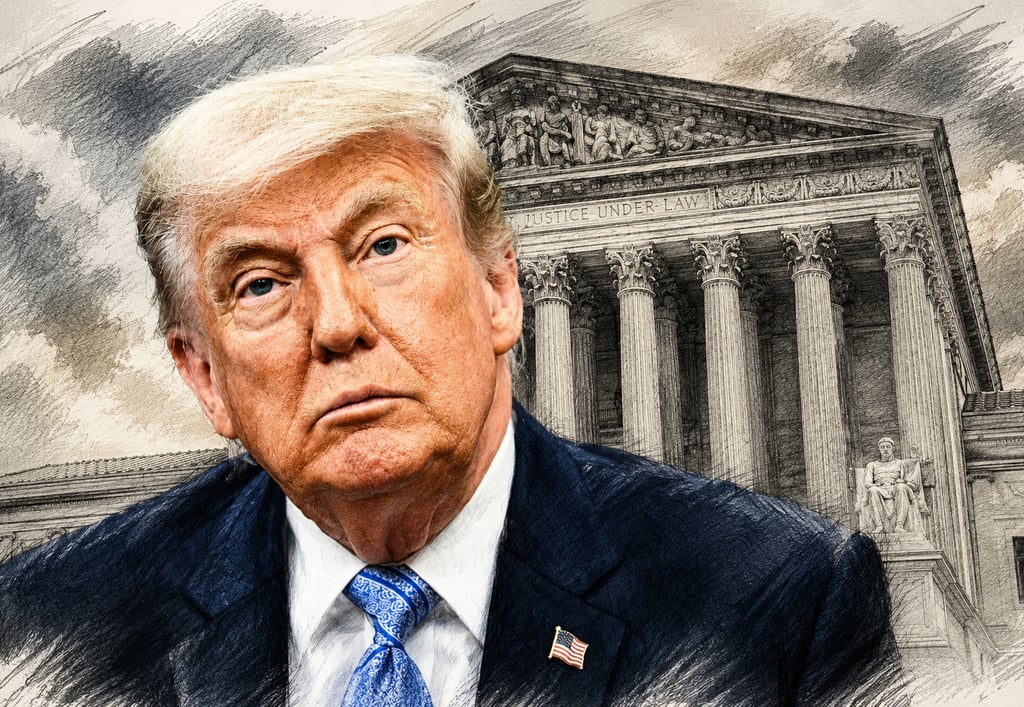
How the Supreme Court Could Reshape the 2026 U.S. Midterm Elections: Redistricting, Mail Voting, and Campaign Finance Explained
The battle for control of Congress in the 2026 U.S. midterm elections may not be decided only by candidates, campaign rallies, or voter turnout. Instead, some of the most important decisions could come from the U.S. Supreme Court, where a series of election-related cases are already changing the political landscape and could have lasting effects on American democracy.
With Republicans holding narrow majorities in both the House of Representatives and the Senate, every seat matters. If Democrats regain control of either chamber in the November 3, 2026 midterm elections, they could slow President Donald Trump's legislative agenda, launch investigations into his administration, and significantly alter the balance of power in Washington.
At the center of this political struggle is the U.S. Supreme Court, which currently has a 6-3 conservative majority. Over the past several months, the court has already issued one major election-related ruling that many legal experts believe benefits Republicans. Now, two additional cases involving campaign finance and mail-in voting could further influence the election environment before Americans head to the polls.
The first major development came in April 2026 when the Supreme Court issued a decision in a Louisiana redistricting case that weakened a key provision of the Voting Rights Act. The ruling made it more difficult to challenge electoral maps as racially discriminatory under federal law. While the legal details are complex, the political implications are easier to understand.
Redistricting is the process of redrawing election district boundaries after population changes. Because district lines can influence election outcomes, control over the process often becomes one of the most powerful political tools available. Following the Supreme Court's ruling, Republican-controlled state legislatures may find it easier to redraw congressional districts in ways that strengthen their electoral position.
Legal scholars believe the decision could have significant consequences across the South, where districts with large Black and Hispanic populations may become more vulnerable to political restructuring. Since Black and Latino voters have historically supported Democratic candidates at higher rates, changes to district boundaries could affect future election results.
Washington University law professor Travis Crum described the ruling as a major advantage for Republicans. According to election experts, the decision could help create conditions that place as many as a dozen Democratic-held House seats at risk over the coming years.
However, the Supreme Court's influence on the 2026 election may not stop there.
Two highly anticipated rulings are expected by the end of June 2026. One involves campaign finance restrictions, while the other focuses on mail-in voting rules in Mississippi. Both cases could shape how elections are conducted nationwide.
The campaign finance case involves Vice President JD Vance and other Republicans who challenged federal limits on coordinated spending between political parties and the candidates they support. The legal challenge dates back to Vance's 2022 U.S. Senate campaign in Ohio.
Under current federal election law, political parties can spend unlimited amounts independently to support or oppose candidates. However, spending that is coordinated directly with a candidate's campaign is subject to legal limits. Supporters of these restrictions argue that they help prevent corruption and stop wealthy donors from bypassing contribution limits.
Without such safeguards, critics say large donors could channel massive sums through political parties and gain greater influence over elected officials.
Republicans argue that these restrictions violate the First Amendment's protections for free speech. Their legal position is based on the belief that political parties and candidates should be able to communicate and work together without government-imposed financial limits.
Many court observers believe the conservative majority on the Supreme Court is sympathetic to this argument. During oral arguments held in December, several conservative justices appeared open to reconsidering the restrictions.
The case also brings renewed attention to the landmark 2010 Supreme Court decision in Citizens United v. Federal Election Commission. That ruling dramatically changed campaign finance law by allowing corporations, labor unions, and outside groups to spend unlimited amounts of money on elections.
A new ruling in favor of Republicans could further expand the role of money in American politics.
The financial numbers involved are significant.
As of April 2026, three major Republican organizations—the Republican National Committee (RNC), the National Republican Congressional Committee (NRCC), and the National Republican Senatorial Committee (NRSC)—held approximately $251 million in cash with no outstanding debt.
By comparison, their Democratic counterparts held around $125 million in cash while carrying more than $17 million in debt.
This fundraising advantage could become even more valuable if the Supreme Court removes restrictions on coordinated spending. Political science professor Timothy Johnson of the University of Minnesota believes such a ruling would allow party committees and candidates to coordinate almost immediately, potentially strengthening Republican campaign operations across the country.
Johnson also notes that some Democratic candidates have built impressive fundraising networks of their own, which may help offset part of the Republican advantage. Still, the overall financial edge currently favors Republicans.
Conservative election attorney Dan Backer argues that stronger political parties could actually improve the political system. According to Backer, political parties tend to be more accountable and less extreme than some outside special-interest groups, making them an important stabilizing force in American politics.
At the same time, another major election case could reshape voting rules nationwide.
The Mississippi mail-in ballot dispute centers on whether ballots that arrive after Election Day should still be counted if they were mailed on time.
Mississippi currently allows absentee ballots to be counted if they are postmarked by Election Day and received within five business days afterward. The state's Republican Party challenged this policy, arguing that federal law requires elections to be completed on Election Day itself.
The legal question before the Supreme Court is whether federal election laws override state laws that permit ballots to arrive after Election Day.
During oral arguments in March 2026, a majority of the justices appeared willing to strike down Mississippi's law. If that happens, the ruling could extend far beyond one state.
According to the National Conference of State Legislatures, fourteen states, along with Washington, D.C., Guam, Puerto Rico, and the U.S. Virgin Islands, currently count ballots that arrive after Election Day as long as they were mailed on or before the deadline.
A ruling against Mississippi could pressure those jurisdictions to change their election procedures as well.
The issue is politically sensitive because mail voting patterns differ between the two major parties.
Data from the MIT Election Lab shows that in the 2024 election, 37 percent of Democratic voters cast ballots by mail compared with 24 percent of Republican voters. During the 2020 election held amid the COVID-19 pandemic, the gap was even larger. Approximately 60 percent of Democratic voters used mail ballots, compared with 32 percent of Republicans.
Because Democrats rely more heavily on mail voting, changes to ballot deadlines could have a disproportionate impact on Democratic voters.
The Democratic National Committee has warned that eliminating grace periods for mailed ballots could disenfranchise millions of Americans, including military personnel stationed overseas, U.S. citizens living abroad, rural voters, elderly voters, disabled individuals, and people who face transportation challenges.
Some legal experts believe the court could strike down Mississippi's law while delaying the practical effect of the ruling until after the 2026 election. This approach would rely on what is known as the Purcell Principle, a legal doctrine that discourages courts from changing election rules too close to an election because doing so may create voter confusion.
The mail voting debate also connects to President Trump's long-running criticism of absentee voting. Since the 2020 election, Trump has repeatedly questioned the security of mail-in ballots despite a lack of evidence showing widespread voter fraud.
In March 2026, Trump signed an executive order aimed at tightening mail voting requirements. That action quickly faced legal challenges from groups arguing that election administration is primarily a responsibility of individual states rather than the federal government.
While these court cases could strengthen Republican electoral prospects, the party still faces political challenges.
Public opinion surveys have shown declining approval ratings for President Trump, driven in part by concerns over the Iran conflict and rising gasoline prices. Historically, the president's party often loses congressional seats during midterm elections, creating an additional obstacle for Republicans.
Yet many analysts believe the Supreme Court's decisions could help offset some of those political headwinds.
What makes the 2026 midterm elections unusual is that the fight is not only about winning votes. It is also about defining the rules under which those votes are cast, counted, and translated into political power.
Questions about district maps, campaign funding, voting deadlines, federal authority, and constitutional rights are all being debated before the nation's highest court. The answers to those questions may influence not only who controls Congress in 2027 but also how future elections are conducted across the United States.
For that reason, the upcoming Supreme Court rulings are about much more than legal theory. They could affect campaign strategies, voter participation, fundraising efforts, district boundaries, and ultimately the balance of power in Washington.
As Election Day approaches, millions of Americans will focus on candidates and campaigns. Yet some of the most important decisions may already be taking shape inside the Supreme Court building, where a handful of justices are preparing to rule on cases that could leave a lasting mark on American democracy long after the 2026 midterm elections are over.
Stay informed with the latest national and international news.
© 2026. All rights reserved.